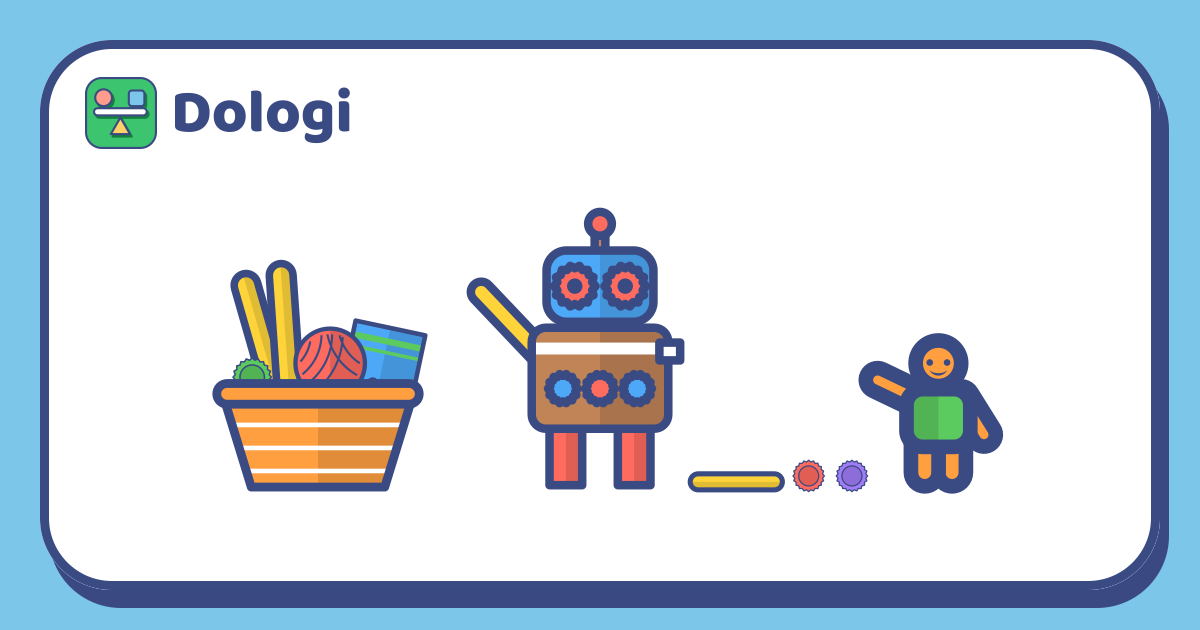
A toy car is a car. A doll is a doll. A bottle cap, on the other hand, can be a wheel today, a coin tomorrow and a robot's eye the day after. Things that have no fixed way to play ask children to decide what they are, and that decision is where a lot of thinking happens.
This article shows how to set up a simple "loose parts basket" at home for children aged about 4 to 10: what to collect, how to keep it safe for your child's age, why you shouldn't set a task, and how to keep the basket interesting for months.
What goes in the basket
"Loose parts" simply means small, everyday materials that can be moved, combined and taken apart in many ways. Most of them are already in your recycling bin or kitchen drawer.
- Round things: clean bottle caps, jar lids with smooth edges, large buttons, wooden rings.
- Long things: craft sticks, cardboard tubes, wide straws, clothes pegs, short pieces of dowel.
- Soft things: fabric scraps, felt, a ball of yarn, ribbon, cotton pom-poms.
- Things to join with: pipe cleaners, rubber bands, paper clips (for older children), masking tape.
- Natural finds: pine cones, smooth pebbles, shells, conkers, large seed pods.
Start small. A shoebox or a basket with ten or twelve kinds of material is enough. Too many choices at once can leave a child tipping everything out and wandering off.
Choose parts that are safe for your child's age
Loose parts are only open-ended if you can relax while your child plays with them. Sort through the basket with your own child in mind, not their age alone.
| Age (rough guide) | Good choices | Leave out for now |
|---|---|---|
| 4–5 | Large caps and lids, cardboard tubes, big fabric pieces, chunky pegs, wide craft sticks | Anything small enough to fit in the mouth, beads, short strings |
| 6–7 | Add buttons, pipe cleaners, yarn, small boxes, masking tape | Sharp lids, glass, anything with a cutting edge |
| 8–10 | Add paper clips, rubber bands, string, cardboard and child-safe scissors | Button batteries, small magnets, anything you wouldn't want broken open |
Wash caps and lids before they go in, and stay nearby while younger children play. If you are unsure whether something is safe for your child, leave it out.
Don't set a task: just ask "What are you making?"
The basket works best when nobody tells your child what to build. Put it on the floor or a low table, sit nearby and let them explore. Some children start building straight away. Others sort the caps by color, line up sticks, or just pour things from one tub to another. All of that counts: sorting, comparing and arranging are thinking too.
When you want to join in, a few open questions help more than instructions:
- "What are you making?"
- "Tell me about this part."
- "What could you use instead if this falls over?"
- "What happens if you add one more?"
Try not to name the creation before your child does. A pile of sticks you think is a house might be a spaceship or a dog's bed. If your child says "I don't know yet," that is a fine answer. Let them keep going.
Change the basket every week
Children often lose interest when the same things sit in the same place for too long. A small weekly change brings fresh ideas without buying anything.
- Swap one or two kinds of material. Take out the pegs, put in cardboard tubes. Keep most of the basket the same so your child can continue last week's ideas.
- Try a theme now and then. All round things for a week, or only soft things, or only things from the garden. A theme narrows the choices just enough to spark a new idea.
- Add one "odd one out". A funnel, a big spoon, a wooden spool. Children often build a whole game around one surprising object.
- Let your child choose. Older children can collect parts themselves on a walk or from the recycling, which turns tidying into part of the game.
Take a photo of each creation
Loose parts creations rarely last. The robot gets taken apart to make a car, and that is part of the point. Taking a photo before it goes back in the basket shows your child that their idea mattered, even though the pieces are free to become something new.
Look at the photos together now and then. "Remember when you made the robot with bottle-cap eyes? What did it do?" Talking about an old creation helps your child explain their own thinking and often sparks the next build. A simple photo album or a few prints on the fridge is enough.
If your child enjoys turning their ideas into pictures too, Dologi has a Creative corner with a Drawing board where they can draw freely, with no scores and no stars. It is one more place to play with their own ideas, not a replacement for a real basket of caps and sticks.
In short
- A loose parts basket holds everyday materials with no fixed way to play: caps, sticks, tubes, fabric, yarn and natural finds.
- Choose parts with your own child in mind, leave out anything small enough to swallow for children who still mouth things, and stay nearby with younger ones.
- Don't set a task; ask "What are you making?" and let your child name their own creation.
- Swap a few parts each week and photograph creations before they are taken apart.
Read more: How many uses can you find for a cardboard box? A challenge in thinking differently, Creative thinking: helping children find more than one way