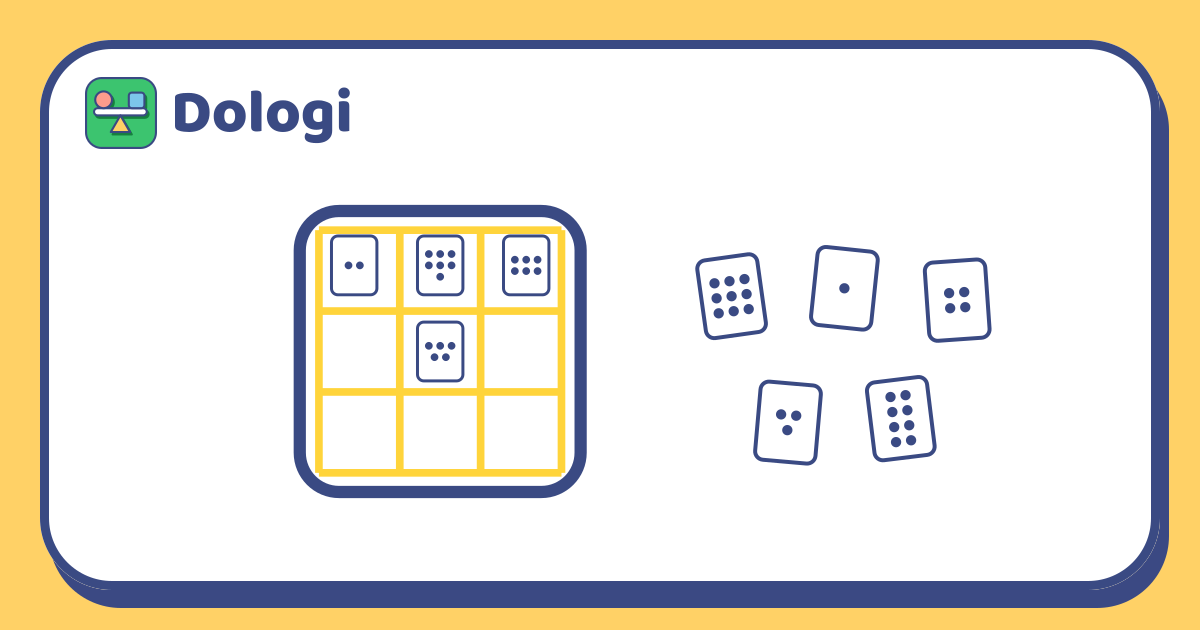
A magic square is a grid of numbers where every row, every column and both diagonals add up to the same total. It looks like an addition exercise, but to build one your child has to guess, test, swap and slowly spot the pattern. That's where adding turns into reasoning.
This post goes step by step: a number-triangle warm-up for children of about 7–9, then the 3×3 magic square for about 9–12, with hints, answers and two variations. The ages are only a rough guide; every child is different.
Make the number cards
Cut nine square cards from thin card and write the numbers 1 to 9 on them. If your child still counts on their fingers, draw dots instead of digits. On a sheet of paper, draw:
- a triangle with a box at each corner and a box in the middle of each side;
- a 3×3 grid with squares big enough for one card each.
Loose cards matter more than you'd think. Your child can pick them up, put them down and swap them without rubbing anything out, so they're more willing to experiment.
Warm-up: the number triangle
Use cards 1 to 6. Place one card in each box of the triangle so that the three numbers along each side add up to 9.
- Hint 1: a corner number sits on two sides at once, so it gets counted twice.
- Hint 2: for a small total, put the small numbers in the corners.
Answer: the corners are 1, 2 and 3. Between 1 and 2 goes 6, between 2 and 3 goes 4, and between 3 and 1 goes 5. Check: 1 + 6 + 2 = 9, 2 + 4 + 3 = 9, 3 + 5 + 1 = 9.
Then keep going: with the same six cards, can you make each side add up to 10, 11 or 12? Yes, all three. Answers: for 10 the corners are 1, 3, 5; for 11 they're 2, 4, 6; for 12 they're 4, 5, 6. Let your child work out the middle numbers.
Older children can explore why: adding the three sides means adding all six numbers (21) plus the three corner numbers a second time. If each side is 9, the three sides make 27, so the corners must add up to 6, which means 1, 2 and 3.
The 3×3 square: find the total first
Now use all nine cards. Arrange them in the 3×3 grid so every row, every column and both diagonals have the same total.
Before trying anything, ask your child: what is that total? This is the step most people skip.
- Hint 1: add up all nine numbers.
- Hint 2: those nine numbers are shared equally across three rows.
Answer: 1 + 2 + … + 9 = 45. The three rows have the same total, so each row is 45 ÷ 3 = 15. Once you know the target, the testing has a direction.
What goes in the middle?
The middle square sits on four lines: the middle row, the middle column and both diagonals. Ask your child to find the number that belongs there.
- Hint 1: try pairing up numbers with the same total: 1 with 9, 2 with 8…
- Hint 2: all four pairs add up to 10. What do you add to make 15?
Answer: 5. Every line through the middle is a pair adding up to 10 with the 5 in between. Older children can prove it more carefully: the four lines through the middle add up to 60. That counts all nine numbers once (45) plus the middle number three extra times, so the middle number is 15 ÷ 3 = 5.
Test and swap until it works
Put the 5 in the middle. Let your child try the rest, with just a few tips from you:
- Squares opposite each other across the middle add up to 10. Put 2 in a corner and the opposite corner is 8.
- Try another corner. Put 4 in the next corner and its opposite is 6.
- Fill the edges by subtracting. The top row has 2 and 6, so the middle of that row is 15 − 8 = 7. Do the same for the other edges.
- Check all eight lines. If one is wrong, swap a pair and check again.
One answer:
| Column 1 | Column 2 | Column 3 | |
|---|---|---|---|
| Row 1 | 2 | 7 | 6 |
| Row 2 | 9 | 5 | 1 |
| Row 3 | 4 | 3 | 8 |
Rows: 2 + 7 + 6, 9 + 5 + 1 and 4 + 3 + 8 all make 15. Columns: 2 + 9 + 4, 7 + 5 + 3 and 6 + 1 + 8 do too. Diagonals: 2 + 5 + 8 and 6 + 5 + 4.
Your child may find a square that looks different. Try turning or flipping the paper: with the numbers 1 to 9, every 3×3 magic square is the same square turned or flipped, eight ways in all. Lots of children find that surprising.
Two variations for older children
Variation 1: the numbers 2 to 10. What does each row add up to, and what goes in the middle? Answer: the nine numbers add up to 54, so each row is 18 and the middle is 6. There's a quicker way: add 1 to every square of the square you've already solved. Each line has three squares, so it goes up by exactly 3.
Variation 2: finish the square. The top row starts with 4 and 9, and the middle is 5. Your child fills in the other six squares.
Answer:
| Column 1 | Column 2 | Column 3 | |
|---|---|---|---|
| Row 1 | 4 | 9 | 2 |
| Row 2 | 3 | 5 | 7 |
| Row 3 | 8 | 1 | 6 |
How to get there: the top row is missing 15 − 13 = 2. The diagonal from 4 through 5 needs 6 in the bottom-right corner. The middle column from 9 through 5 needs 1. The diagonal from 2 through 5 needs 8. The last two come from the columns: 15 − 4 − 8 = 3 and 15 − 2 − 6 = 7.
Once your child is confident, swap roles: they hide a few squares of a solved magic square and challenge you to fill them in.
In Dologi, the Math topic has a puzzle type called "Add along the lines": your child fills in numbers so that each line adds up to a given total, the same kind of thinking as the number triangle above.
In short
- Start with the 1–6 number triangle, then move on to the 3×3 square with 1–9.
- Find the row total first (15), then the middle number (5), and the testing has a direction.
- Loose cards make it easy to try and swap; check all eight lines.
- Older children can practise explaining why, and hide squares to challenge you back.
Read more: Fruit math puzzles for children aged 7–10: what number is each fruit, solved step by step