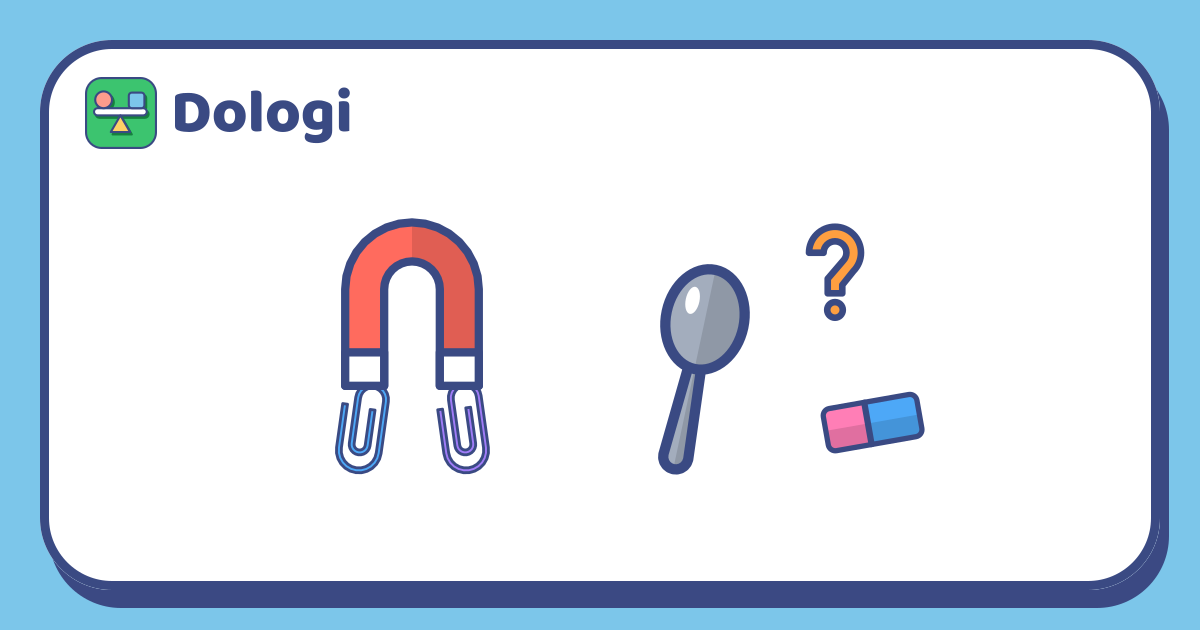
Hand your child a magnet and they will almost certainly run around the house pressing it against everything. That is already an experiment. Add one small step, guess before you test, and the game turns into a real science session.
This article suggests how to explore magnets with children of roughly 4 to 10: hunting for things that stick, finding the surprises, testing what a magnet can pull through, and discovering why two magnets sometimes pull together and sometimes push apart.
What you need
- A large magnet that's easy to hold: a horseshoe magnet, a bar magnet or a big fridge magnet. Keep tiny magnets and toys with small magnets out of reach of young children.
- A tray of things to test: paper clips, large drawing pins, keys, a metal spoon, a plastic spoon, coins, kitchen foil, a bottle cap, an eraser, a pencil, a marble, a bit of wool, a leaf.
- A sheet of paper with two columns: "Sticks" and "Doesn't stick".
Keep magnets away from phones, computers and bank cards. No long explanation is needed, just one rule: "Magnets stay on this table."
Guess first, then test
Your child picks up each object and says: "I think this will stick" or "it won't". You write it down, or your child puts the object on the side of the sheet they guessed. Only then do they try it with the magnet.
| Object | My guess | Result |
|---|---|---|
| Paper clip | Sticks | Sticks |
| Plastic spoon | Doesn't | Doesn't |
| Kitchen foil | Sticks | Doesn't |
| Key | Sticks | Depends on the key |
When a guess turns out wrong, pause for a moment: "You thought it would stick, but it didn't. Strange, why might that be?" A wrong guess is when your child does the most thinking.
Younger children only need to sort things into two piles. Older children can add a column: "What is it made of?"
Not every metal sticks
After one round, many children come up with a rule: "Things made of iron or steel stick; plastic and wood don't." That's close, and worth praising. Then test the rule with a few more objects:
- Kitchen foil and drinks cans are often aluminium, a metal that doesn't stick.
- Stainless steel spoons: some stick, some barely do. There are many kinds of steel.
- Coins and keys: it depends on the metal they are made of, so each one can be different. This is a good place to test each one rather than guess for all of them.
A child-friendly way to say it: magnets attract some metals, mostly iron and steel, not every metal. What your child just did, making a rule and then looking for more examples to check it, is exactly how scientists test their ideas.
What can a magnet pull through?
Put a paper clip on a sheet of paper and hold the magnet underneath. Does the clip follow the magnet? Then try thicker and thicker things:
- A sheet of paper, a piece of card, a thin exercise book.
- A paper plate: draw a road or a maze on it, put the clip on top and steer it with the magnet underneath.
- Get a clip out of a glass of water without wet fingers: drop a clip into a plastic cup of water, then slide the magnet up the outside of the cup to pull the clip to the top.
Your child can also measure strength: stack sheets of paper one at a time until the clip stops following, and count the sheets. Try it with two different magnets, changing only the magnet each time and keeping the same paper and the same clip.
Two ends of a magnet: pull or push?
You'll need two bar magnets. Stick a small piece of coloured tape on one end of each.
- Bring the two taped ends close together. What happens?
- Turn one magnet round, and bring a taped end close to an untaped end. What now?
- Put one magnet on a toy car and use the other to "push" the car along without touching it.
Your child will feel the magnets sometimes pulling together and sometimes pushing apart, as if there were an invisible cushion between them. Each magnet has two different ends, called poles. Like poles push apart; unlike poles pull together. Let your child discover the rule before you give it a name.
Older children can try making a compass: stroke a sewing needle along the magnet about twenty times, always in the same direction, push it through a small slice of cork, and float it in a bowl of water. The needle usually turns slowly to point one way. Handle the needle yourself.
A link to sorting
A magnet experiment is really a sorting exercise: each object goes into "sticks" or "doesn't stick", then you look for what each group has in common. In Dologi, the "Sort into groups" puzzle also asks children to put things into boxes by colour, shape or number, the same habit of spotting what things share.
In short
- One large magnet and a tray of household objects are enough; keep small magnets away from young children.
- Always guess first, record results in "sticks" and "doesn't stick" columns, and pause on the wrong guesses.
- Let your child discover that not every metal sticks and that magnets work through paper and water.
- Like poles push apart, unlike poles pull together: let your child find it before hearing the name.
Read more: Homemade magnet fishing: catch a fish, count the dots