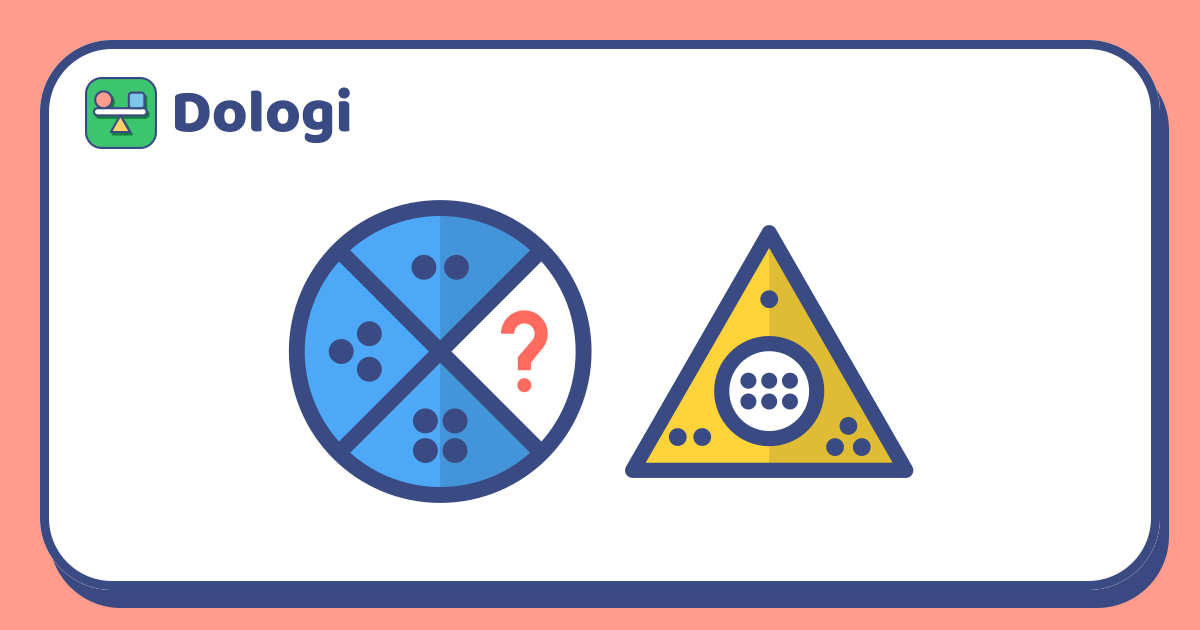
A circle split into parts, a number in each part, and one part showing a question mark. A triangle with numbers at its three corners and one in the middle. These "find the missing number" puzzles turn up in workbooks, puzzle pages and fun quizzes, and many children aged around 8 to 12 love them. The hard part is not the arithmetic. It is that the rule is hidden: your child has to work out which operation the puzzle-maker used.
This article walks through the three most common types, with two puzzles of our own for each and the answers at the end. More important than any single answer is a habit that works for every type: try the operations one at a time, and only fill in the gap when the rule works for every part.
How to test: add, subtract, multiply, then check every part
When your child meets a picture with a question mark, they can follow four steps:
- Find a complete part. That is the example to learn the rule from: a triangle that already has its middle number, a row with all three cells filled, or a pair of opposite parts with both numbers.
- Try each operation, easiest first. Add everything. Take the smaller number from the bigger one. Multiply. Double. If nothing works, multiply two numbers and then add or subtract the third.
- Check the rule on the second and third parts. This is the step children skip most often. With only one part, two or three different rules often fit. Ask: "Does this rule work for every part?"
- Only fill in the gap when every part fits. If one part does not fit, go back to step 2 and try another operation.
Encourage your child to jot the rules they try on scrap paper and cross out the ones that fail. A page full of crossings-out is a sign they are doing it the right way, not a sign they are doing badly.
Type 1: corner numbers make the middle number
Each triangle has three numbers at its corners (top, bottom left, bottom right) and one in the middle. The middle number comes from the three corner numbers by the same rule in every triangle.
Puzzle 1 (warm-up):
| Triangle | Top | Bottom left | Bottom right | Middle |
|---|---|---|---|---|
| First | 2 | 3 | 4 | 9 |
| Second | 5 | 1 | 6 | 12 |
| Third | 4 | 7 | 2 | ? |
Puzzle 2 (with a trap):
| Triangle | Top | Bottom left | Bottom right | Middle |
|---|---|---|---|---|
| First | 1 | 2 | 4 | 7 |
| Second | 2 | 3 | 5 | 13 |
| Third | 4 | 3 | 6 | ? |
In puzzle 2, adding the corners of the first triangle gives exactly 7, so it is easy to think the rule is found. A hint for your child: "Try the adding rule on the second triangle."
Type 2: three-by-three number grids
The grid has nine cells, one of them a question mark. Usually the third cell in each row comes from the first two, but sometimes the rule runs down the columns instead. This article sticks to number grids; grids made only of pictures that change colour or size are a different kind of puzzle.
Puzzle 3 (by rows):
| Column 1 | Column 2 | Column 3 | |
|---|---|---|---|
| Row 1 | 2 | 2 | 4 |
| Row 2 | 3 | 5 | 15 |
| Row 3 | 4 | 6 | ? |
Puzzle 4 (if rows do not work, try columns):
| Column 1 | Column 2 | Column 3 | |
|---|---|---|---|
| Row 1 | 6 | 4 | 5 |
| Row 2 | 3 | 5 | ? |
| Row 3 | 9 | 9 | 12 |
A hint for puzzle 4: "Is there a rule in row 1? If not, read column 1 from top to bottom."
Type 3: circles with opposite parts
The circle is cut into parts like slices of a cake. In this type, the rule usually links two parts that face each other across the centre. Since we cannot draw the circle here, the numbers are read clockwise, starting from the top part. Your child can draw the circle on paper to make it easier to see.
Puzzle 5: a circle with eight parts, read clockwise: 3, 5, 2, 7, 6, 10, 4, ?
Puzzle 6: a circle with six parts, read clockwise: 4, 9, 1, 8, 3, ?
A hint: the part opposite the first one is halfway round the circle. With eight parts, part 1 faces part 5 and part 2 faces part 6. With six parts, part 1 faces part 4. Your child can write each opposite pair on its own line and compare them.
Answers, and how your child can make their own
- Puzzle 1: 13. The middle number is the sum of the corners: 2 + 3 + 4 = 9 and 5 + 1 + 6 = 12, so 4 + 7 + 2 = 13.
- Puzzle 2: 14. Adding works for the first triangle (1 + 2 + 4 = 7) but fails on the second (2 + 3 + 5 = 10, not 13). The rule that works for both: multiply the two bottom corners, then take away the top one. 2 × 4 − 1 = 7 and 3 × 5 − 2 = 13, so 3 × 6 − 4 = 14.
- Puzzle 3: 24. Row 1 fits both adding (2 + 2 = 4) and multiplying (2 × 2 = 4). Row 2 only fits multiplying: 3 × 5 = 15. So 4 × 6 = 24. The answer 10 belongs to someone who stopped at row 1.
- Puzzle 4: 7. The rows share no rule, but every column does: the top cell plus the middle cell makes the bottom cell. 6 + 3 = 9 and 4 + 5 = 9, so 5 + ? = 12, which makes 7.
- Puzzle 5: 14. The opposite pairs are 3 and 6, 5 and 10, 2 and 4, 7 and ?. The first pair fits both "add 3" and "double", but the second pair (5 and 10) only fits doubling. Double 7 is 14.
- Puzzle 6: 11. The opposite pairs are 4 and 8, 9 and 3, 1 and ?. Each pair adds up to 12, so the missing number is 11.
Once your child has solved them, invite them to make up a puzzle for you. Here is how:
- Choose the rule first and write it down out of sight, for example "multiply the two bottom corners, then add the top one".
- Draw at least two complete parts that follow the rule, then one part with a question mark.
- Before handing it over, ask: "Could a different rule also fit every part?" If so, change one number so that only one rule works.
That last step shows your child why a puzzle needs at least two worked examples, and it is the moment they really understand how to check a rule. You can deliberately answer with a rule that only fits the first part, so they get to point out the mistake.
In Dologi, the "Next number" puzzles in the Patterns topic practise exactly this habit: your child finds the rule in a row of numbers and checks it step by step before choosing an answer.
In short
- Missing number puzzles usually come in three types: triangles with corner numbers, three-by-three grids, and circles with opposite parts.
- Try adding, subtracting, multiplying and doubling in turn, then combine two operations if nothing works.
- One part often fits several rules; ask "Does this rule work for every part?" before filling in the gap.
- Let your child make up their own puzzles and check that each one has only one answer.
Read more: Patterns in numbers: odd and even, counting in twos and skip counting