Your child reads the first choice, likes it, and bubbles it in. Or they get down to two answers and pick the wrong one, the one that was almost right. Then they're surprised: "But I knew this!"
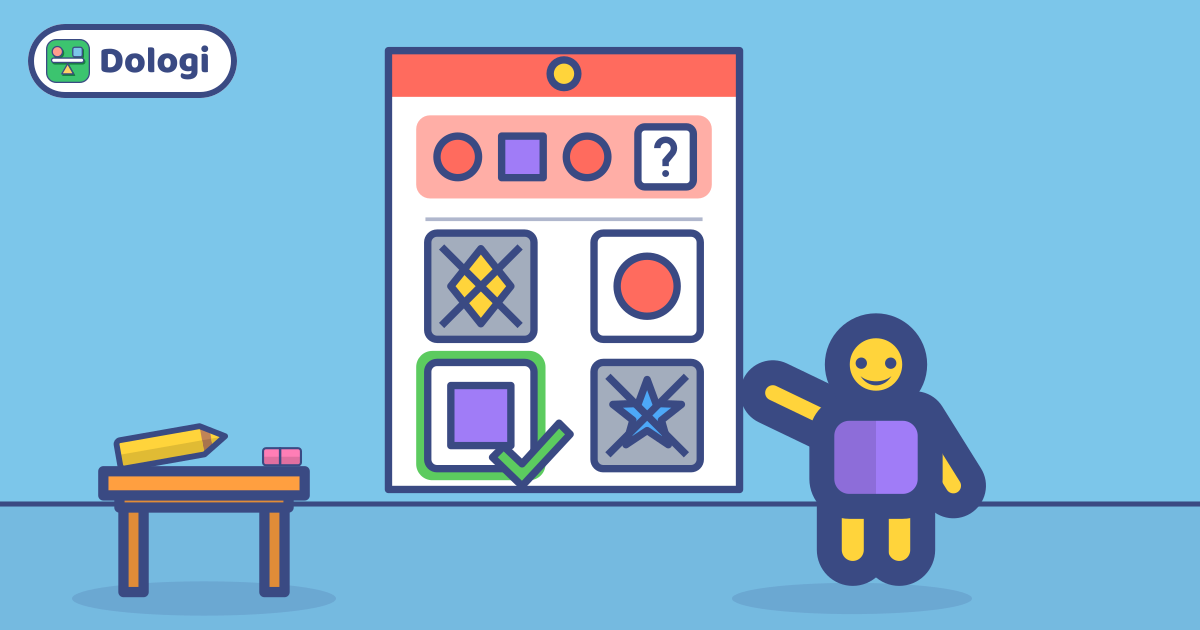
Multiple-choice questions reward a specific kind of thinking: looking at every option and asking, "Can this one be right? Why not?" Ruling out wrong answers isn't a trick for skipping the work. Done well, it is the work: each crossed-out choice needs a reason. Here's how to teach it at home, step by step.
Read the question, then every choice
Most multiple-choice mistakes start before any choice is read.
- Read the question twice. The second time, point to the key words: not, all, most, best, first, about. "Which animal is not a mammal?" asks the opposite of "Which animal is a mammal?"
- Answer in your head first. Cover the choices with a hand and ask, "What do you think the answer is?" Then uncover them and look for that answer.
- Read all the choices before choosing. The first one that sounds good may be the trap. Questions are often written so that one wrong choice looks very close to the right one.
Cross out what's surely wrong, with a reason
Go through the choices one by one. If a choice can't be right, cross it out lightly in pencil (so it's still readable) and say why. Try this one with a child who has started multiplication:
Mia has 3 bags with 4 apples in each bag. How many apples does she have? A. 7 B. 12 C. 34 D. 1
- D. 1 is out: that's fewer than one bag holds.
- C. 34 is out: each bag has fewer than 10 apples, so 3 bags have fewer than 30.
- That leaves A. 7 and B. 12.
Notice that every cross has a sentence behind it. If your child can't say why a choice is wrong, it stays in. Crossing out "because it looks weird" is guessing in disguise.
Compare the last two choices
Often two choices are left, and one is the "almost right" answer. This is where careful thinking pays off: go back to the question and find the detail that decides.
In the apple problem, 7 is what you get by adding 3 + 4. But the question says 4 apples in each bag: that's 4 + 4 + 4 = 12. So the answer is B.
Reading questions work the same way:
Before school, Sam pulled on his boots, grabbed his umbrella and splashed through the puddles on the sidewalk. What was the weather probably like? A. Hot and sunny B. Rainy C. Snowy D. It was nighttime
Sunny is out (puddles, boots and an umbrella). Nighttime is out (he's going to school). Snowy and rainy both fit the boots, but the umbrella and the puddles point to rain: B. Ask your child to put a finger on the words that prove it. This is the same skill as building reading comprehension step by step.
Check before moving on
- Read the question again with your answer in it. "Mia has 12 apples." Does that answer exactly what was asked?
- Check backward when you can: 12 apples in 3 bags makes 4 per bag. It fits.
- Change an answer only with a reason. Rereading and spotting a key word is a good reason; feeling nervous is not.
- Stuck after crossing out? Choose the choice with the best reason, mark the question, and come back to it at the end if there's time.
One thing to avoid: "rules" like "pick the longest answer" or "C comes up most." They don't work reliably, and they teach children to look at the shape of the answers instead of the question. The goal is understanding, with elimination as a way to organize it. If your child tends to tap answers quickly, teaching children to stop and check has more ideas.
Practice at home: write your own questions
The best way to understand wrong answers is to write them.
- Swap roles. Your child writes a question with one right answer and three wrong ones for you. Ask, "Which mistake is each wrong answer for?" A good wrong answer is a common slip, like adding instead of multiplying.
- Which one doesn't fit? Name four things ("dog, whale, bat, shark") and ask which one is not a mammal, with a reason for every animal. (The shark: it's a fish. The whale and the bat are the traps.)
- Four pictures, yes-or-no questions. Lay out four cards. You secretly pick one, and your child asks yes-or-no questions ("Does it have wheels?"), turning over the cards each answer rules out.
- "Always" statements. One counterexample is enough to rule out a choice that says "always"; always, sometimes or never true turns that into a game.
Keep it low-pressure. Multiple-choice practice right before a test can make some kids more nervous; see helping kids stay calm before a test and a gentle plan for end-of-term review.
In Dologi's Logic topic, the Who lives here? puzzle shows clue cards and a house with a question mark. Your child works out who cannot live there, and the one left over is the answer: ruling out, with a reason for every choice.
In short
- Read the question twice, spot the key words, and read every choice before picking.
- Cross out the choices that are surely wrong, and say why each one is wrong.
- Compare the last two choices against the exact words of the question, then check the answer.
- Skip guessing rules; practice by having your child write wrong answers for you.
Read more: My child just guesses: teaching children to stop and check, My child is scared of tests, Building reading comprehension step by step