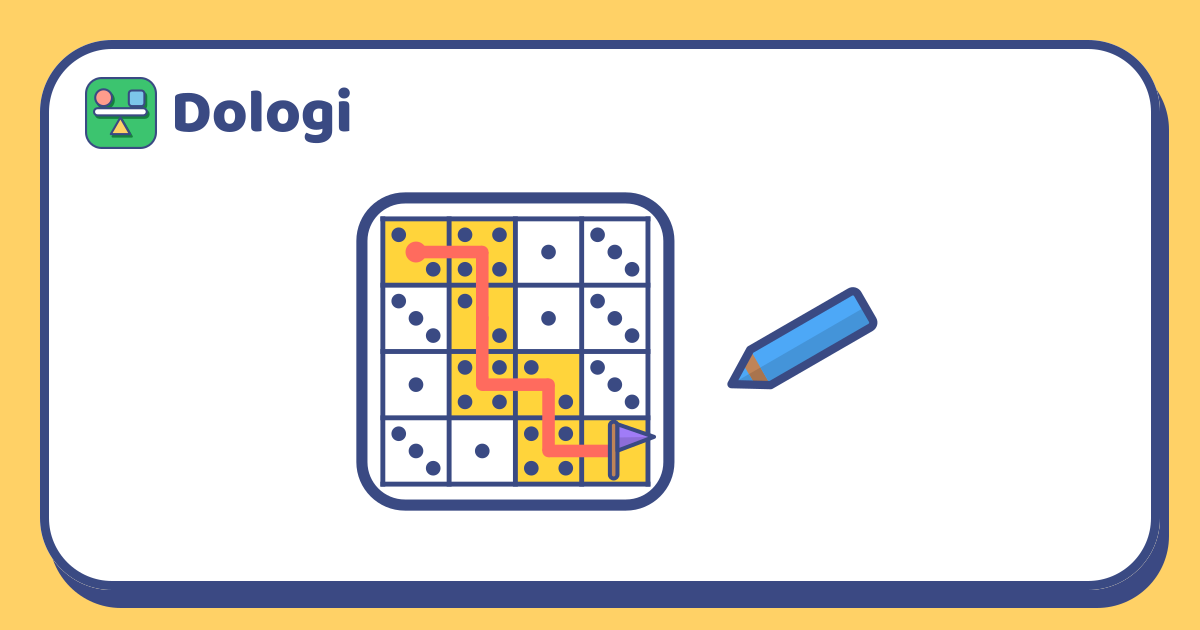
A number maze has no walls. It's a grid of numbers: your child starts in one corner, walks to the opposite corner and adds up every square on the way. The challenge is to find the path whose total hits a target number exactly. It looks like an adding exercise, but your child has to plan, compare routes and notice when a path can't possibly work.
This post has four levels you can draw in a minute, each with hints and an answer, and ends with your child making mazes for you. The ages are only a rough guide; every child is different.
How to set up a number maze
Draw a grid with squares big enough to write in. In the mazes below, columns are labeled A, B, C, D from left to right and rows 1, 2, 3, 4 from top to bottom, so A1 is the top-left square. Explain the rules once:
- Start in the top-left square and finish in the bottom-right square.
- Move to a square next to you: left, right, up or down. Never diagonally.
- Never step on the same square twice.
- Add up every square you step on, including the start and the finish.
Two small habits make it much easier. Write the running total in pencil in the corner of each square as you go, so a wrong turn is easy to undo. Or put a dried bean on each square of the path and only add up once the path is finished. For children who don't yet read numbers well, draw dots in the squares instead of digits and let them count.
Level 1: follow the even numbers (about 6–7)
No adding yet. Your child walks from A1 to D4 stepping only on even numbers: 2, 4, 6, 8, 10.
| A | B | C | D | |
|---|---|---|---|---|
| 1 | 2 | 8 | 5 | 3 |
| 2 | 7 | 4 | 1 | 9 |
| 3 | 8 | 6 | 10 | 7 |
| 4 | 5 | 9 | 2 | 4 |
- Hint 1: from the 2 at the start, which squares next door are even?
- Hint 2: at the 6 there are two even squares to choose from. One of them leads nowhere.
Answer: 2 → 8 → 4 → 6 → 10 → 2 → 4 (A1, B1, B2, B3, C3, C4, D4). The 8 at A3 is a trap: it's even, but the only even square next to it is the 6 you came from. If your child wants more, ask them to add up the path: 36.
Level 2: hit the target (about 7–8)
Now a 3×3 grid with a simpler rule: only move right or down. Find the path that adds up to exactly 17.
| A | B | C | |
|---|---|---|---|
| 1 | 3 | 3 | 5 |
| 2 | 5 | 1 | 5 |
| 3 | 6 | 6 | 3 |
- Hint 1: with only right and down, there are just six paths. Try the ones that start by going right, then the ones that start by going down.
- Hint 2: the bottom row has two 6s. A path along it gets a big total.
Answer: 3 → 5 → 1 → 5 → 3 (down, right, right, down), and 3 + 5 + 1 + 5 + 3 = 17. The six paths add up to 19, 15, 16, 17, 18 and 23, all different. Follow-up question: can you make 20? No path does it, and "it's impossible" is a real answer your child can prove by listing all six.
Level 3: when the short way isn't enough (about 8–10)
Same 3×3 size, but your child can now move in any of the four directions, still never twice on the same square. The target is 18.
| A | B | C | |
|---|---|---|---|
| 1 | 1 | 1 | 1 |
| 2 | 2 | 2 | 5 |
| 3 | 1 | 4 | 3 |
- Hint 1: going only right and down, the biggest total is 13. To reach 18 you have to take a detour.
- Hint 2: all nine squares add up to 20. So the path must leave out squares worth exactly 2.
- Hint 3 (for older children): color the grid like a chessboard. Each step changes color, and the start and finish are the same color, so a path always covers an odd number of squares: 5, 7 or 9. You can't leave out just one square, so leave out two 1s.
Answer: down, down, right, up, right, down. That's 1 + 2 + 1 + 4 + 2 + 5 + 3 = 18, skipping the two 1s at B1 and C1. Working from "what do I leave out?" instead of "what do I add?" is a useful trick for lots of puzzles.
Level 4: the biggest total (about 9–10)
Back to right and down only, on a 4×4 grid. Which path gives the biggest total?
| A | B | C | D | |
|---|---|---|---|---|
| 1 | 5 | 2 | 9 | 8 |
| 2 | 7 | 3 | 9 | 7 |
| 3 | 4 | 2 | 8 | 6 |
| 4 | 3 | 2 | 1 | 3 |
Most children first take the bigger neighbor at every step: 5 → 7 → 4 → 3 → 2 → 1 → 3, only 25. The 7 looks tempting, but after it the path drifts away from the 9s.
A better way: in every square, write the biggest total you can have when you arrive there. Squares in the top row and left column can only be reached one way. For any other square, take the bigger of the two totals above it and to its left, then add the square's own number.
| A | B | C | D | |
|---|---|---|---|---|
| 1 | 5 | 7 | 16 | 24 |
| 2 | 12 | 15 | 25 | 32 |
| 3 | 16 | 18 | 33 | 39 |
| 4 | 19 | 21 | 34 | 42 |
Answer: 42. To find the path, go backwards from D4, each time to the bigger total above or to the left: 5 → 2 → 9 → 9 → 8 → 6 → 3 (right, right, down, down, right, down). Filling in a table of best totals is the same idea programmers use to find the best route through a map.
Your child makes the maze
Once your child has solved a few, swap roles. The easiest way to build a maze is to draw the path first:
- Draw a 3×3 or 4×4 grid and mark a path from start to finish.
- Write numbers along the path and add them up. That total is the target.
- Fill the other squares with numbers, including a few tempting ones.
- Before handing it over, check together whether another path gives the same total. If one does, change a number or accept two answers.
Step 4 is where the real thinking happens: your child has to look at the maze as the solver will.
In Dologi, the Math topic has a puzzle called "Fewest steps": your child draws a path from the house to the tree, where each road shows how many steps it takes, and looks for the smallest total. It's the same adding along a path, with a different goal.
In short
- A number maze is a grid where your child walks from corner to corner and adds up the squares on the way.
- Start with "even numbers only", then a target on a 3×3 grid, then free movement, then the biggest total.
- Useful tricks: list every path, think about what to leave out, and write the best total in each square.
- Making a maze for someone else, and checking it has only one answer, is the best level of all.
Read more: Drawing mazes for your child: three levels from easy to hard