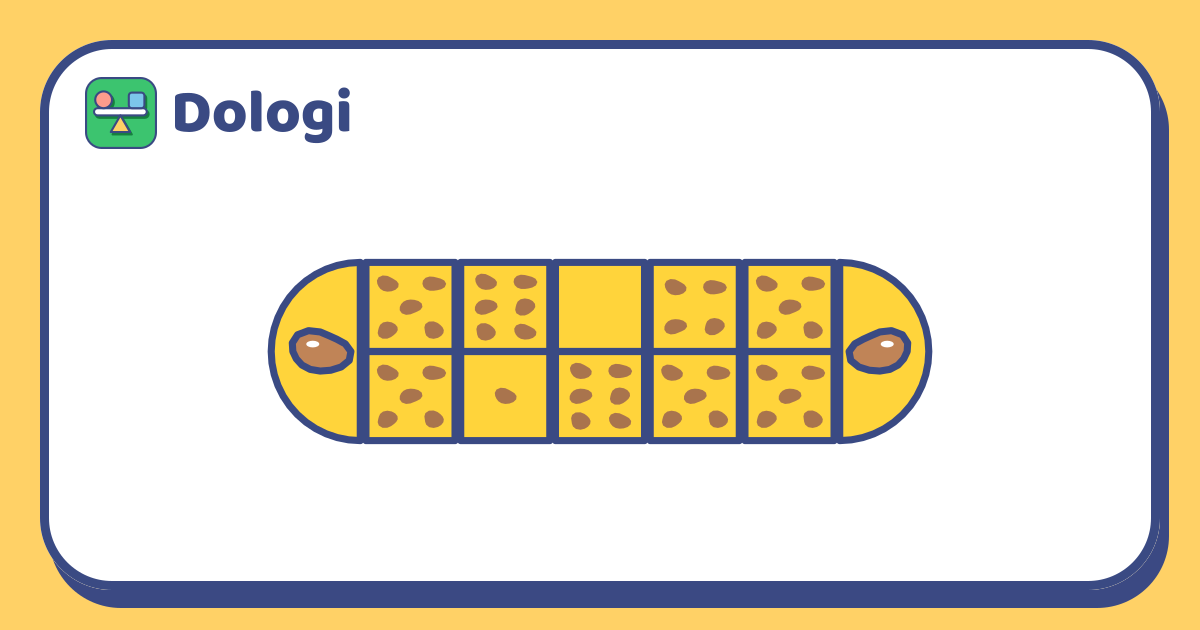
"Five pebbles… one, two, three, four, five. The next square has pebbles, so I keep going!"
Ô ăn quan, roughly "capture the mandarin squares", is a traditional game from Vietnam, played on a board drawn in chalk on the ground or scratched in the dirt. It belongs to a big family of "sowing" games found in many parts of the world: you pick up pebbles and drop them one by one along a row of holes or squares. All you need is something to draw with and a handful of pebbles, beans or buttons. Every turn is counting practice, and good players learn to count ahead before they move.
Drawing the board and setting up
- Draw a long rectangle and divide it into two rows of five squares. Each player sits on one long side and owns the five squares in front of them.
- Add a half-circle at each end. These are the two "mandarin" squares.
- Put five small pebbles in each of the ten squares, and one big stone in each half-circle.
Any small objects work: pebbles, dried beans, shells or buttons. If younger siblings are around, use pieces big enough not to be swallowed. A board on paper works just as well as one on the pavement.
A simple version for younger children
For children around four to six, start with sowing and counting only:
- Pick up all the pebbles from one of your squares.
- Choose a direction, left or right.
- Drop one pebble into each square in turn, going round the board, half-circles included.
Then the other player does the same. Don't worry about capturing yet. Let your child count out loud, one pebble per square, and before each move ask: "You have four pebbles. Where will the last one land?" Your child can point first, then sow and check. That small guess is the heart of the game.
The full rules
Rules differ from region to region, and families often have their own. This is a common version:
- On your turn, pick up all the pebbles from one of your own five squares (never from a half-circle) and sow them one by one in the direction you choose.
- When you drop the last pebble, look at the next square:
- It has pebbles: pick them all up and keep sowing in the same direction.
- It's empty, and the square after it has pebbles: you capture the pebbles in that square and keep them. If the pattern repeats (empty, then full), you capture again.
- It's a half-circle, or there are two empty squares in a row: your turn ends.
- If all five of your squares are empty at the start of your turn, put one of your captured pebbles back into each of them, then play.
- The game ends when both half-circles have been captured. Each player takes the pebbles left on their own side, and everyone counts. A big stone often counts as ten pebbles.
Counting ahead and thinking ahead
The skill that wins ô ăn quan is counting before you move. A child who can see "six pebbles from this square to the right ends here" can check each of their five squares, and both directions, before choosing. That's up to ten possible moves, and looking at them one by one is a big step in planning.
Questions that help:
- "Which square would let you capture something?"
- "If you sow from here, which empty square will you leave for the other player?"
- "Who has more pebbles now? How many more?"
Older children start noticing that a move which looks good can leave an empty square right in front of a full one, an easy capture for the other player.
| Rough age | What to try |
|---|---|
| 4–5 | Sowing only; counting one pebble per square; guessing where the last pebble lands |
| 6–7 | The capture rule with an adult's help; counting the score at the end |
| 8–9 | The full rules; checking several squares and both directions before moving |
| 10 and up | Avoiding gifts for the other player; trying regional rules and comparing |
Ages are only a rough guide, and every child is different.
In Dologi, the Math topic has puzzles such as "Add along the lines", where children place numbers so that each line adds up to a given total. As with choosing a square in ô ăn quan, children try a move, count, and change their mind if it doesn't work.
In short
- Ten squares in two rows, a half-circle at each end, five pebbles per square and a big stone in each half-circle.
- Start with sowing and counting, and ask "where will the last pebble land?"
- The full game adds capturing: an empty square followed by a full one.
- The real skill is counting ahead: checking each square and each direction before moving.
Read more: The last stick game: a simple strategy game that teaches children to work backwards