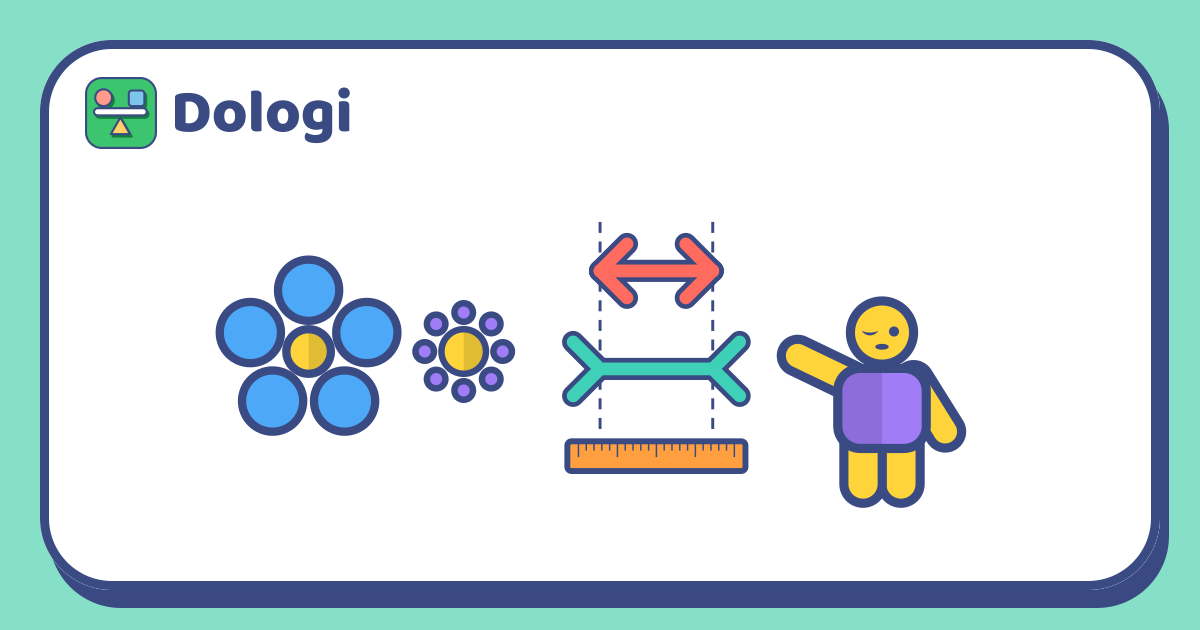
Show your child two lines and ask which one is longer. They answer straight away, sure of themselves. Then you put a ruler on both lines and they turn out to be exactly the same length. Most children react with a laugh, a "No way!" and a request to measure again.
That moment of surprise is worth a lot. An optical illusion is a picture that tricks our eyes, and it is one of the friendliest ways to show a child that what we see first is only a guess. This article gives you three illusions you can draw together with a pencil and a ruler, a simple routine of "guess, then check", and ideas for carrying the habit into everyday life. It suits children aged roughly 6 to 12.
Why illusions are worth a few minutes
Our eyes and brain work fast. They judge sizes and lengths by comparing things with what is around them, and most of the time those quick judgments are good enough. An illusion is a drawing built so that the surroundings lead the quick judgment the wrong way.
Being fooled is not a sign that your child isn't paying attention. Adults are fooled by the same pictures. The useful lesson is a different one: looking gives you a first answer; measuring tells you whether it's right. A child who learns to say "it looks longer, let me check" is practicing the same careful thinking they will need for math, science and, later on, for news and claims they hear from others.
Three illusions you can draw together
You need paper, a pencil, a ruler, and something round to trace around, such as a coin, a bottle cap and a cup. Draw the pictures yourself, or let an older child draw while you read out the steps.
1. Lines with arrow ends
- Draw two straight horizontal lines of the same length, for example 10 cm, one above the other, about 5 cm apart. Use the ruler so that their left ends and right ends line up exactly.
- At both ends of the top line, add two short slanted strokes that point back towards the middle, like arrowheads: the line now looks like a double-headed arrow.
- At both ends of the bottom line, add two short strokes that open outwards, like the feathers at the end of an arrow.
Ask: "Which line is longer?" Many people see the bottom line as clearly longer. This picture is often called the Müller-Lyer illusion, after the scientist who described it, but your child doesn't need the name to enjoy it.
2. A circle in a crowd
- Trace around the same coin twice, leaving plenty of space between the two circles.
- Around the first circle, trace a ring of five or six big circles using the cup.
- Around the second circle, trace a ring of eight or so small circles using the bottle cap.
Ask: "Which middle circle is bigger?" For many people the one among small circles looks bigger. This one is known as the Ebbinghaus illusion.
3. The upside-down T
Draw a horizontal line 8 cm long. From its middle, draw a vertical line going up, also 8 cm long. Ask which line is longer. Many children (and adults) choose the vertical one.
Guess first, then check
The checking is where the learning happens, so give it as much attention as the trick itself.
- Guess out loud. Your child says which one looks longer or bigger.
- Say how sure. Hold up one, two or three fingers: a little sure, quite sure, very sure.
- Check with a tool. Choose the one that fits your child's age.
- Compare and talk. "Were your eyes right? What do you think fooled them?"
| Tool | How to use it | Good for |
|---|---|---|
| Strip of paper | Lay it along the first line, mark both ends with a pencil, then slide it to the second line | Younger children who can't read a ruler yet |
| Ruler | Measure each line and write the two numbers side by side | Children who can read centimeters |
| Tracing paper or baking paper | Trace one middle circle, then lay the tracing over the other | Shapes and circles, where a ruler is awkward |
Step 2 matters more than it seems. When a child who was "very sure" finds out they were wrong, they learn that feeling certain and being right are not the same thing. Keep the tone light: you were fooled too, and that is the fun of it.
Let your child make the illusion
Once the trick is known, hand over the pencil.
- Change one thing. Make the slanted strokes longer, shorter or more open, and see whether the effect gets stronger or weaker. Use the paper strip each time to keep the lines truly equal.
- Fool the family. Your child draws an illusion and tests it on a grandparent or a sibling, then shows them how to check. Explaining the check is a good sign the idea has sunk in.
- Go the other way. Ask your child to draw two lines that look equal but aren't. This needs real measuring.
As a rough guide, children around 6 or 7 enjoy the surprise and the paper strip. From about 8 to 12, many like changing one part at a time and noting what happens, which is a small experiment in its own right. Every child is different, so follow your child's interest.
From paper to everyday life
The real goal is a habit that works away from the drawings: notice when a judgment is based only on how something looks, and check it when it matters.
- Glasses of juice. A tall, thin glass can look as if it holds more than a short, wide one. Pour each into a measuring jug and see.
- Which way is shorter? Two paths in the park can look different in length. Count your steps on each.
- Which piece is bigger? Cake slices on different plates can fool the eye. Lay one on top of the other.
- A handy phrase. Agree on a family phrase such as "It looks like it… let's check", and use it yourself too.
In Dologi, the "Put in order" puzzles include wavy ropes that children arrange from shortest to longest "as if pulled straight". A curly rope can look shorter than it really is, so your child practices the same habit: don't trust the first look, think about the real length.
In short
- Optical illusions show children, in a playful way, that what we see first is only a guess.
- Three easy ones to draw at home: lines with arrow ends, a circle among big or small circles, and an upside-down T.
- Use the routine: guess out loud, say how sure, check with a strip of paper, a ruler or tracing paper, then talk about it.
- Carry it into daily life with a simple phrase: "It looks like it… let's check."
Read more: Observation skills: teaching children to look closely before deciding, How do you know? Teaching children to look for evidence, Teaching children to measure: long and short, heavy and light, full and empty