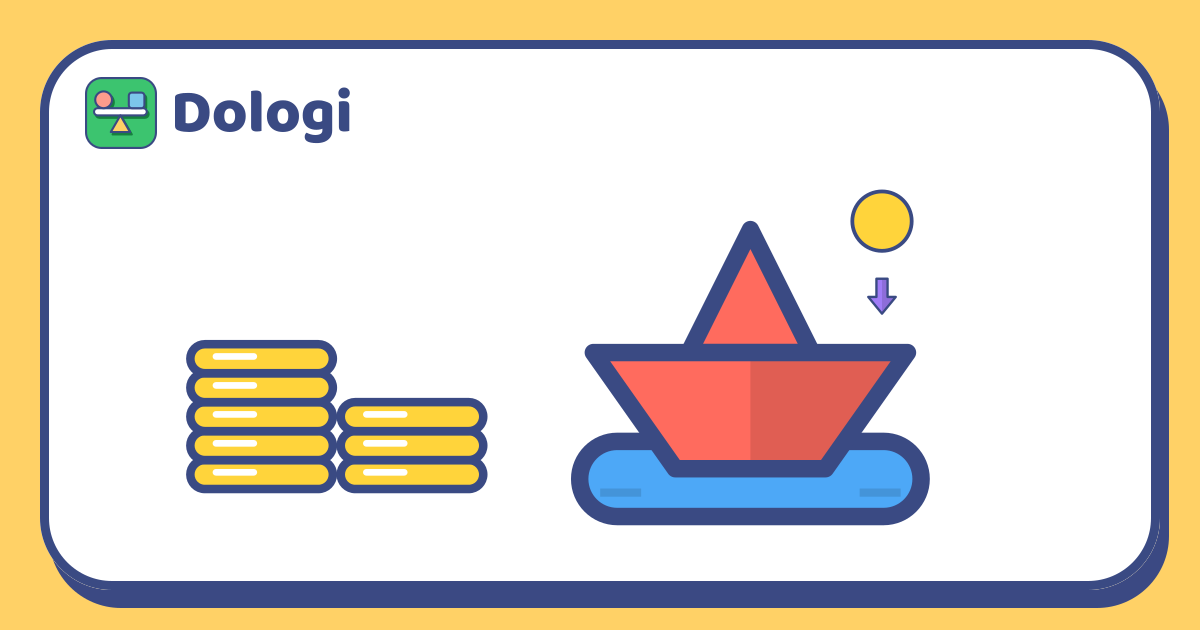
A paper boat floats in a basin of water. One coin goes in, then another. Everybody holds their breath: which coin will be one too many?
This small experiment is full of maths. Your child estimates, counts one by one, compares a guess with a result and finds out that the shape of a boat changes how much it can carry.
What you need
- A basin or a large bowl of water, standing on a towel.
- Paper, or kitchen foil if you want boats that last longer.
- Twenty to thirty coins of the same kind. Buttons or paper clips work too.
- Paper and a pencil for the results.
Coins are small, so this is a game for children who no longer put things in their mouths, and an adult stays beside the water.
A box boat in one minute
If your family knows how to fold the classic paper boat, use it. If not, a box boat is quicker and usually carries more.
- Take half a sheet of paper.
- Fold each of the four edges up by two finger widths and open them again.
- Stand the four edges up. At each corner, pinch the spare paper into a small triangle and fold it flat against the side. A piece of tape holds it in place.
Paper goes soft after a few minutes in water. That is part of the game: a new boat for each round.
Guess, load, count
- Guess. "How many coins will it carry?" Everyone writes a number down before the first coin.
- Load. Lay the coins in gently, one at a time, counting aloud.
- Stop. The boat has sunk when water comes over the side. The coin that sank it doesn't count.
| Round | Guess | Coins carried | How far off |
|---|---|---|---|
| 1 | 5 | 12 | 7 |
| 2 | 11 | 14 | 3 |
| 3 | 15 | 13 | 2 |
The last column is the interesting one. Hardly anybody guesses right the first time, but each result makes the next guess better. That is what estimating is: a guess that gets corrected by counting.
Where the coins sit
Run two rounds with the same kind of boat.
- In the first, put every coin at one end.
- In the second, spread the coins evenly: one on the left, one on the right, one in the middle.
Ask for a prediction first. The boat loaded at one end tips and takes in water after only a few coins, while the evenly loaded one carries far more. Let your child explain why in their own words. "It leaned over" is a fine start.
Changing the boat
Change one thing at a time and keep everything else the same.
| What you change | Question to ask first |
|---|---|
| A whole sheet instead of half | Will a bigger boat carry twice as many coins? |
| Higher sides and a smaller floor | Does a tall, narrow boat beat a wide, flat one? |
| Foil instead of paper | Does the material change the number? |
| Buttons instead of coins | Will it carry more buttons than coins? Why? |
Children often expect the tall boat to win and are surprised by the wide, flat one.
More maths from the same basin
- How many more? One boat carried 14 coins and the other 9. What is the difference?
- Counting in twos. Load two coins at a time, one on each side: 2, 4, 6, 8.
- The value of the cargo. If every coin is worth the same, older children can work out how much money the boat was carrying.
| Rough age | What to try |
|---|---|
| 4–5 | Counting the coins aloud one by one; saying which boat carried more |
| 6–7 | Writing down a guess and the result; counting in twos |
| 8–9 | The table with its "how far off" column; one end against evenly spread |
| 10 and up | Changing one thing about the boat and comparing; working out the value of the cargo |
Ages are only a rough guide, and every child is different.
In Dologi, "Count and answer" puzzles in the Math topic ask children to count only the things the question asks about, for example only the stars. It is practice in the same habit: one by one, skipping nothing and counting nothing twice.
In short
- A paper boat, a basin of water and a handful of coins make a counting experiment.
- Guess first, load one coin at a time, and compare the guess with the result.
- Coins spread evenly let the boat carry more than coins piled at one end.
- Change one thing about the boat at a time, and let the count decide.
Read more: The sink-or-float experiment: guess first, then test