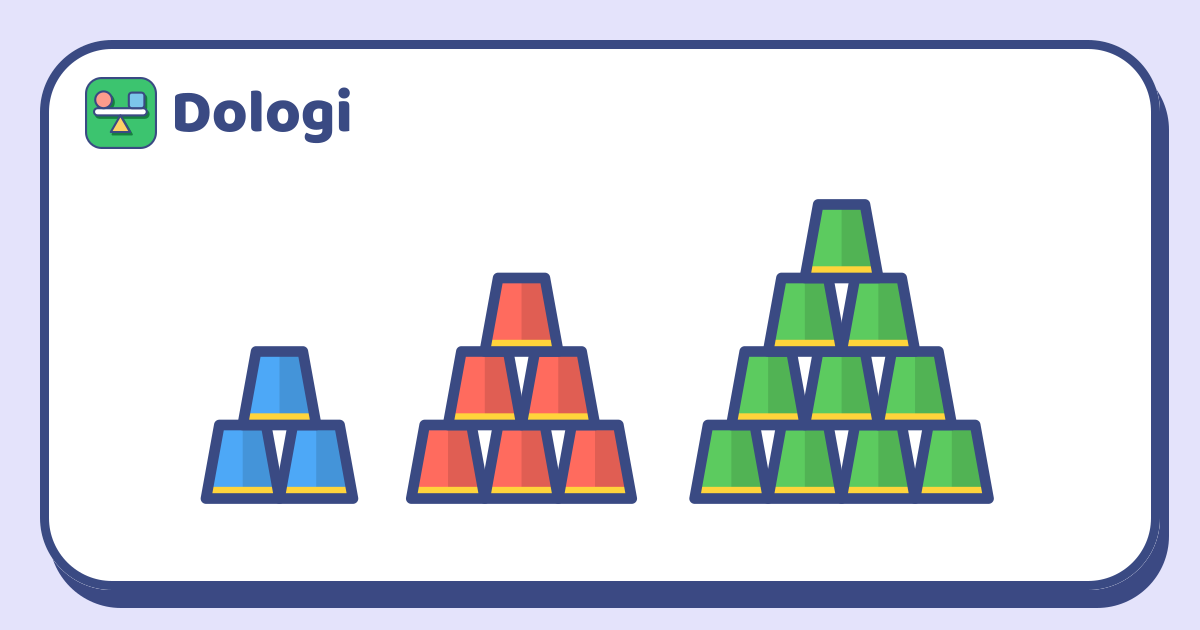
A stack of paper cups is one of the cheapest building sets there is. The cups are light, they make almost no noise when they fall, and a tower that took five minutes to build can be packed away in ten seconds.
Building with them teaches a surprising amount: balance, planning, a number pattern that grows row by row, and the calm it takes to start again after everything has fallen over.
What you need
- Twenty to thirty cups of the same size, paper or plastic.
- A flat surface. The floor is better than a table for tall towers.
- A few sheets of card, if you want to build with floors later on.
The classic pyramid
- Stand four cups upside down in a row, close together.
- Put three cups on top, each one standing on two cups below.
- Then two, then one.
Each cup rests on two others, like a little bridge. That is what makes the pyramid steady, and it is worth pointing out: "What is this cup standing on?"
The pattern in the rows
Count the cups in each pyramid on the cover: three, six, ten. Build them one after another and write the numbers down.
| Cups in the bottom row | Cups altogether |
|---|---|
| 2 | 3 |
| 3 | 6 |
| 4 | 10 |
| 5 | 15 |
| 6 | 21 |
Ask your child what they notice. Each new pyramid needs as many extra cups as its new bottom row: three more, then four more, then five more. Once that is clear, predict the next one before building it: a bottom row of seven should need 28 cups.
Then turn the question round: "We have 20 cups. What is the biggest pyramid we can build, and how many cups will be left over?"
Five challenges
| Challenge | How it works |
|---|---|
| Tallest tower | Twelve cups, any shape you like. Measure the height in hand spans |
| Copy the model | You build a small structure; your child builds exactly the same one beside it |
| Build from a drawing | Draw a tower seen from the front; your child builds it from the drawing alone |
| Wall or pyramid? | Build one wall with cups stacked straight on top of each other and one with cups bridging two below. Tap the table gently: which survives? |
| Floors | A sheet of card on four cups makes a floor. How many floors can you build with 20 cups? |
The fourth challenge is a real experiment. Let your child predict the result first and explain it afterwards in their own words.
When the tower falls
It will fall, and often. That is part of the game, not a failure.
Wait a moment, then ask: "Where did it start to fall? What could we change?" Common discoveries are a wider base, cups placed exactly in the middle of the two below, and slower hands near the top.
If frustration takes over, go back to a smaller pyramid that works, and add one row at a time.
| Rough age | What to try |
|---|---|
| 4–5 | Pyramids of three and six cups; counting the cups in each row |
| 6–7 | Pyramids of ten and fifteen; predicting the total; copying a model |
| 8–9 | The table and its pattern; the biggest pyramid from a given number of cups; floors |
| 10 and up | A pyramid with a square base of nine cups, then four, then one; building from a drawing made by someone else |
Ages are only a rough guide, and every child is different.
In Dologi, "Count the cubes" puzzles in the Space topic ask children to count all the cubes in a stack, including the ones hidden underneath and behind. It is the same habit of seeing a structure layer by layer.
In short
- Paper cups are a quiet, cheap building set that packs away in seconds.
- In a pyramid, every cup stands on two others: that is why it holds.
- Count the rows: 3, 6, 10, 15. Each pyramid adds one more cup than the last step did.
- When the tower falls, ask where it started and what to change.
Read more: Growing patterns: add two, double up, and guess what comes next