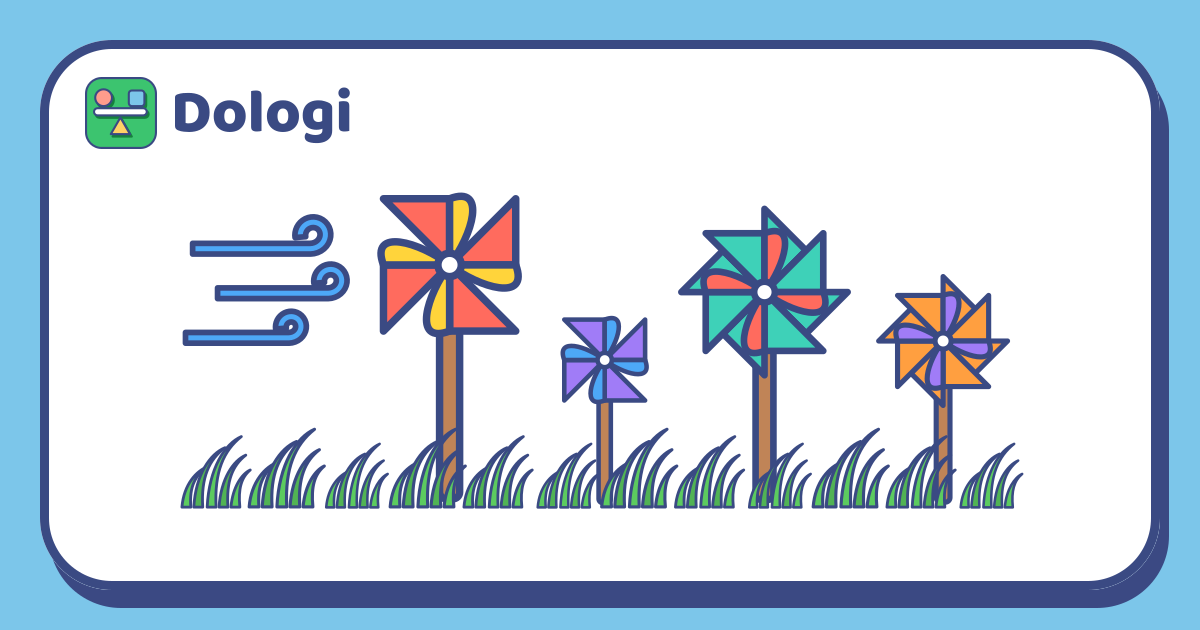
A paper pinwheel takes ten minutes to make, and the moment it starts spinning, a child wants to know whether a bigger one would spin faster. That is already a science question.
Here is how to make one, then turn a windy afternoon into a small experiment: predict, test fairly, count the turns and work out why.
What you need
- Squares of stiff paper or thin card, for example 20 cm and 10 cm across. Drawing paper or an old greeting card works well.
- A pencil with an eraser on the end, or a drinking straw.
- A pin, or a paper fastener with two legs that fold open.
- A small bead or a short piece of straw to go between the paper and the stick.
- A ruler, scissors and colored pens.
- A breezy day, or an electric fan.
An adult handles the pin. With a straw and a paper fastener, most children can do every step themselves.
Make a four-blade pinwheel
- Decorate both sides of the square first, then color one corner so that one blade will be easy to spot later.
- With a ruler, draw both diagonals lightly in pencil. Where they cross is the center.
- Cut along each diagonal from the corner towards the center, and stop about two fingers' width before the center. You now have four triangular flaps.
- Each flap has two loose corners. Take one corner from each flap, always the one on the same side, and bend it into the center without creasing it. The four corners overlap in the middle.
- Push the pin through the four corners and the center, then through the bead, then into the pencil eraser. With a straw, poke the paper fastener through the center and through the straw near the top, then fold its legs open.
- Leave a small gap so the paper doesn't rub on the stick. Blow gently: if it turns, it's ready.
For an eight-blade pinwheel, make two four-blade pinwheels of the same size and put them on the same pin, the second one turned an eighth of a turn so its blades sit in the gaps of the first.
Predict, then test fairly
Before each test, ask: "Which one will spin fastest? Why?" Your child points and gives a reason.
| What changes | Question to ask first |
|---|---|
| Four blades or eight blades | Do more blades make it spin faster? |
| Big or small square | Does a big pinwheel spin faster or slower? |
| Standing still or walking, then running | What happens on a day with no wind at all? |
The key to a fair test: change only one thing. If you compare a big eight-blade pinwheel with a small four-blade one, nobody can tell whether the size or the number of blades made the difference.
- With a fan: use the lowest speed and mark a spot on the floor with tape. Hold each pinwheel at that spot, at the same height, facing the fan.
- Outdoors: the wind keeps changing, so hold two pinwheels side by side at the same time. Then swap hands and test again.
- Standing still or running: on a calm day, the pinwheel barely turns when you stand still. Walk, then run: moving through the air makes its own wind.
Older children may notice that the eight-blade pinwheel is also twice as heavy. "Is that still fair? What else changed?" is a great question to discuss.
Count the turns
To say "faster" for sure, count. Your child watches the colored blade and counts out loud each time it passes the top, while someone else times 10 seconds with a kitchen timer or a clock. If the pinwheel spins too fast to count, move a little further from the fan or wait for a gentler breeze.
Test each version three times, because no two gusts are exactly the same. One family's chart, in front of a fan on its lowest setting, might look like this:
| Version | Run 1 | Run 2 | Run 3 |
|---|---|---|---|
| Small, four blades | 15 turns | 14 turns | 16 turns |
| Big, four blades | 9 turns | 10 turns | 9 turns |
| Big, eight blades | 10 turns | 9 turns | 11 turns |
Your results may be quite different: paper, folds and how tight the pin is all change the numbers.
| Rough age | What to try |
|---|---|
| 5–6 | Hold two pinwheels side by side; say "faster" or "slower"; predict by pointing |
| 7–8 | Count the turns of the colored blade in 10 seconds; fill in a three-run chart |
| 9–10 | Work out the average of three runs; invent their own question (thicker paper, rounder blades) and test it |
These ages are only a rough guide; every child is different.
Why does a pinwheel spin?
Each blade is curved and tilted. When the wind hits it, the air slides off the curve and is pushed to one side, and the blade gets pushed the other way. All the blades are bent the same way, so all the pushes go round in the same direction, and the pinwheel spins.
Ideas to explore together, without rushing to the answer:
- Which way does it spin? Make a pinwheel with the corners bent the other way. It spins the opposite way, because the pushes now go round the other way.
- Big or small? A big blade catches more wind, so a big pinwheel often starts turning in a gentler breeze. But its tips have further to travel on each turn, so in the same wind a small pinwheel often makes more turns. Often, not always: let the chart decide.
- Running: when you run, the air rushes past the pinwheel just like wind. Running into the wind makes it spin faster; running with the wind can make it slow down.
- Friction: a tight pin or paper rubbing the stick slows it down. That is why the bead helps.
Ask first, "Why do you think that one won?", and listen. An explanation that isn't quite right is a good place to start the next test.
In Dologi, the Math topic has a puzzle for older children called "Count the turns": each gear shows its number of teeth, one gear turns a set number of times, and your child works out how many turns the gear with the question mark makes. Like the pinwheel chart, it treats turns as something you can count and compare.
In short
- A square of card, a stick and a pin make a pinwheel in ten minutes.
- Change one thing at a time: number of blades, size, standing still or running.
- Count the turns of a colored blade in 10 seconds, three times for each version.
- Predict first, compare with the chart and let your child explain why.
Read more: Making a hypothesis: teaching children to guess with a reason, then test it