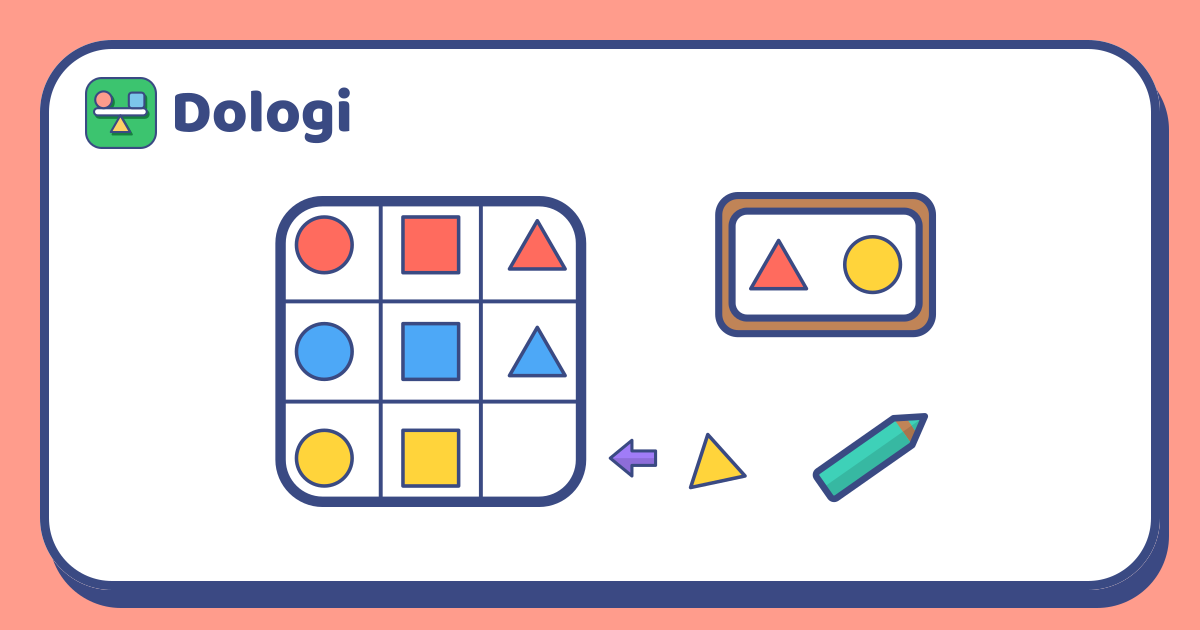
Grids of three rows and three columns with one empty square turn up in workbooks and puzzle books all the time. With eight pictures to take in at once, many children find them confusing at first, yet the way to solve them is quite tidy. Usually one thing changes along the rows and another changes down the columns, and the empty square has to fit both.
This post is for children of roughly 6 to 12. Every child develops at their own pace, so treat the ages as a rough guide. You will start with a 2×2 grid made of real objects, move on to hand-drawn 3×3 grids, teach your child two questions that work for any grid, and then let them make a grid to puzzle you. Four puzzles with answers are at the end.
What a pattern grid is
Each square holds a picture with a few features: colour, shape, size, number of dots, direction. In the simplest kind of grid, the pictures in one row share one feature and the pictures in one column share a different one. For example:
| Column 1 | Column 2 | Column 3 | |
|---|---|---|---|
| Row 1 | red circle | red square | red triangle |
| Row 2 | blue circle | blue square | blue triangle |
| Row 3 | yellow circle | yellow square | ? |
Every row shares a colour and every column shares a shape. The empty square sits in the yellow row and the triangle column, so it is a yellow triangle. This post sticks to features you can see; no sums are needed.
Start with a 2×2 grid of real objects
For children around six, or anyone meeting this kind of puzzle for the first time, start with things they can hold. Two strips of tape crossed on the table, or a big plus sign drawn on paper, give you four squares.
- What you need: two red things and two blue things, one big and one small in each colour. Plastic cups, wooden blocks or jar lids all work. Add two or three "decoys" in other colours or sizes.
- How to set it up: the top row is all red, the bottom row all blue; the left column is all big, the right column all small. Fill three squares and leave one empty.
- Your child's turn: pick the right object from the pile for the empty square, then say why.
At first, say the rule out loud together: "The top row is all red, the bottom row is all blue. This side is big, that side is small." Once your child has the hang of it, swap roles: they look away, you take out any one object, and they work out which one it was.
Move on to a drawn 3×3 grid
When the 2×2 grid feels easy, draw a three-by-three grid on paper and fill it with coloured pens. Change the features step by step using the levels below, playing a few grids at each level before moving up.
| Level | Rows change | Columns change | Suggested age |
|---|---|---|---|
| 1 | Colour | Shape (circle, square, triangle) | About 6–7 |
| 2 | Shape | Size (big, medium, small) | About 7–8 |
| 3 | Colour | Number of dots inside (one, two, three) | About 7–9 |
| 4 | Every row and column has all three shapes and all three colours, in a shifted order | Same as rows | About 9–12 |
You can also make a grid harder by moving the empty square. The bottom right corner is the easiest; a gap in the middle or the top row makes children look more carefully.
Two questions: what changes in this row, and in this column?
This is the most important part. Instead of guessing straight away, teach your child to go step by step:
- Look at a full row. "How are these three pictures the same? How are they different?"
- Look at a full column. Ask the same two questions.
- Put it together for the empty square. "Which row is the empty square in, and which column? So what must it have?"
- Place it and check. Read the whole row and the whole column out loud with the new picture in. It is only done when both work.
The most common mistake is looking in one direction only. In the example above, a child might pick a yellow circle because "the bottom row is all yellow": right colour, wrong shape. Rather than saying it is wrong, ask: "Can you read column three for me?" and let them spot the mismatch.
When your child is stuck, give hints in steps, moving on only when the step before is not enough: cover the grid with paper so only one row shows; say "only look at the colours for now"; and only then point to the two squares in the same row and the same column as the gap.
Let your child draw a grid to puzzle you
Making a grid shows children how one is built, and most love setting the puzzle.
- Your child picks two features to change, for example colour along the rows and size down the columns.
- They draw all nine squares on scrap paper first, then copy it onto a new sheet, leaving one square empty.
- You solve it and think out loud: "This row changes colour, this column changes size, so the empty square must be…"
- Now and then, give an answer that is only half right, so your child gets to point out the mistake.
If their grid has a square that breaks the rule, that is a good chance to fix it together: "I read this row and the colour changes, but what about this column?"
In the Patterns topic in Dologi, there is a puzzle type called "Pattern grid": a grid with one question mark, where children choose the picture that fits both its row and its column. The pictures change from puzzle to puzzle: sometimes shapes, sometimes balloons, arrows or ladybugs.
Four puzzles with answers
Copy the grids onto paper and draw the pictures instead of the words.
Puzzle 1:
| Column 1 | Column 2 | Column 3 | |
|---|---|---|---|
| Row 1 | big circle | medium circle | small circle |
| Row 2 | big square | medium square | ? |
| Row 3 | big triangle | medium triangle | small triangle |
Puzzle 2 (every picture is a circle):
| Column 1 | Column 2 | Column 3 | |
|---|---|---|---|
| Row 1 | red, 1 dot | ? | red, 3 dots |
| Row 2 | green, 1 dot | green, 2 dots | green, 3 dots |
| Row 3 | purple, 1 dot | purple, 2 dots | purple, 3 dots |
Puzzle 3 (every picture is an arrow):
| Column 1 | Column 2 | Column 3 | |
|---|---|---|---|
| Row 1 | orange, pointing up | blue, pointing up | purple, pointing up |
| Row 2 | orange, pointing right | blue, pointing right | purple, pointing right |
| Row 3 | ? | blue, pointing down | purple, pointing down |
Puzzle 4 (harder):
| Column 1 | Column 2 | Column 3 | |
|---|---|---|---|
| Row 1 | red circle | blue square | yellow triangle |
| Row 2 | yellow square | red triangle | blue circle |
| Row 3 | blue triangle | yellow circle | ? |
Answers:
- A small square. Each row keeps one shape and each column keeps one size: column 3 is small.
- A red circle with 2 dots. Row 1 is all red; column 2 is all two-dot circles. The gap is in the top row, so your child has to read the column from the bottom up.
- An orange arrow pointing down. Row 3 is all down arrows and column 1 is all orange.
- A red square. No row in this grid shares a colour or a shape, so the question becomes "what is this row missing?". Every row and every column has a circle, a square and a triangle, and red, blue and yellow. Row 3 already has a triangle and a circle, so it needs a square; it already has blue and yellow, so it needs red. Check column 3 (yellow triangle, blue circle): it is also missing a square and red.
In short
- A pattern grid usually has one thing changing along the rows and another down the columns; the empty square has to fit both.
- Start with a 2×2 grid of real objects, then move on to drawn 3×3 grids and change the features bit by bit.
- Teach your child to ask "what changes in this row, and in this column?" and to check both directions before deciding.
- Let your child make a grid to puzzle you: setting a puzzle is another way of understanding the rule.
Read more: Growing patterns: add two, double up, and guess what comes next