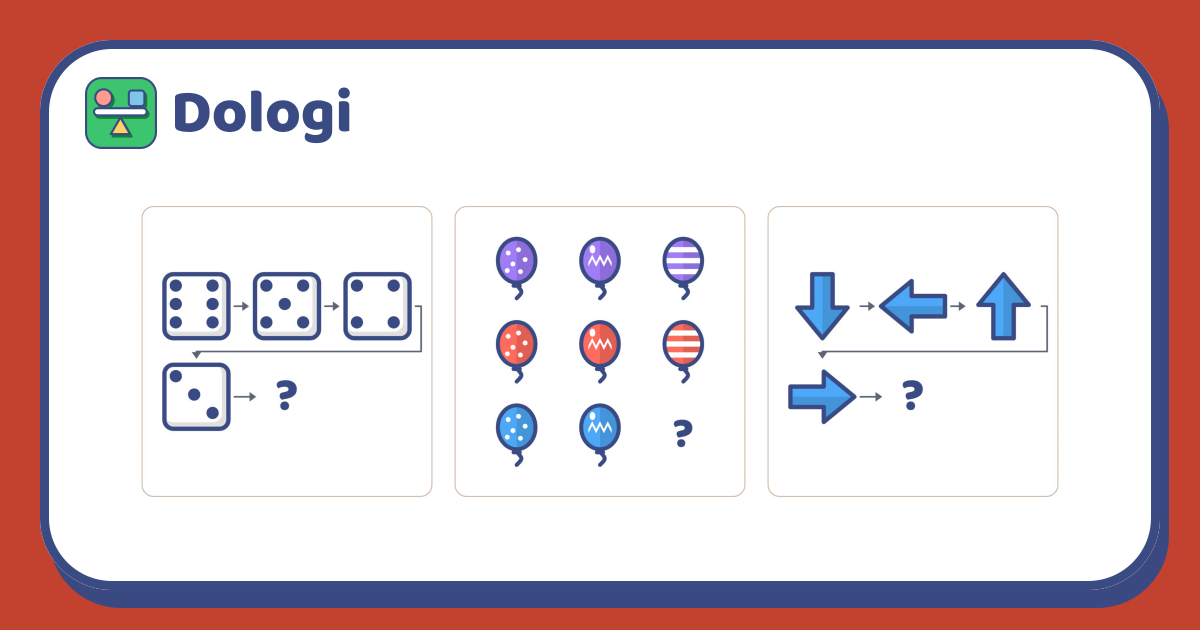
This third set of pattern puzzles for ages 5–6 has ten puzzles and more kinds than the first two: dice faces with changing dots, a lamp that blinks to the beat, a dance that follows a song, a carpet and a balloon grid with rows and columns, turning arrows, piano keys and a number row. At this age, children practice spotting what repeats and what changes steadily, then use that to predict the next step. All the puzzles come from the Dologi app, ordered from easy to harder.
How to use this post: show your child one picture at a time and let them find the pattern and say it in their own words before choosing. The answer is behind the "Show answer" button under each picture. If they get stuck, suggest comparing two pictures side by side: what stays the same, and what has changed?
Puzzle 1: More and fewer
Ages 5–6
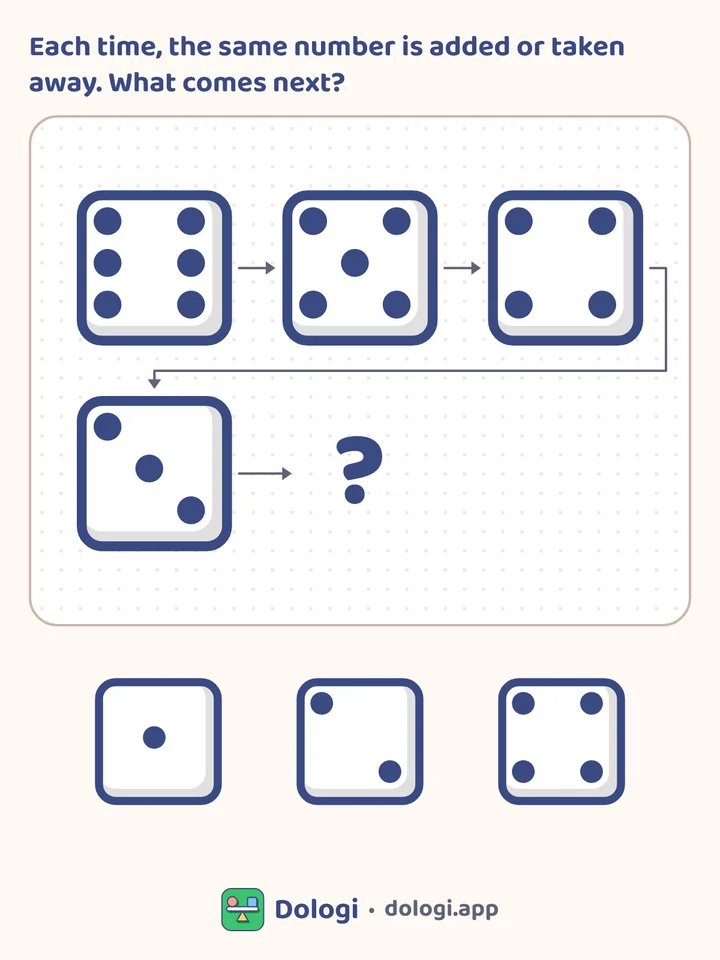
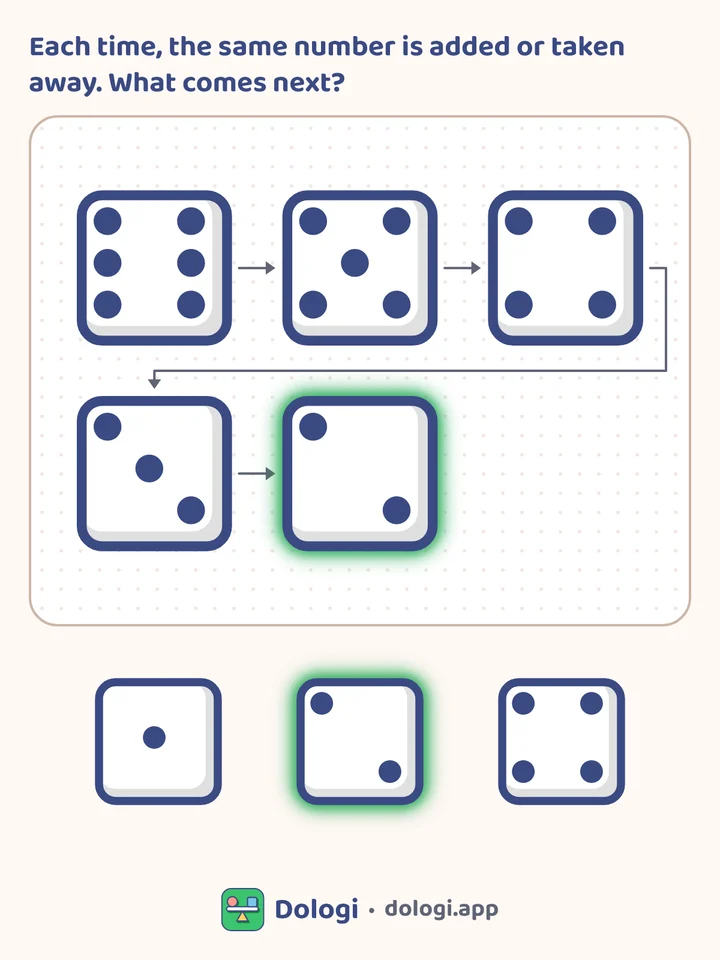
What it builds: Your child counts the dots on each die, compares two faces side by side to see how much the dots change each time, and then takes one more step the same way. Spotting a steady change is the root of counting on, counting back and, later, addition and subtraction. Keep playing: lay out a row of buttons, add or remove the same number each turn, and let your child guess how many will be on the table next turn.
Puzzle 2: Blinking lamp
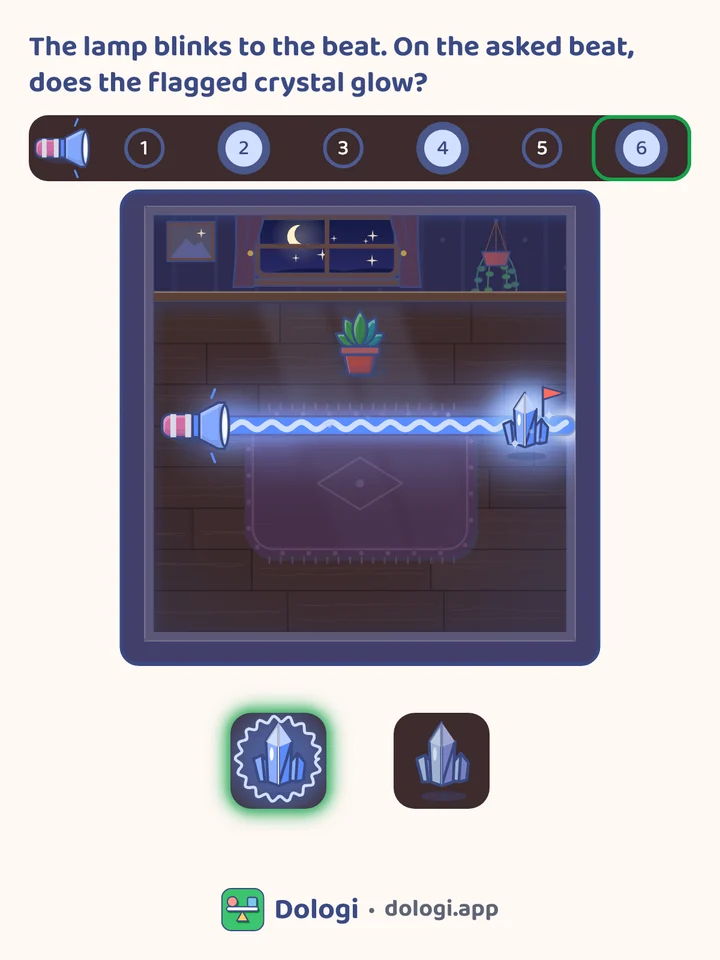
Ages 5–6
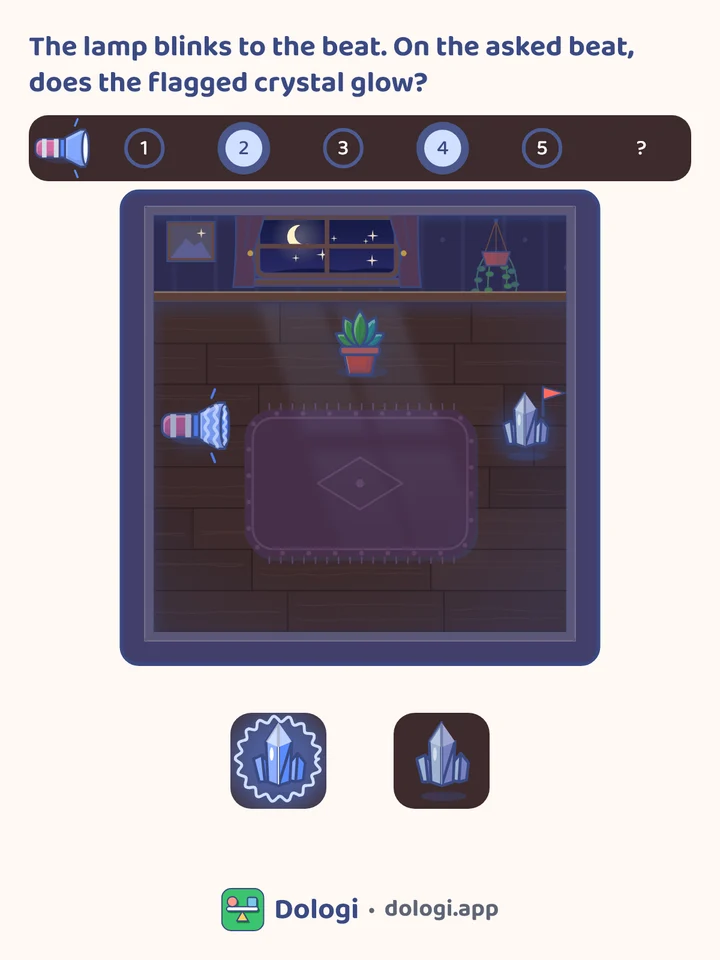
What it builds: The row of beats at the top shows which beats the lamp has already lit; your child works out how often the lamp shines, then counts on to the beat with the question mark to tell whether the beam reaches the flagged crystal then. Keeping a steady beat helps with singing in time, clapping along to music and, later, skip counting. Keep playing: switch a flashlight on and off in a fixed rhythm and ask your child to predict whether it will be on or off the seventh time.
Puzzle 3: Dance to the music
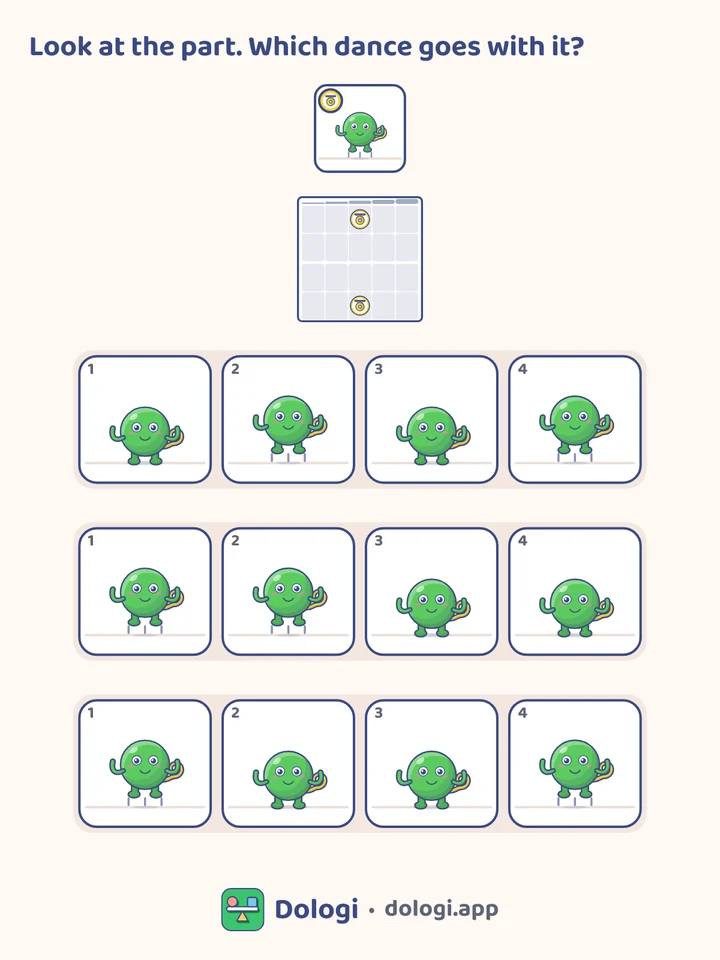
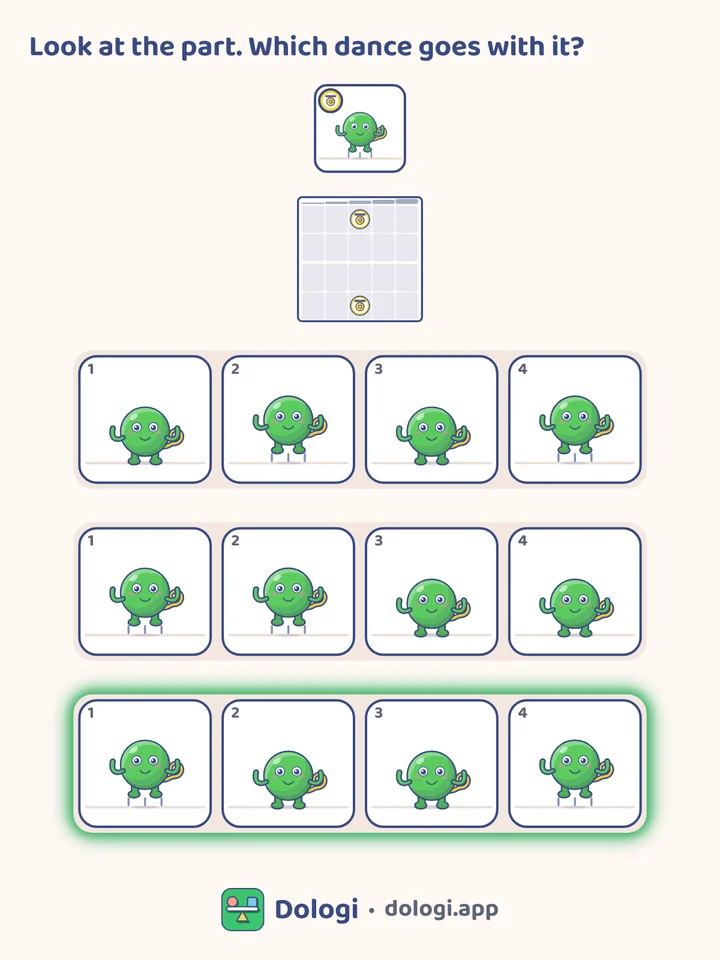
Ages 5–6
What it builds: The sample frame at the top shows which move goes with a note in the song; your child reads the song one row at a time from the top, makes the character do that move wherever a row has a note, and finds the strip of four frames in the right order. Reading symbols and turning them into actions is a skill they use with road signs, music and multi-step instructions. Keep playing: draw a row of four boxes, where a dot means jump and an empty box means stand still, and let your child read the row and act it out.
Hint: Each frame is one row of the part, from the top. Tap a part to hear it.
Puzzle 4: Patch the carpet
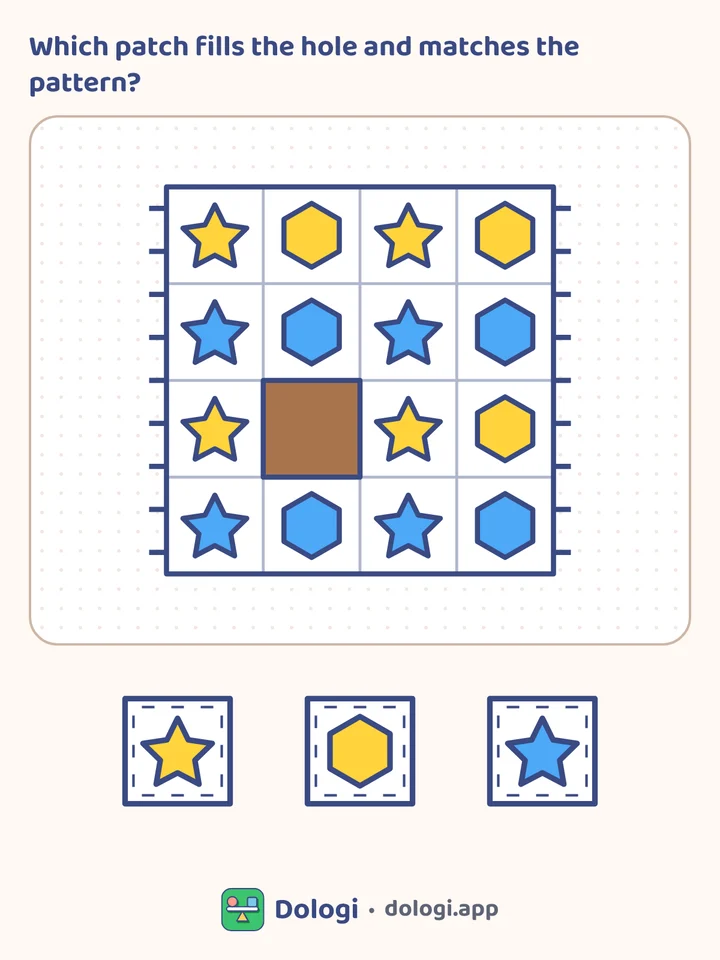
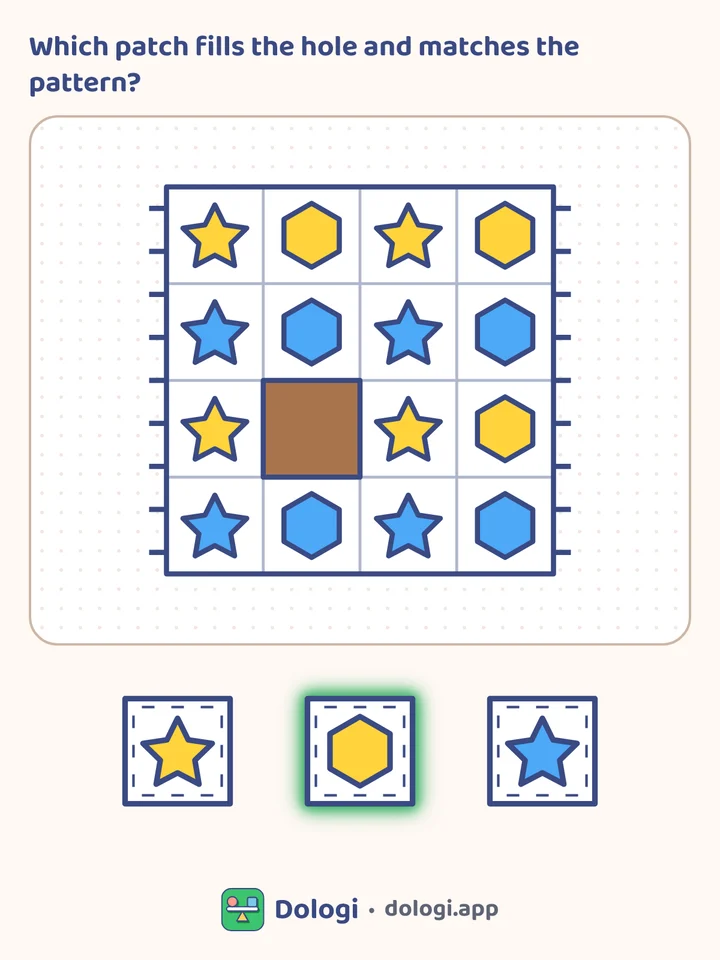
Ages 5–6
What it builds: The carpet follows two rules at once, one along the rows and one down the columns; your child looks across for the color and down for the shape of the missing patch. Holding two conditions in mind at the same time helps with reading timetables and calendars and choosing things that meet two requirements. Keep playing: on squared paper, color a row in two alternating colors with your child, use different colors on the next row, then cover one square for them to guess.
Hint: Look at the rows and columns next to the hole. The pattern repeats.
Puzzle 5: Pattern grid
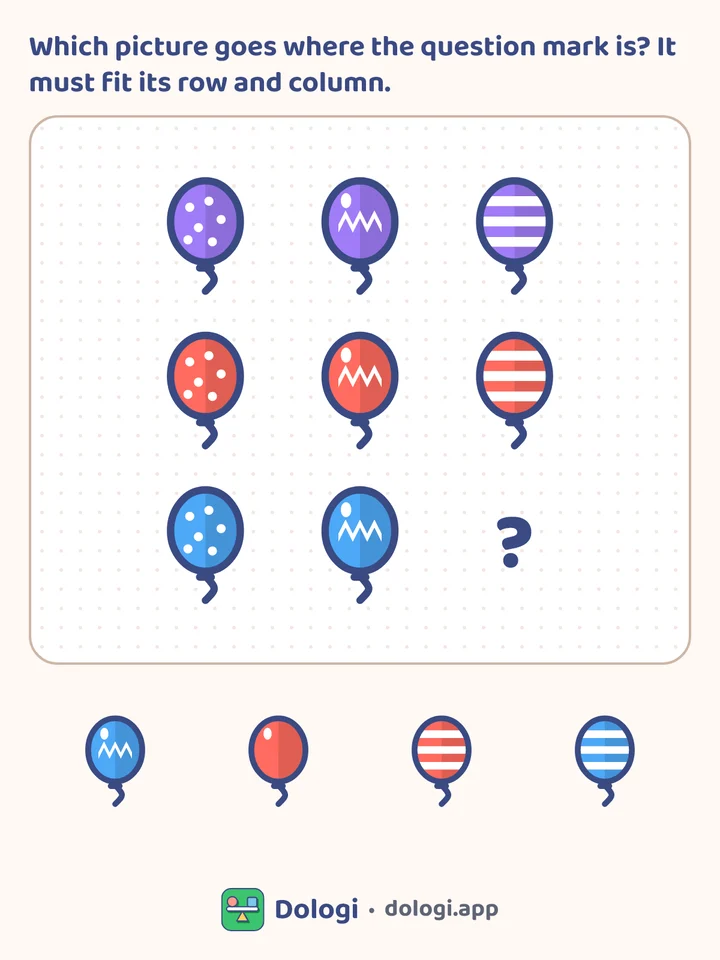
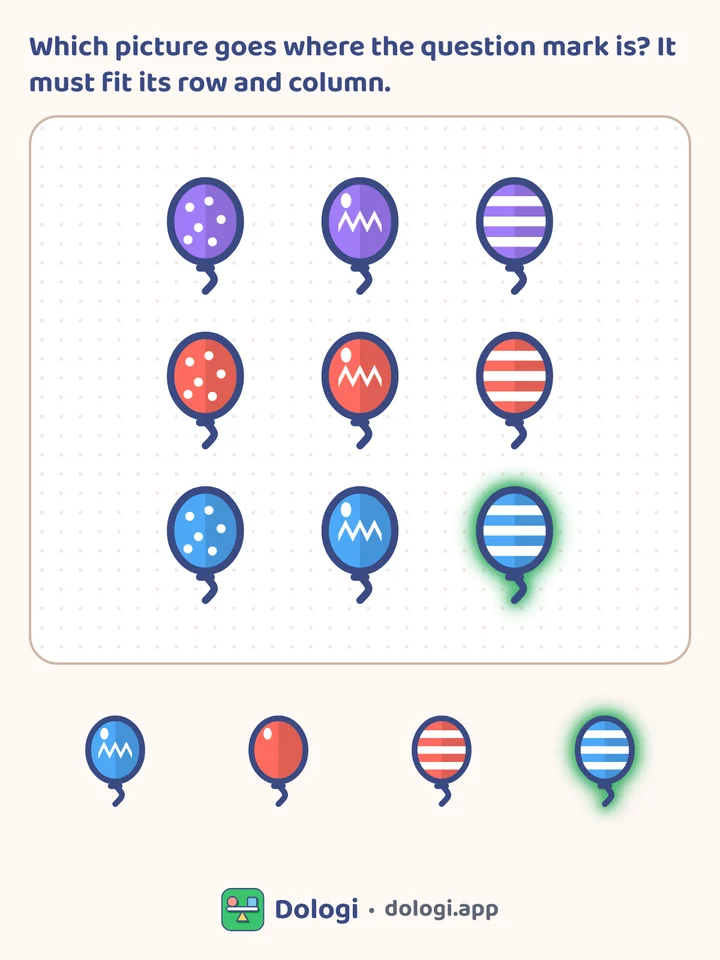
Ages 5–6
What it builds: Each balloon has two features, color and pattern; your child looks for what stays the same along a row and what stays the same down a column, then picks the balloon that fits both. This is the thinking behind sorting tables, which they will meet again when grouping and reading charts at school. Keep playing: arrange toys in three rows and three columns, one color per row and one kind per column, then take one away and let your child find where it goes.
Puzzle 6: How did it change?
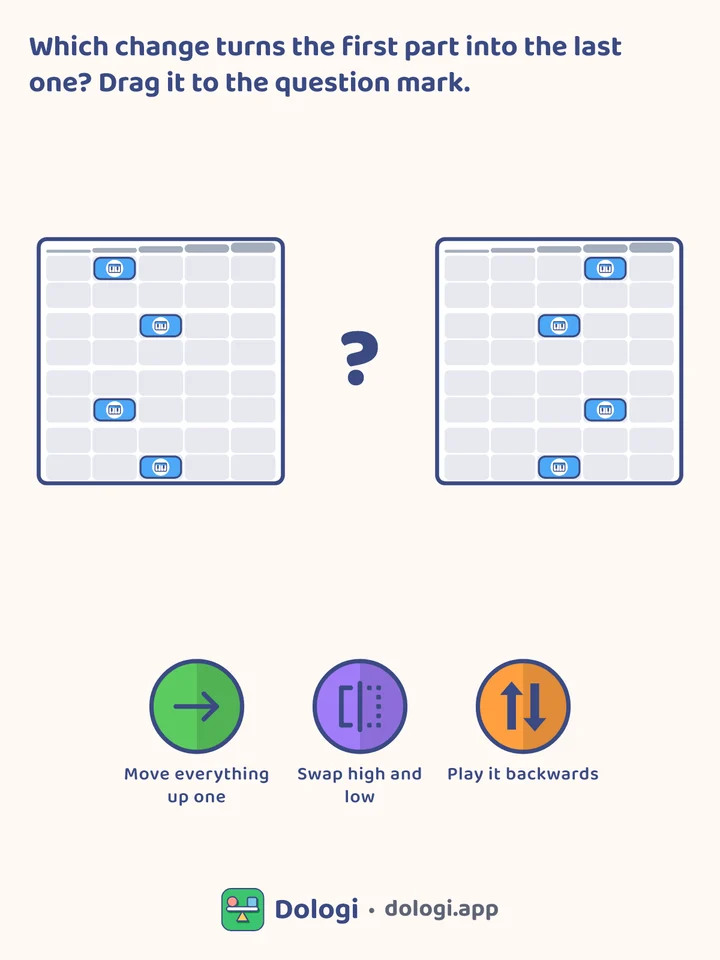
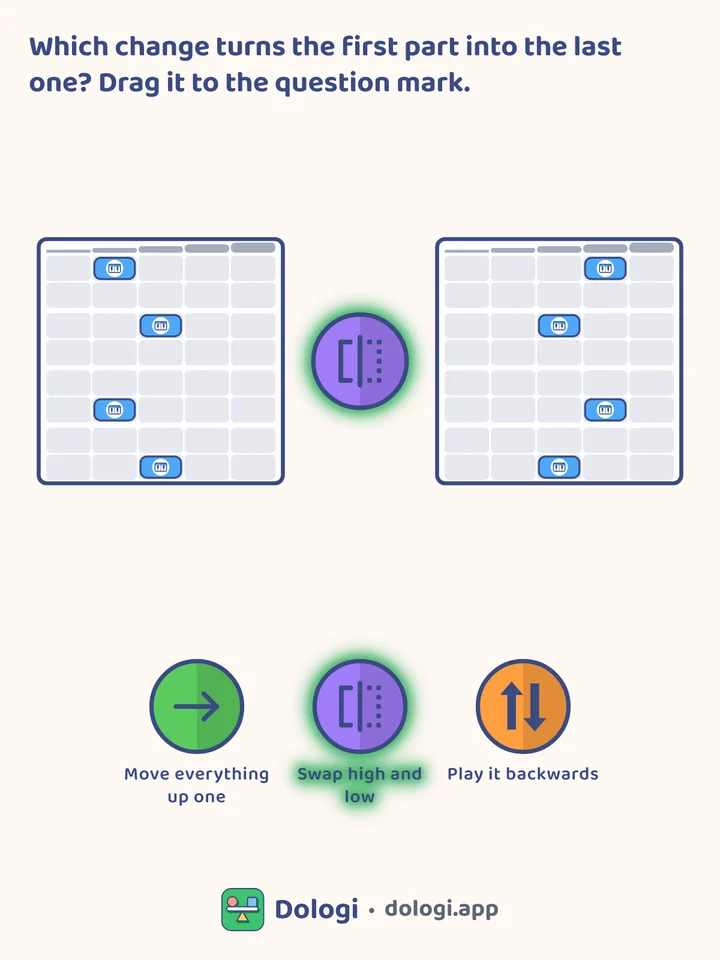
Ages 5–6
What it builds: Your child compares each note in the first part with the last: did it stay in its row or move to another, and which column is it in now? Then they choose the change that does exactly that. Looking at a before and an after to work out what happened is the thinking they use when comparing two pictures, finding mistakes and, later, in science. Keep playing: line up three toys, have your child look away while you reverse the order or swap left and right, then let them guess what you did.
Puzzle 7: Going around
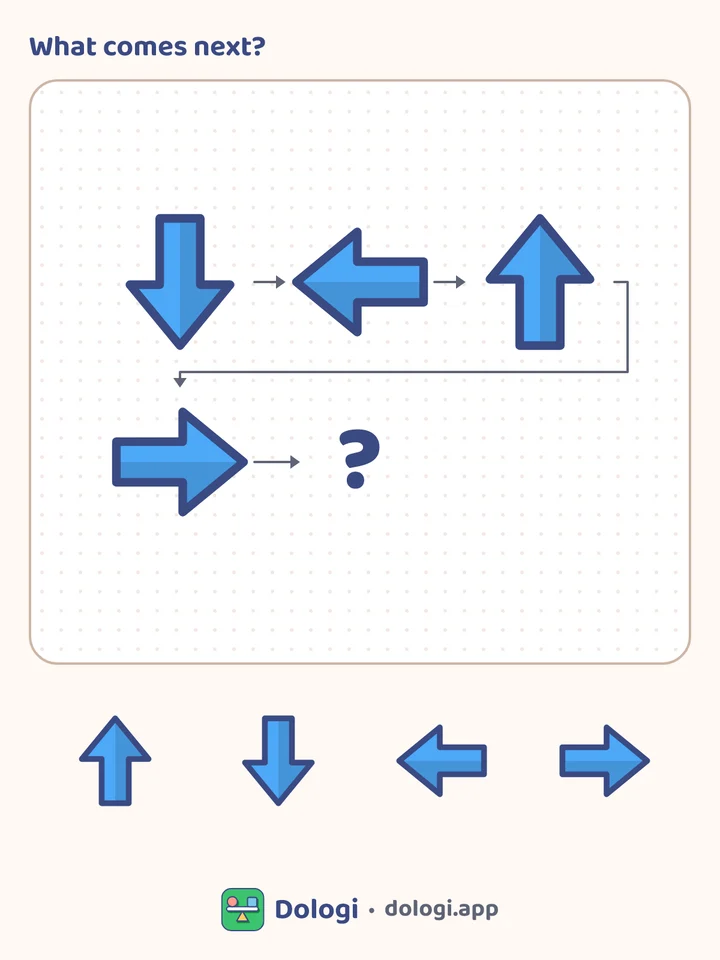
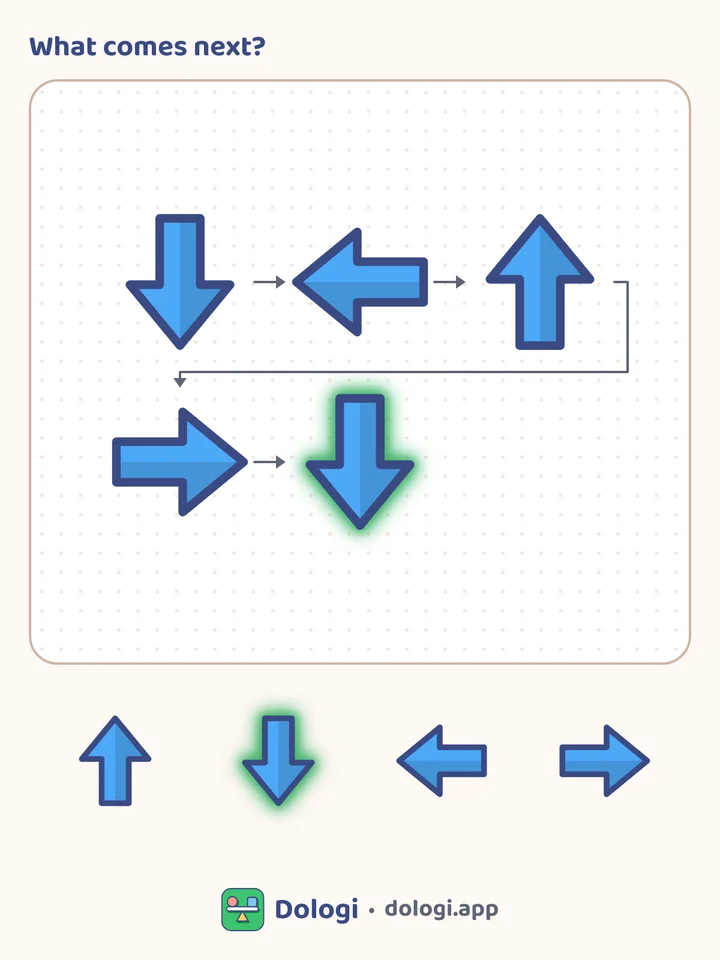
Ages 5–6
What it builds: The arrow changes direction at every step, always turning the same way; your child traces each arrow with a finger, says its direction out loud and feels which way it turns before choosing. Seeing a steady turn helps them understand how clock hands move, tell left from right and take the right turn on a walk. Keep playing: put a slipper in the middle of the floor, turn its toe a quarter turn the same way each time, and let your child predict where it will point next.
Puzzle 8: What comes next?
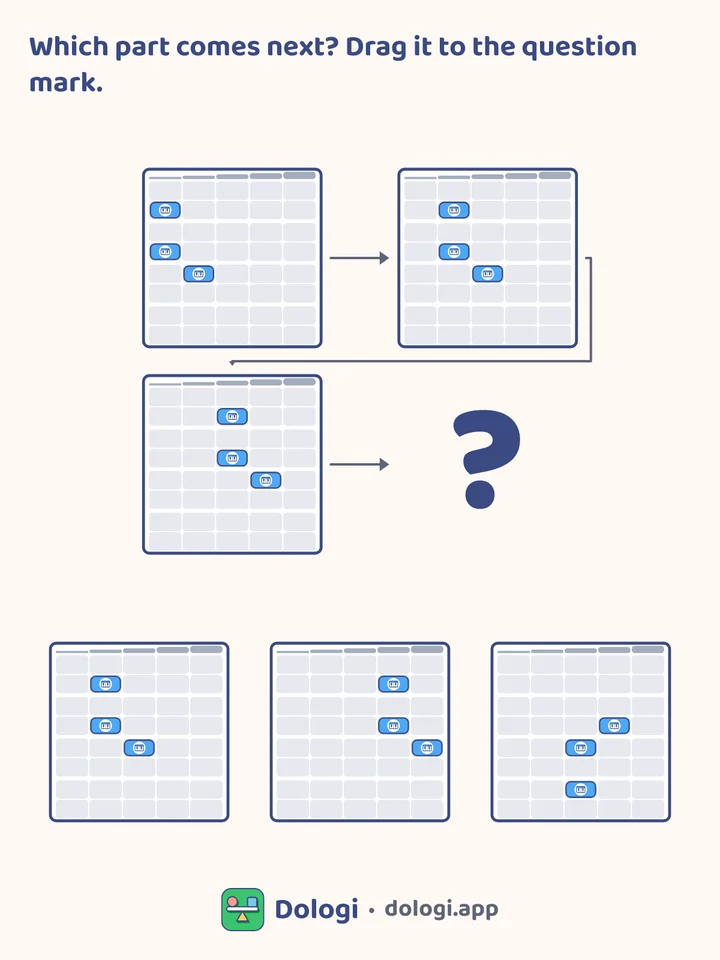
Ages 5–6
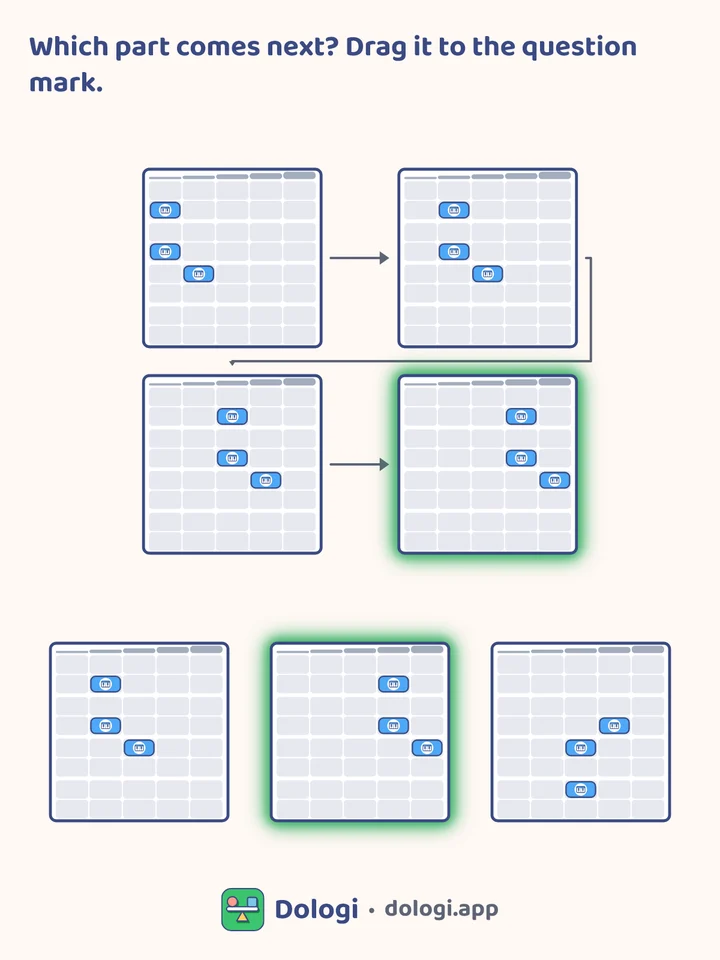
What it builds: The first three song parts show the whole group of notes moving the same way each time; your child compares part 1 with part 2 and part 2 with part 3, then imagines one more move. Picturing a group of things moving together is an early step in spatial thinking and helps them copy shapes and draw from a model more accurately. Keep playing: put three coins on squared paper, slide all three one square in the same direction each turn, and let your child make the next move.
Hint: Compare part 1 with part 2: where did the notes move?
Puzzle 9: Next key
Ages 5–6
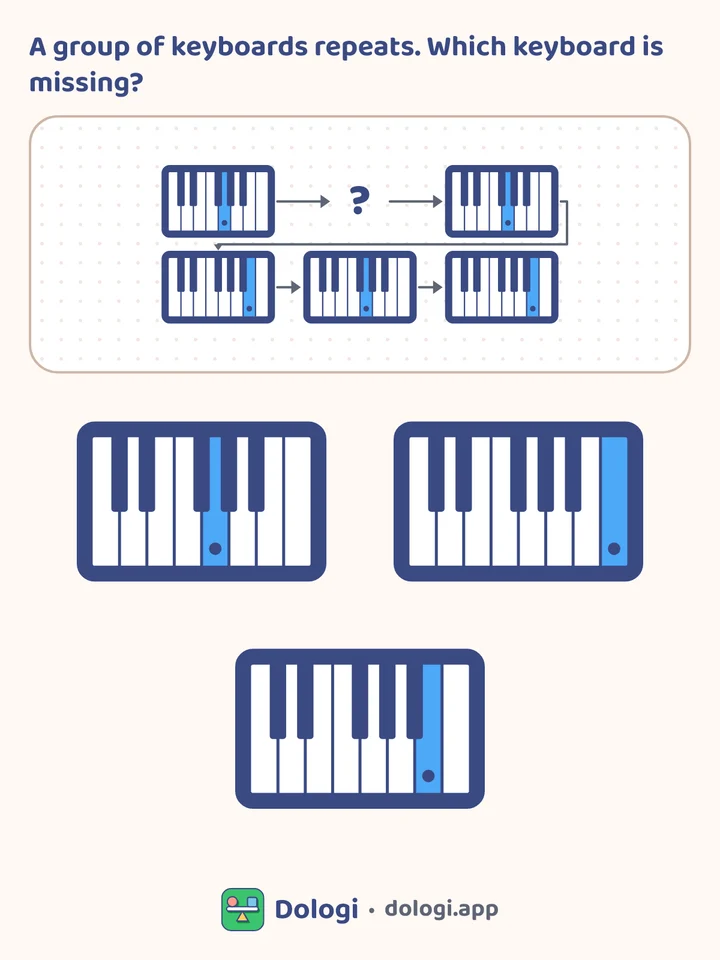
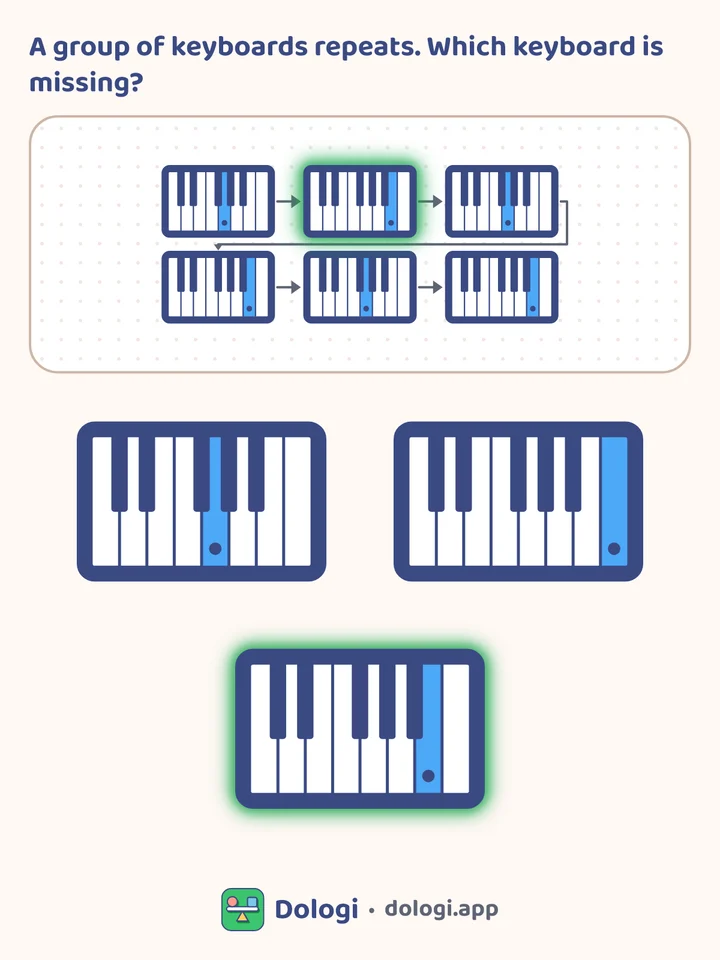
What it builds: A group of keyboards appears and then repeats; your child finds that group among the other keyboards, counts which white key the colored key is on, and fills the gap so the group is complete. Finding the repeating part of a sequence helps them learn songs and rhymes by heart and remember the familiar steps of the day. Keep playing: line up spoons and chopsticks in a repeating group, hide one in the middle and ask your child which one was taken.
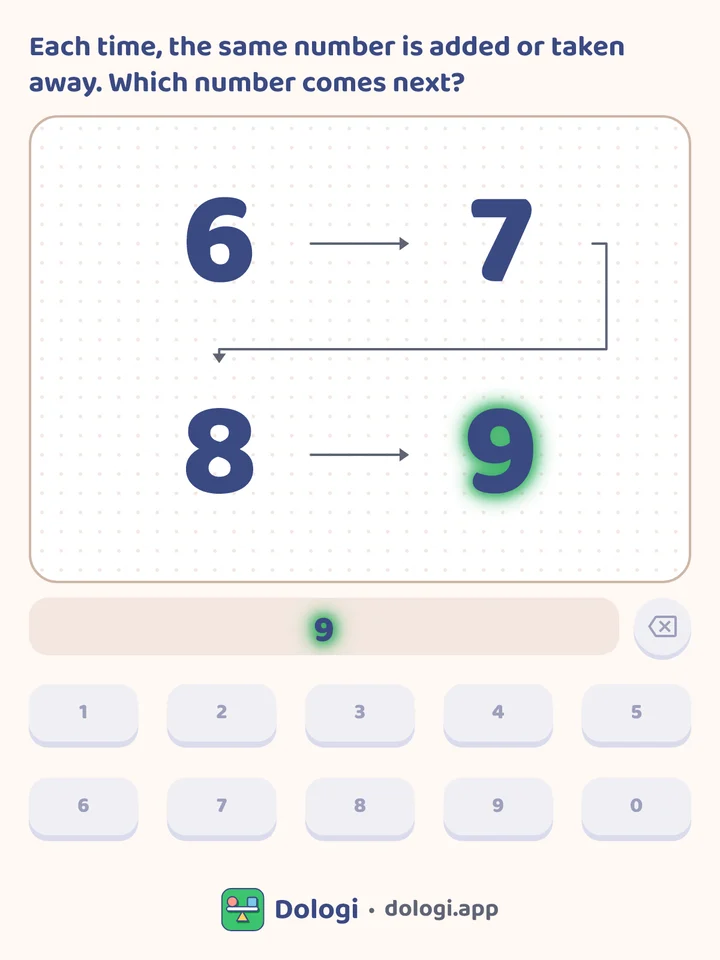
Puzzle 10: Next number
Ages 5–6
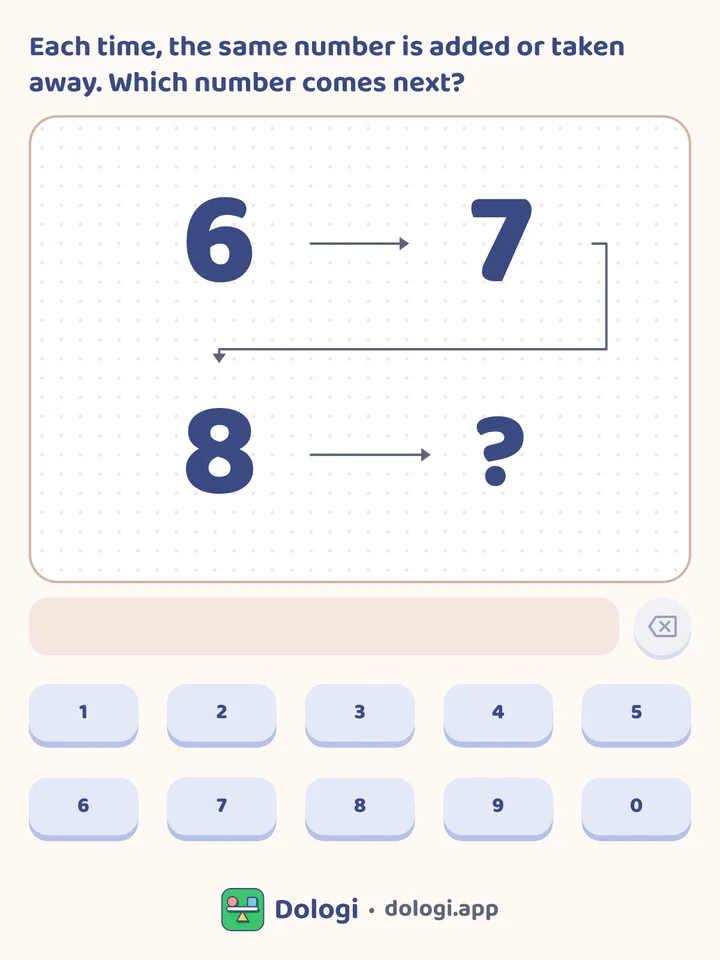
What it builds: Your child looks at two numbers side by side to see how much they go up or down each time, then types the next number on the number pad. There are no ready-made choices here, so they have to come up with the number themselves and recognize the right digit, one step closer to writing numbers on their own. Keep playing: in a lift or on the stairs, read the floor numbers together as they come and guess the next one before you get there.
Does your child enjoy finding patterns? The Dologi app has many more puzzles of these kinds: longer rows of pictures, songs with more notes and grids with more rows and columns. The puzzles get harder with age and with how your child plays, so they can practice a little each day without getting bored.