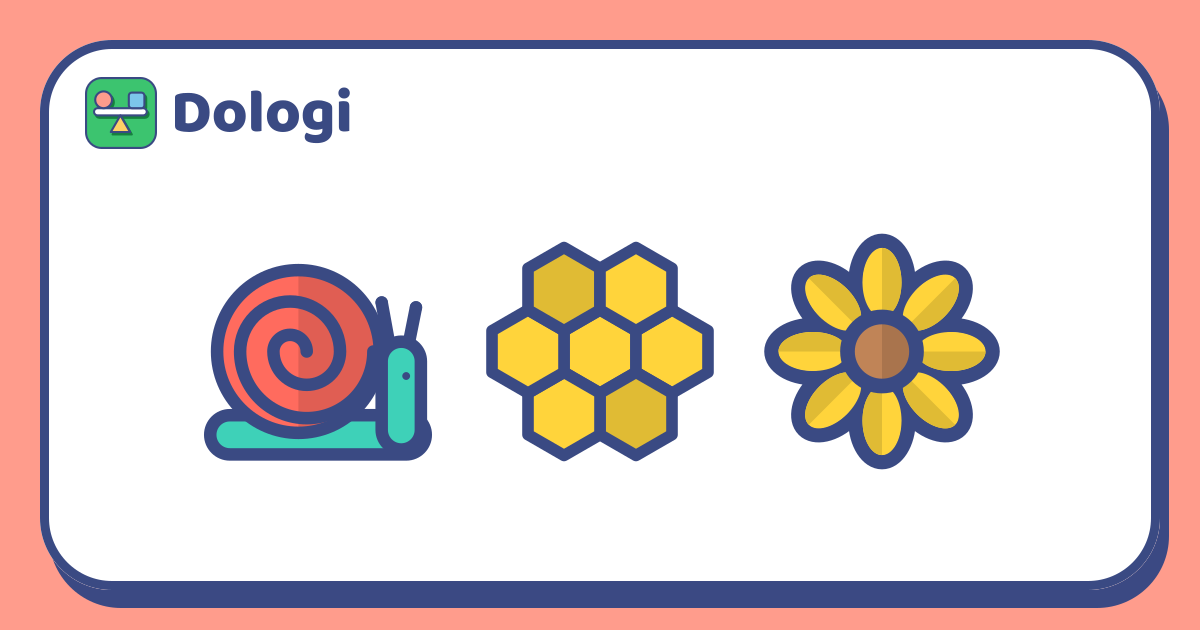
A snail's shell curls round and round. The cells of a honeycomb are all the same six-sided shape. A sunflower's seeds sit in curving lines that sweep out from the middle. Once you start looking, nature is full of patterns, and children are very good at spotting them.
Looking for patterns outdoors combines observation, counting and asking "why?" It needs nothing but a walk, a park or a garden, and maybe a magnifying glass.
Why look for patterns in nature
- Patterns help us predict. If petals repeat, you can guess where the next one is. If the days get shorter in autumn, you can guess what comes next.
- Counting and comparing. "This flower has five petals, that one has eight." Nature gives endless things to count.
- Questions. Why are honeycomb cells six-sided? Why do snail shells curl? Children don't need the full answers to enjoy wondering.
- Careful looking. Many patterns only appear when you slow down and look closely.
Spirals
- Snail shells. Follow the spiral with a finger from the middle to the edge. Does it turn the same way on every snail you find?
- Pine cones. Look at the base of a pine cone: the scales form spirals going in two directions.
- Sunflowers. In a ripe sunflower head, the seeds sit in curving lines that spiral out both ways.
- Ferns and some plants. Young fern leaves often unroll from a tight curl.
Draw a spiral together, starting in the middle and going round and round, getting wider each time.
Hexagons
Honeycomb cells are hexagons: six sides, six corners. Hexagons fit together with no gaps, like tiles on a floor. Squares and triangles can do that too, but circles can't: try drawing circles side by side and look at the gaps.
At home, try fitting coins together (gaps) and then paper hexagons (no gaps). Count the neighbours: each hexagon in the middle of a honeycomb touches six others.
Counting petals, and a famous sequence
Look at flowers in a garden or park (without picking them) and count the petals. Make a little table in a notebook with three columns: the flower, the number of petals, and whether every flower of that kind has the same number.
Many flowers have three, five or eight petals. Older children may enjoy a famous number sequence: 1, 1, 2, 3, 5, 8, 13… Each number is the two before it added together. Some of these numbers turn up again and again in petals and in the spirals of pine cones and sunflowers. Can your child continue the sequence?
Stripes, spots, branches and cycles
- Stripes and spots. Zebras, tigers, ladybirds, some caterpillars. Are the spots the same on both sides?
- Branches. A tree trunk splits into branches, which split into smaller branches, then twigs. Leaf veins do the same. So do rivers on a map.
- Cycles in time. Day and night, the shape of the moon over a month, the seasons over a year. These are patterns that repeat in time rather than in space.
Keep a moon diary for a month: draw the moon's shape each evening you can see it, and look at how it changes.
A pattern walk
Take a short walk with one mission: find patterns. Bring a notebook or take turns pointing them out. Ages are rough guides; every child is different.
- Around 4–5: find stripes, spots and things that repeat; count petals together.
- Around 6–7: look for spirals and hexagons, record petal counts, draw what you found.
- Around 8 and up: compare flowers of the same kind, explore the number sequence, keep a moon diary.
In Dologi, the Patterns topic has puzzles like "Repeating patterns" and "More and fewer", where children find the rule and choose what comes next. A nice follow-up after a pattern walk outdoors.
In short
- Nature is full of patterns: spirals, hexagons, stripes, spots, branches and cycles.
- Look closely at snail shells, pine cones, honeycombs and sunflowers, and count petals.
- Older children can explore the number sequence that appears in some plants.
- Take a pattern walk and let your child record and draw what they find.
Read more: Symmetry in nature: leaves, butterflies and flowers