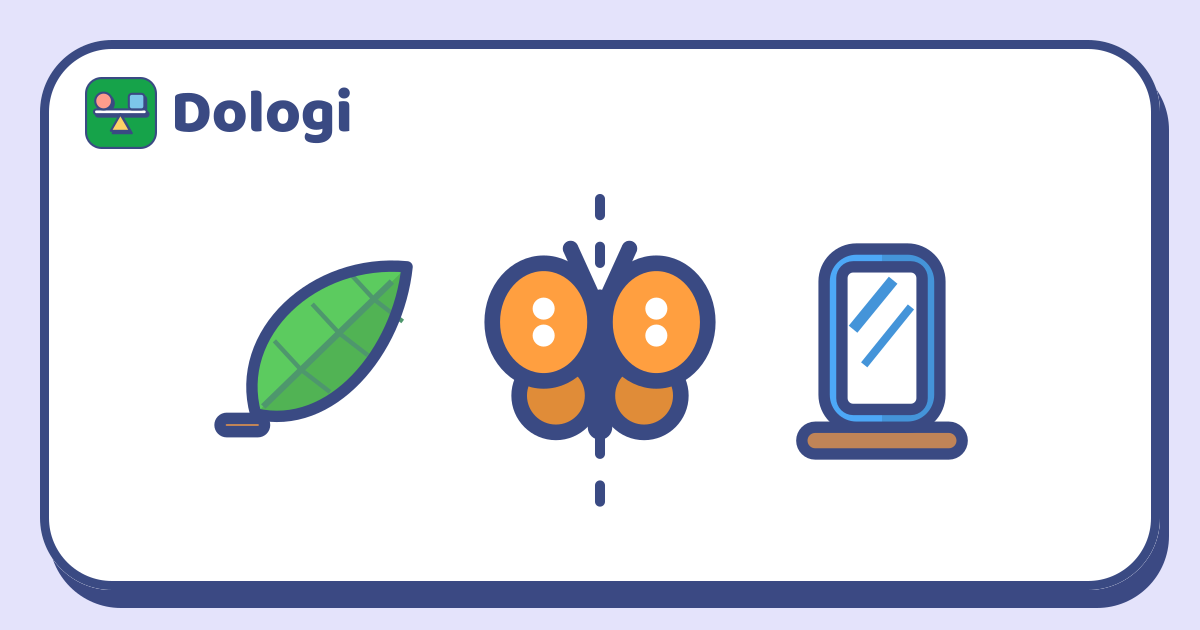
Look closely at a butterfly and you'll notice something: the left wing is almost exactly like the right one. The same is true of many leaves, faces, beetles and flowers. Children notice this pattern early, and a simple "symmetry hunt" turns that curiosity into real spatial thinking.
This post explains symmetry in words children understand, gives you two easy ways to test it, and suggests a walk or a garden hunt you can do in twenty minutes.
What symmetry means
For young children, the easiest explanation is: if you could fold it down the middle, the two halves would match. The fold line is called the line of symmetry.
- A butterfly has one line of symmetry, down the middle of its body.
- Many leaves have one, along the central vein.
- A square has four, and a circle has endless lines of symmetry.
You don't need the words straight away. Start with "the same on both sides", then introduce "line of symmetry" once your child has found a few examples.
Two ways to test it
Children believe what they can check. Here are two simple tests.
The fold test. Draw or trace a shape on paper, cut it out and fold it. If the edges meet all the way round, the shape is symmetrical along that fold. This works well for leaves pressed flat or for drawings of things you found.
The mirror test. Stand a small mirror upright along the middle of a leaf, a picture or a toy. Look into the mirror: if the half in front plus its reflection looks like the whole object, the line you chose is a line of symmetry. Then try the mirror in a different position and see what happens.
The mirror test is especially fun with a picture of a face or a butterfly: children are surprised that half a picture can "become" a whole one.
A symmetry hunt
Take a short walk in the garden, a park or even around the house, and look for things that are the same on both sides.
| Where to look | Things you might find |
|---|---|
| Garden or park | Leaves, butterflies, beetles, some flowers, feathers |
| Kitchen | A cup, a fork, an apple cut in half from top to bottom |
| Around the house | Doors, windows, chairs, a ball |
| Your own body | Eyes, ears, hands held side by side |
Collect fallen leaves, take photos or make quick drawings. Back home, test your finds with a mirror or a fold.
Round symmetry: flowers and starfish
Some things are symmetrical in a different way. A daisy, a sliced orange or a starfish looks the same when you turn it a little, not only when you fold it. This is called rotational symmetry, or round symmetry.
- Count the petals of a flower or the segments of an orange.
- Turn a picture of the flower slowly: when does it look exactly the same again?
- Compare: does a butterfly look the same if you turn it upside down?
This comparison is a great thinking exercise for children around 7 or older: "Which things can you fold to match, which can you turn to match, and which can do both?"
Look for what isn't symmetrical
Nature is rarely perfect. A leaf may have a bite taken out of it, one wing may be torn, a flower may have one petal missing. Looking for these differences is just as useful:
- "Is this leaf exactly the same on both sides? What's different?"
- "Which things in the kitchen are not symmetrical?" A teapot with a spout on one side, a pair of scissors, a mug with a handle.
- "Is your face perfectly symmetrical? Look in the mirror." (Nobody's is.)
Spotting the small differences trains careful observation and stops children assuming "nearly the same" means "exactly the same".
In Dologi, "Mirror painting" puzzles ask children to colour the other half of a picture so it matches across the line, the same idea as the mirror test at home, on a grid.
In short
- Symmetry means the two halves match when you fold something down the middle.
- Test it with a paper fold or a small mirror standing on the line.
- Go on a symmetry hunt outdoors, in the kitchen and around the house.
- Compare fold symmetry with the round symmetry of flowers, and look for what isn't symmetrical too.
Read more: Grid drawing and symmetry for children: copy, mirror and fold to check