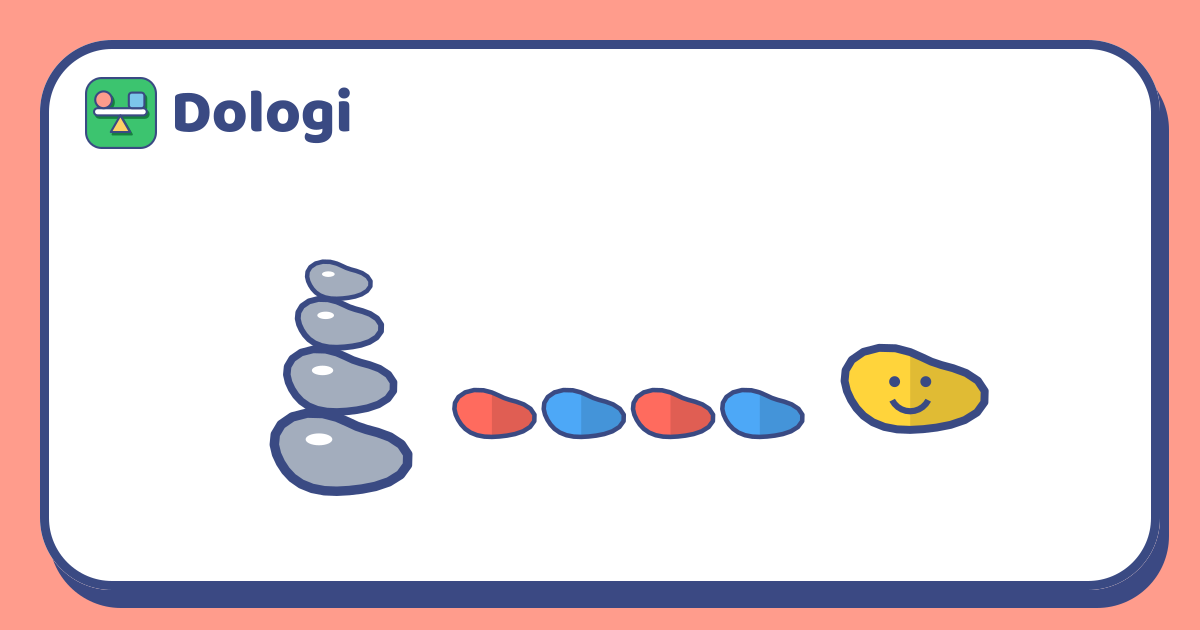
"This one's the biggest. This one's the smoothest. And this one looks like a potato!"
Pebbles are free, sturdy and endlessly varied. A small bag collected on a walk or at the beach can become a sorting set, a counting set, a building set and an art project. Here are some ways to play with them, from simple sorting for younger children to pattern puzzles for older ones.
Collecting and cleaning
- Collect only where it's allowed, and only a small handful. Some beaches and parks ask visitors to leave stones where they are.
- Wash the pebbles at home in a bowl of soapy water. Children love scrubbing them.
- Small pebbles are a choking risk for babies and toddlers, so keep them away from younger siblings.
Sorting and putting in order
Pebbles differ in many ways at once, which makes them perfect for sorting.
- By size: big, medium, small. Then line them up from smallest to largest.
- By colour: grey, white, reddish, striped.
- By feel: smooth or rough, flat or round.
- By weight: hold two pebbles, one in each hand. Which is heavier? Is the biggest always the heaviest?
Ask your child to invent a sorting rule, then guess each other's rules: "Why did you put these together?"
Counting and groups
- Count the collection, then count it again in groups of five or ten. Which way is quicker?
- Make two piles and ask: "How many altogether?" Then take some away: "How many are left?"
- Line pebbles up as a number track: one pebble, two pebbles, three pebbles…
- Estimate first: "How many pebbles do you think are in the bowl?"
Stacking towers
Balancing pebbles is harder than stacking blocks, and that's what makes it interesting.
- How many pebbles high can you build before it falls?
- Does it work better with the biggest at the bottom? Try it the other way round.
- Which pebbles are good for stacking? Usually the flat ones. Children discover this by trying.
Each fall is a small experiment: what made it topple?
Painting and patterns
Painted pebbles open up even more games. Use paint or markers that work on stone, and let them dry well.
- Pattern stones. Paint pebbles in two or three colours and make repeating lines: red, blue, red, blue. Start a pattern and let your child continue it, then make it harder: red, red, blue, red, red, blue.
- Dot stones. Paint dots from one to ten for counting games and matching numbers to quantities.
- Picture stones. Paint a sun, a house, a cat, a tree. Pick three at random and tell a story that uses all three.
- Face stones. Happy, sad, surprised, sleepy: a nice way to talk about feelings.
Pebble pictures
Arrange pebbles on the ground or a table to make a picture: a fish, a house, a flower. Then:
- Make a picture and ask your child to copy it exactly next to yours.
- Make it bigger: copy the same picture with twice as many pebbles.
- Take a photo, mix up the pebbles, and rebuild the picture from memory.
| Rough age | What to try |
|---|---|
| 3–4 | Washing pebbles; sorting into big and small; simple towers |
| 5–6 | Lining up from smallest to largest; counting in groups of five; AB patterns |
| 7–8 | Heavier or lighter, then checking; harder patterns; copying pebble pictures |
| 9 and up | Inventing sorting rules for others to guess; making a picture bigger; picture-stone stories |
Ages are only a rough guide, and every child is different.
In Dologi, "Repeating patterns" puzzles in the Patterns topic ask children to find the part that repeats and choose what comes next, just like continuing a line of painted pebbles.
In short
- A small handful of washed pebbles makes a free sorting, counting and building set.
- Sort by size, colour, feel and weight; line them up in order and compare.
- Towers that topple are experiments: flat stones and big bases work best.
- Painted pebbles add patterns, number games, stories and pictures to copy.
Read more: Patterns in nature: snail shells, honeycombs and sunflowers