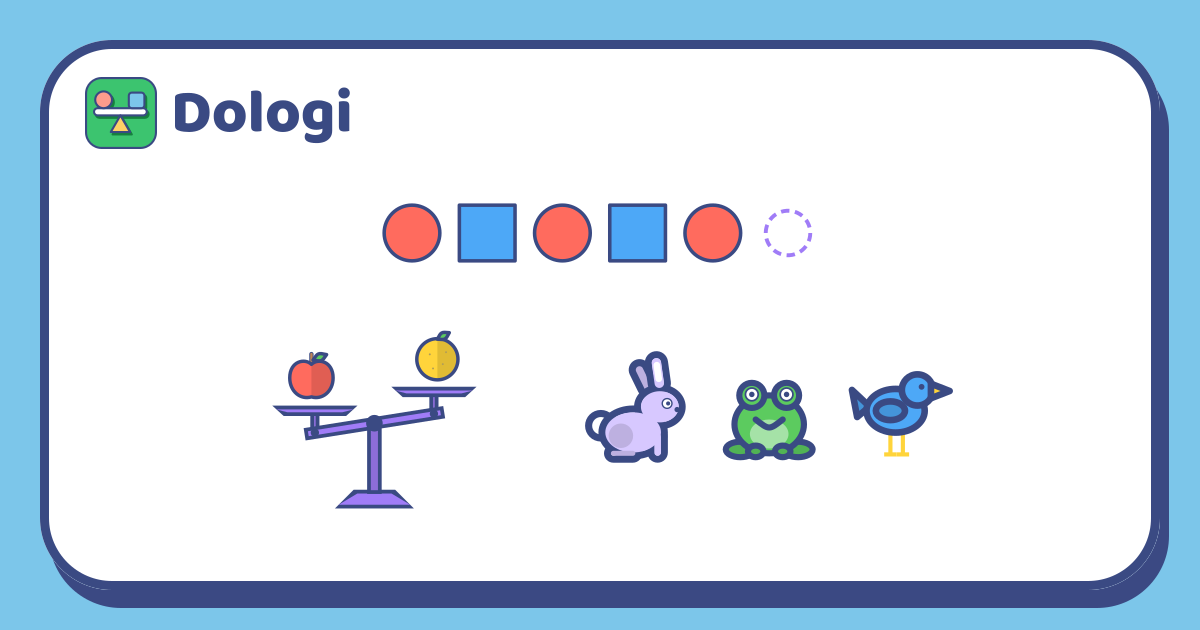
Around six or seven, many children can count confidently to 20, are starting to read short sentences, and love being asked something "a little bit harder". It is also a good age to move from "seeing" the answer to "explaining" it: not just pointing at the right picture, but saying why. Every child develops at their own pace, so treat these ages as a rough guide.
This post has twelve puzzles in three groups: patterns, balance scales, and lining up. Within each group, every puzzle is a little harder than the one before. You can sketch them on paper in a minute or two, or set them up with real things: fruit, soft toys, bottle caps. At the end you will find stepped hints and the answers with short explanations to talk through together.
Four pattern puzzles
Draw the row on paper and leave an empty box at the end. Your child says or draws what is missing.
| Puzzle | What to draw | What to ask | Skill it builds |
|---|---|---|---|
| 1 | Eight boxes: red circle, red circle, blue circle, red circle, red circle, blue circle, red circle, empty box | "What colour goes in the empty box?" | Spotting the part that repeats |
| 2 | Five groups of dots: 1 dot, 3 dots, 5 dots, 7 dots, empty group | "How many dots come next?" | Seeing a row that grows evenly |
| 3 | Star, 1 circle, star, 2 circles, star, 3 circles, star, empty box | "What comes after the last star?" | A growing pattern |
| 4 | Red circle, blue square, red triangle, blue circle, red square, empty box | "Which shape, and which colour?" | Tracking two changes at once |
Puzzle 4 is the hardest of the group: the shape goes round in a cycle of three (circle, square, triangle) while the colour goes round in a cycle of two (red, blue). If your child only watches one of them, they will get half the answer.
Four balance scale puzzles
Draw a two-pan balance: the pan that goes down holds the heavier thing, and level pans mean the same weight. With a coat hanger, two small bags and some string, you can even make a real one to try things out.
| Puzzle | What the balance shows | What to ask | Skill it builds |
|---|---|---|---|
| 5 | An apple in the left pan goes down, an orange in the right pan goes up | "Which fruit is heavier?" | Reading a balance |
| 6 | First balance: the apple is heavier than the orange. Second balance: the orange is heavier than the lemon | "Which fruit is the heaviest? Which is the lightest?" | Linking two facts |
| 7 | Level balance: one box on one side, two balls on the other | "Two boxes weigh the same as how many balls?" | Doubling both sides |
| 8 | Level balance: a pear and three marbles on the left, a pear and a box on the right | "The box weighs the same as how many marbles?" | Taking the same thing off both sides |
Four "who is where" puzzles
Line up soft toys on the table so your child can see the front and the back of the line. For the harder ones, let them move the toys around.
| Puzzle | The clues | What to ask | Skill it builds |
|---|---|---|---|
| 9 | The rabbit is in front of the bear. The bear is in front of the duck | "Who is at the front? Who is at the back?" | Ordering from clues |
| 10 | Five animals stand in a line. The cat is second from the front | "Counting from the back, where is the cat?" | Counting from both ends |
| 11 | The bear is third from the front and also third from the back | "How many animals are in the line?" | Drawing it to see it |
| 12 | The rabbit, the bear and the duck stand in a line. The duck is not at the front or the back. The rabbit is right behind the duck | "Who is at the front?" | Starting from the clue you are sure of |
Stepped hints and "I know because…"
When your child is staring at the paper in silence, hold back the answer. Go one step at a time, and only move on when the step before is not enough:
- Read the puzzle again together. "Can you tell me what the balance is doing?" Children often get stuck because they missed one detail.
- Point to where to look. "Just look at the colours for now, forget the shapes." Or: "Which clue tells you something for sure?"
- Use real things. Line up the toys, put bottle caps on the paper, draw a dot for each animal. At this age, hands often work things out before heads do.
After every answer, right or wrong, invite your child to finish the sentence "I know because…". For example: "I know the apple is the heaviest because the apple is heavier than the orange, and the orange is heavier than the lemon." It helps them check their own thinking, and if the answer is wrong, it shows you exactly where they got stuck. When the answer is wrong but part of the reason is right, praise that part first, then look at the rest together.
In Dologi, the "Balance scales" puzzles in the Logic topic also put blocks on a two-pan balance, and children use which way the scale tips to work out which block is heavier, just like puzzles 5 to 8 above.
Answers and short explanations
- Red. "Red, red, blue" repeats. Box seven is the red that starts a new round, so box eight is red too.
- 9 dots. Each group has 2 more dots than the one before: 1, 3, 5, 7, 9.
- 4 circles. After each star, there is one more circle than last time.
- A blue triangle. The shapes go circle, square, triangle, so box six is a triangle. The colours alternate red, blue, so box six is blue.
- The apple. The pan with the apple went down, so the apple is heavier.
- The apple is the heaviest and the lemon is the lightest. The apple is heavier than the orange and the orange is heavier than the lemon, so the apple is heavier than the lemon too. You never need to weigh the apple against the lemon.
- 4 balls. One box weighs the same as two balls, so adding another box means adding two more balls.
- 3 marbles. Both sides have a pear. Take both pears off and the balance stays level, leaving three marbles on one side and the box on the other.
- The rabbit is at the front and the duck is at the back. The line is rabbit, bear, duck.
- Fourth. Draw five dots, circle the second one from the left, then count from the right: one, two, three, four.
- 5 animals. There are two animals in front of the bear and two behind it. Two plus one plus two is five.
- The bear. The duck is not at the front or the back, so it is in the middle. The rabbit is right behind the duck, so the rabbit is at the back. That leaves the bear at the front.
In short
- Six- and seven-year-olds can handle puzzles that need two things held in mind at once: two changes in one row, two balances, two ends of one line.
- When your child is stuck, set it up with real things: toys, fruit and bottle caps show what a drawing cannot.
- Give hints in steps, from rereading the puzzle to working it out by hand, instead of giving the answer.
- Ask "I know because…" after every answer, whether it is right or wrong.
Read more: Balance puzzles for children: reasoning about heavy and light