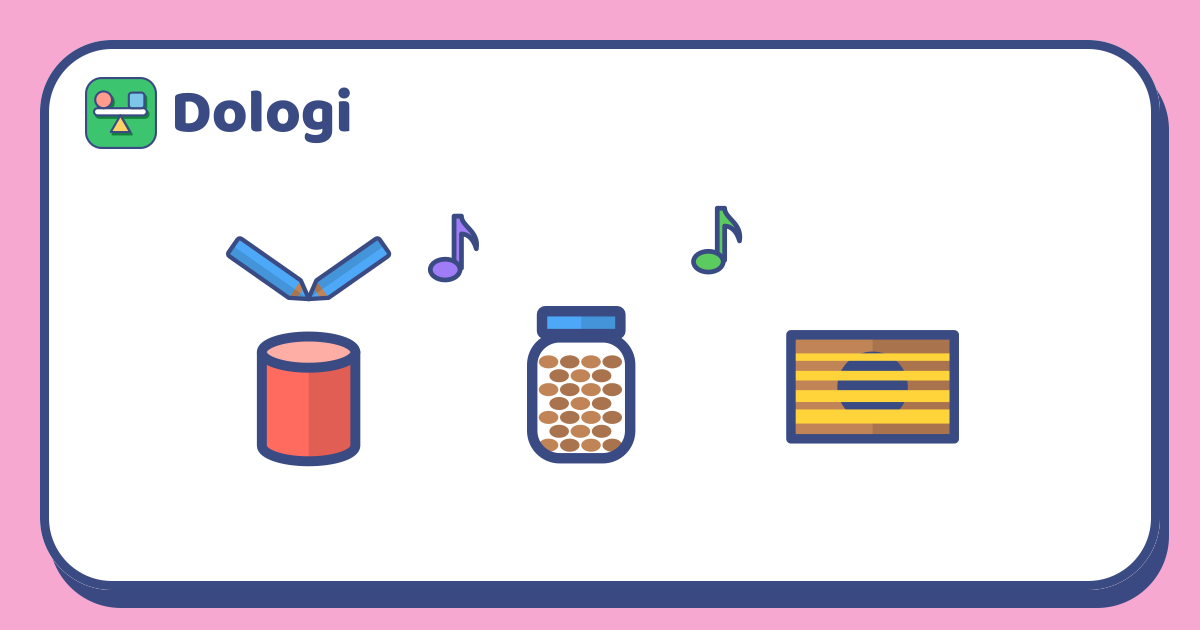
An empty tub, a handful of dry beans, a tissue box and a few rubber bands. Half an hour later you have a drum, a shaker and a guitar, and a child who wants to know why the thick band sounds lower than the thin one.
Making instruments from recycling is a craft and a listening game in one. Your child builds something with their hands, then has to listen carefully to what it does. Small changes, a few more beans or a tighter band, change the sound, and noticing those changes is the point.
Three instruments to make
The drum. Use an empty plastic tub or a cardboard tube with a lid, such as a container for oats or snacks. Tape the lid on firmly. Two pencils or wooden spoons are the sticks. A wide, flat lid gives a deeper sound than a small one.
The shaker. Put a small handful of rice, dry beans or pasta into a plastic bottle or tub. Screw the lid on tight and wrap it with tape. Use plastic rather than glass, and stay close by when young children handle small grains.
The rubber band guitar. Cut a round hole in the top of a shoebox or tissue box (adults do the cutting). Stretch four rubber bands of different thickness around the box, across the hole. Pluck them one at a time.
Rubber bands can snap. Show your child how to pluck them gently and keep faces away when stretching them on.
Experiments: what changes the sound?
Once the instruments are made, ask your child to guess before they try. "What will happen if…?" turns the instruments into small experiments.
| Try this | What usually happens |
|---|---|
| A few beans or a lot of beans in the shaker | Fewer beans give a lighter, clearer rattle; a full bottle sounds dull |
| Rice instead of beans | Rice sounds softer and more like rain |
| A thick band and a thin band | The thick band usually sounds lower |
| A loose band and a tight band | Pulling the band tighter makes the sound higher |
| Tapping the drum in the middle or near the edge | The middle often sounds deeper, the edge sharper |
| Soft taps and hard taps | Louder, but the same note |
Some results will surprise you, and that is fine. The habit that matters is guessing first and then listening to check.
Listening games with the band
- Which one was it? Your child closes their eyes. You play one instrument. Which one was it? Later, play two in a row.
- High to low. Put the four rubber bands in order from the highest sound to the lowest. Can your child find the highest one without looking?
- Loud and soft. Play the drum loud, then very soft. Your child copies, then leads.
- Stop and start. Everyone plays while you hold up your hand; when you lower it, everyone stops at once.
- The family band. Each person gets one instrument and plays a short rhythm in turn, then all together.
| Rough age | What to try |
|---|---|
| 4–5 | Decorating a drum and a shaker; loud and soft; guessing the instrument with eyes closed |
| 6–7 | The rubber band guitar with help; few beans or many; stop and start |
| 8–9 | Thick and thin, tight and loose bands; guessing before trying; putting sounds from high to low |
| 10 and up | Designing a new instrument; a table of results; tuning bands to play a short tune |
Ages are only a rough guide, and every child is different.
In Dologi, the Listening topic has puzzles such as "High or low", where children decide which of two sounds is higher. It's the same question your child asks when they pluck a thick band and a thin one.
In short
- A tub, a bottle of beans and a box with rubber bands make a drum, a shaker and a guitar.
- Use plastic, tape lids shut, do the cutting yourself and supervise small grains and stretched bands.
- Guess first, then listen: more beans, thicker bands and tighter bands each change the sound.
- Eyes-closed guessing, ordering sounds from high to low and a family band turn the instruments into listening games.
Read more: Clap it back: rhythm echo games for children