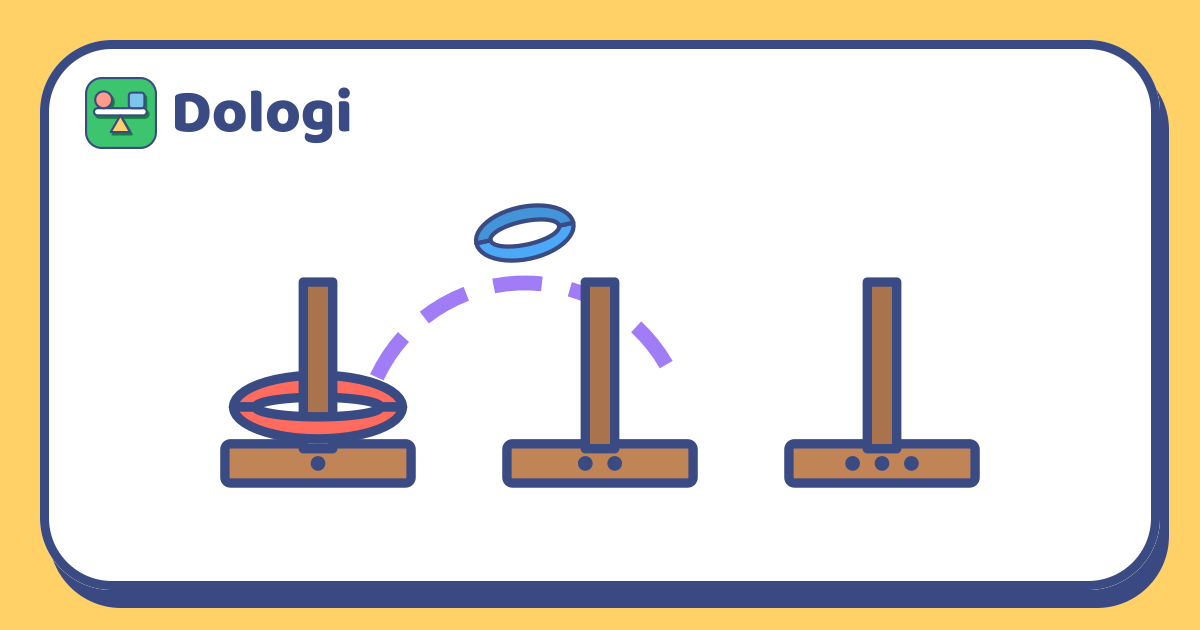
A ring leaves the hand, wobbles through the air and drops over the peg. Or it doesn't, and your child immediately wants another go.
Ring toss is a fairground classic that is easy to make at home. It trains the hand and the eye to work together, and it comes with built-in maths: every ring that lands is worth points, and the points have to be added up. There is even a small lesson about risk hiding in it.
Making the game
Rings. Cut the middle out of paper plates and you have light rings that can't break anything. Rings of thick rope taped into a circle, or rings cut from a cardboard box, work as well. Five rings are enough.
Pegs. Use what stands up by itself:
- plastic bottles with a little water or sand in the bottom,
- a kitchen roll holder,
- a stool turned upside down, which gives you four pegs at once.
The throwing line. A strip of tape on the floor. Start close, about three big steps from the nearest peg.
Stand three pegs in a line, one behind the other: near, middle and far.
How to play and score
Each player throws five rings in a turn. A ring only counts if it ends up over the peg.
| Peg | Points |
|---|---|
| Near | 1 |
| Middle | 2 |
| Far | 3 |
Mark the points on each peg with dots, as on the cover, so that children who can't read numbers yet can still keep score.
After five rings, add up the turn. Two rings on the near peg and one on the far peg make 1 + 1 + 3 = 5. Write it down with tally marks or numbers, play four or five rounds and find the total.
Older children quickly notice a shortcut: three rings on the middle peg are three twos, so 3 × 2 = 6.
Safe or risky?
Here is the question that turns a throwing game into a thinking game: "Which peg should you aim at?"
The near peg is easy but worth little. The far peg is worth a lot but hard to hit. Most children simply go for the far one. Suggest an experiment instead.
- Throw ten rings at the near peg and count the hits.
- Throw ten rings at the far peg and count the hits.
- Work out the points for each.
Suppose your child hits the near peg seven times and the far peg twice. That is 7 points against 6, so for now the "boring" peg wins. Next month, with better aim, the answer may change.
Children discover two things here: a big prize isn't worth much if you rarely get it, and you can find that out by collecting a few numbers rather than guessing.
Adjusting the difficulty
| To make it easier | To make it harder |
|---|---|
| Move the line closer | Move the line back |
| Bigger rings | Smaller rings |
| A wider gap between pegs | Pegs close together, so rings bounce off |
| Both hands | The hand you don't write with |
| Rough age | What to try |
|---|---|
| 4–5 | One peg, close up; counting the hits out of five |
| 6–7 | Three pegs worth 1, 2 and 3; adding up a turn; tally marks |
| 8–9 | The safe-or-risky experiment; running totals over five rounds |
| 10 and up | Different points for different colours of ring; working out exactly what you need to win |
Ages are only a rough guide, and every child is different.
Playing together
- Different lines for different players. A younger child throws from closer, an adult from further back.
- Team score. Add everyone's points and try to beat yesterday's family total.
- The thrower collects the rings. It keeps the game moving and gives everyone a short walk.
In Dologi, the Math topic has short picture puzzles about counting, comparing and adding small amounts. They fit well alongside games like this one, where the numbers come from something your child has just done.
In short
- Paper-plate rings and bottles as pegs are enough for a ring toss game.
- Near pegs are worth 1, the middle 2 and the far 3: add up five rings per turn.
- Test "safe or risky" with ten throws at each peg and compare the points.
- Adjust the distance, the ring size and the hand to keep the game just hard enough.
Read more: Bottle bowling: a home-made game for counting and adding