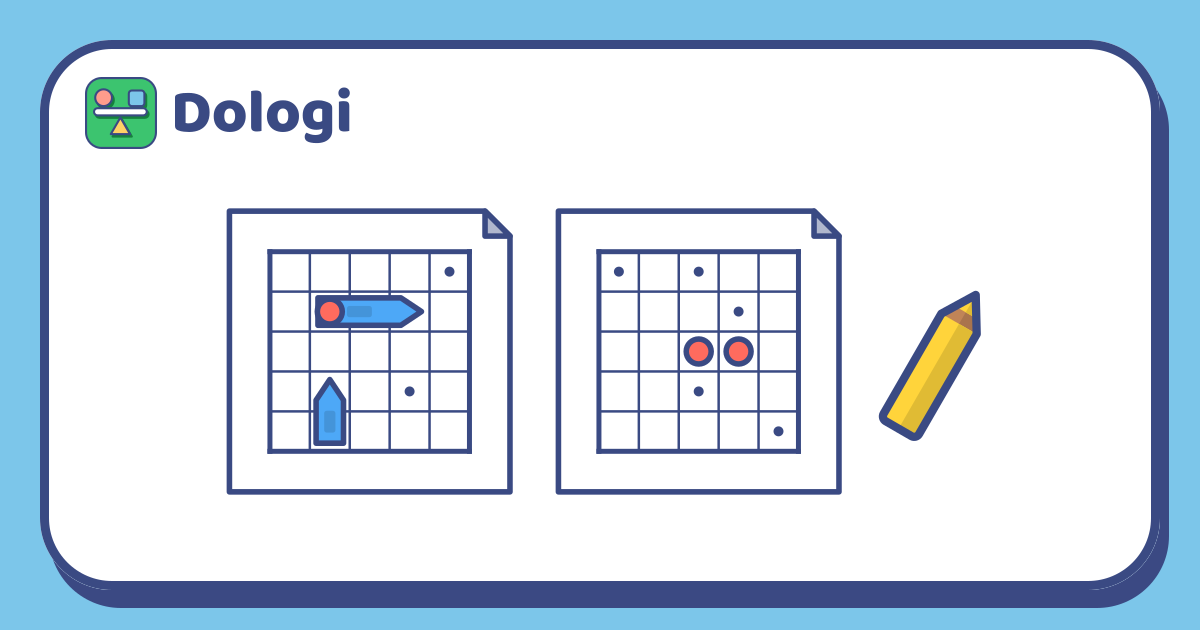
Your child has outgrown simple guessing games but still loves a proper match against a parent, with a winner and a loser. Sea battle on paper is that kind of game: each player hides a few ships on a grid of squares, then you take turns calling out a square to find where the other player's ships are.
All it takes is paper and a pencil, so it works at the table, in the car or in a waiting room. The best part is not the luck. It is the moment your child starts using the shots already taken to choose the next one. Below is how to set it up, how to play, and the questions that help your child reason, for children from about 7, plus an easier version for younger ones.
Setting up: two grids each
Each player draws two identical square grids on one sheet:
- My ships: where you hide your fleet and mark the shots the other player fires at you.
- My shots: where you record the shots you fire at the other player's grid.
Label the columns with letters A, B, C… and the rows with numbers 1, 2, 3… so every square has its own name: C4 is column C, row 4. Squared math paper is ideal. Stand a book up between you as a screen.
Pick a grid size that suits your child:
| Grid | Each player's fleet | Good for |
|---|---|---|
| 6 × 6 | one 3-square ship, two 2-square ships | first games, beginners |
| 8 × 8 | one 4-square ship, two 3-square ships, two 2-square ships | once naming squares feels easy |
| 10 × 10 | one 5, one 4, two 3 and one 2-square ship | longer games, older kids |
A ship is a straight line of squares, across or up and down, never diagonal. Many families add a rule that ships may not touch, not even at the corners. It makes the game easier to reason about, so agree on it before you start.
How a turn works
- The shooter calls a square, for example "D5".
- The other player checks their ship grid, answers "hit" or "miss", and marks that square on their ship grid.
- The shooter records it on their shots grid: a big dot for a hit, a small dot for a miss.
- When every square of a ship has been hit, its owner says "sunk" and how long the ship was.
- Swap turns. The first to sink the whole fleet wins.
Honest answers are the heart of the game. At the end, open both ship grids and check them together. If a square was called wrongly, treat it as normal and look together for where the slip happened.
Reasoning from the hits
At first everyone shoots at random. After a few games, show your child that every shot, even a miss, tells you something.
- One hit: the ship must run through one of the four squares next to it (above, below, left or right). No need to try the diagonals.
- Two hits side by side in a row: the ship lies across. The next shot goes at one end of that row, not above or below.
- Misses are information too: a gap fenced in by misses that is shorter than the smallest ship still afloat cannot hold a ship. Skip it.
- A sunk ship: if you play the no-touching rule, every square around it is empty. Your child can dot those in straight away and save shots.
Now and then, ask before your child calls a square:
- "Which squares can't possibly have a ship?"
- "Where could the 4-square ship still fit?"
- "Why this square and not the one next to it?"
They do not need the right answer at once. Saying the reason out loud already helps them look back at how they are thinking.
Shooting with a plan, hiding with a plan
Once the game feels familiar, talk through two more ideas.
Search in a checkerboard pattern. Imagine the grid shaded black and white like a chessboard. Every ship is at least 2 squares long, so it must cover at least one "black" square. Shooting only at black squares is enough to find every ship, and it uses at most half the shots. When the short ships have sunk, your child can space the shots out even more.
Hide ships so they are hard to guess. Everyone has habits: always along the edge, or all the ships bunched in a corner. Change the layout every game, and notice where the other player likes to hide. Your child will start thinking "if I were Dad, where would I put it?", which is a lovely step in reasoning.
Adjusting for age
- Around 6: a 5 × 5 grid with two 2-square ships each. Replace letters and numbers with a color at the top of each column and a shape at the start of each row (red column, star row). You can keep the shots grid for them.
- Want shorter games: a player keeps shooting while they hit and only passes the turn on a miss.
- Play as a team: you and your child share one fleet and discuss every shot, thinking out loud so your child hears how you reason.
- Older kids wanting a challenge: add an L-shaped or T-shaped island that takes up several squares, or fire three shots per turn before hearing any of the results.
Naming a square by its column and row is also a first step into coordinates, which your child will meet again on maps and in math lessons later.
If your family uses Dologi, the "Who lives where?" puzzles in the Logic topic practice the same kind of ruling-out: each clue card crosses off places that are impossible until only one fits.
In short
- Each player needs two grids: one to hide ships, one to record shots. Start with a 6 × 6 grid and a small fleet.
- A big dot is a hit and a small dot is a miss, and both help you choose the next square.
- Ask "which squares can't have a ship?" and "why this square?" so your child puts their reasoning into words.
- Adjust the grid, the fleet and the way squares are named to your child's age, and always check the grids together at the end.
Read more: The 20 questions game: guessing an object with yes-or-no questions