Every parent who plays chess with a seven-year-old hits the same dilemma. Play for real, and within a few moves you've taken half their pieces and their lip is trembling. Blunder on purpose, and they win, but in a strange way, and sometimes they ask straight out: "Did you let me win?"
You don't actually have to choose between "losing on purpose" and "playing all out." There are plenty of ways to make the game a good fit for your child while you still play for real and they still win for real. Here is each approach, and how to dial it back as your child grows.
Why both extremes tend to backfire
- Losing on purpose: kids catch on faster than parents think, especially when you hang your queen for no reason. A win like that teaches them nothing and can even feel a little insulting. And if every game is a gift, playing friends can come as a shock.
- Winning every time: if every game ends after ten moves, your child never sees themselves improving, gets bored and quits. Losing is normal, but losing over and over without knowing why stops being learning.
The goal is a game where your child has a real chance to win, thanks to their own thinking.
Giving odds: fair and the right size
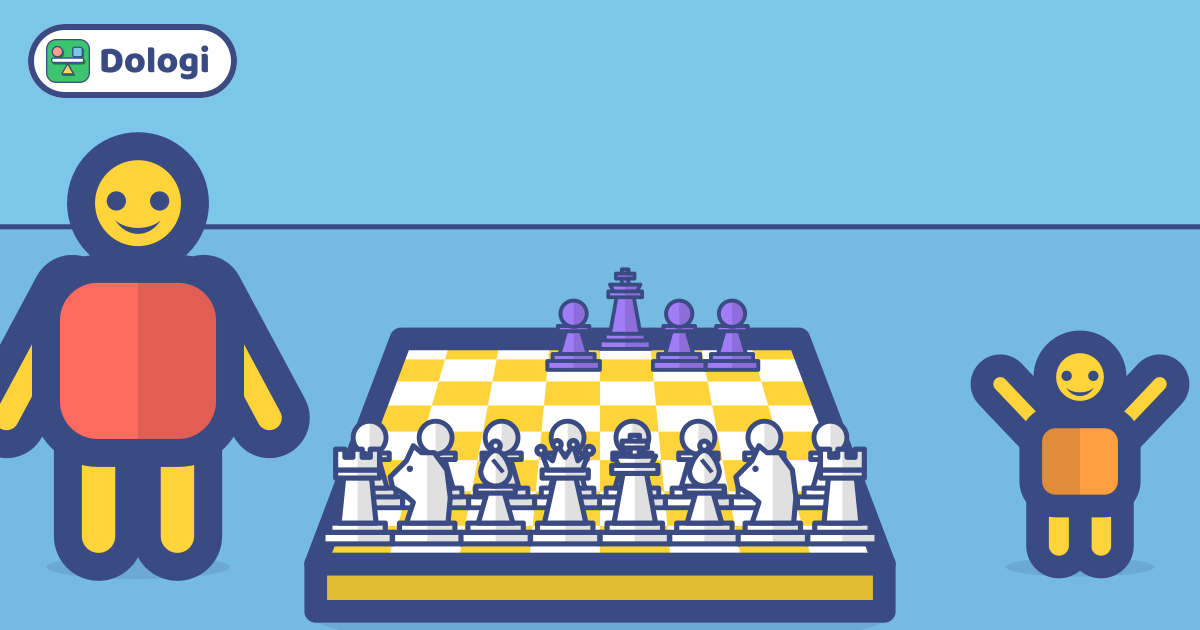
Giving odds means you remove some of your own pieces before the game starts, then play your best. Your child knows exactly what you gave up, so when they win, it's a real win under conditions you both agreed on.
| Odds | What you remove | Good fit when (roughly) |
|---|---|---|
| Huge | Keep only your king and a few pawns | Your child has just learned how the pieces move |
| Big | Remove your queen and both rooks | Your child can play a full game but often loses pieces |
| Medium | Remove your queen | Your child checks whether a piece is safe before moving it |
| Small | Remove one rook or one knight | Your child often wins at the level above |
| None | Full set | You're evenly matched |
An easy rule to remember: when your child wins three games in a row at one level, give one step less next time; when they lose three in a row, give one step more. Your child will see their progress clearly, level by level, without anyone having to say so.
Changing a few rules for your child
Besides odds, you can give your child some learner's privileges:
- One take-back per game, for when they spot their own blunder.
- A heads-up from you: before capturing their piece, ask, "Are you sure about that last move?" This teaches them to check their own moves, which is very different from silently taking their piece.
- No time pressure for them, while you move quickly.
- Start from the middle: set up a position where your child is ahead and see if they can hold on.
Write these down as "house rules," and drop them one by one when your child no longer needs them.
Think out loud so your child learns from the game
When you play for real, say what you're thinking: "I'm moving my knight here, because from here it attacks both your rook and your bishop." Your child hears how a stronger player plans, and gets a chance to stop it. When you take a piece, explain briefly: "Nobody was protecting your bishop, so I could take it." After the game, replay one or two key moves and ask, "What else could you have done there?"
That way, even a loss is a lesson, not just a defeat.
When your child wins, when your child loses
- When they win: congratulate them sincerely and ask which move they liked best. Don't say "I let you win" if you didn't.
- When they lose: name something they did well ("you kept your king safe for a long time"), then pick one thing to try next time. Just one.
- When they cry after losing: let them calm down first and talk later. My child cries every time they lose has more ideas.
- Shake hands after the game, whoever wins, the way chess players do.
The Chess room in Dologi's Creative corner has six chess buddies, from easy to hard, starting with Squirrel, a good match for kids who have just learned how the pieces move, all the way to Elephant. The easier buddies slip up now and then on purpose so your child gets a game that fits, a bit like giving odds. The app doesn't keep a win-loss record, so your child plays to learn, not to protect a score.
In short
- Losing on purpose is easy for kids to spot and teaches nothing; winning every time wears them down.
- Clear odds, followed by your best play, let your child win for real under agreed conditions; give less as they start winning regularly.
- Learner's privileges (one take-back, an "Are you sure?") help your child learn without getting crushed.
- Thinking out loud and replaying a move or two afterward turn even a loss into a lesson.
Read more: My child cries every time they lose, I don't know how to play chess. Can I still learn it with my child?