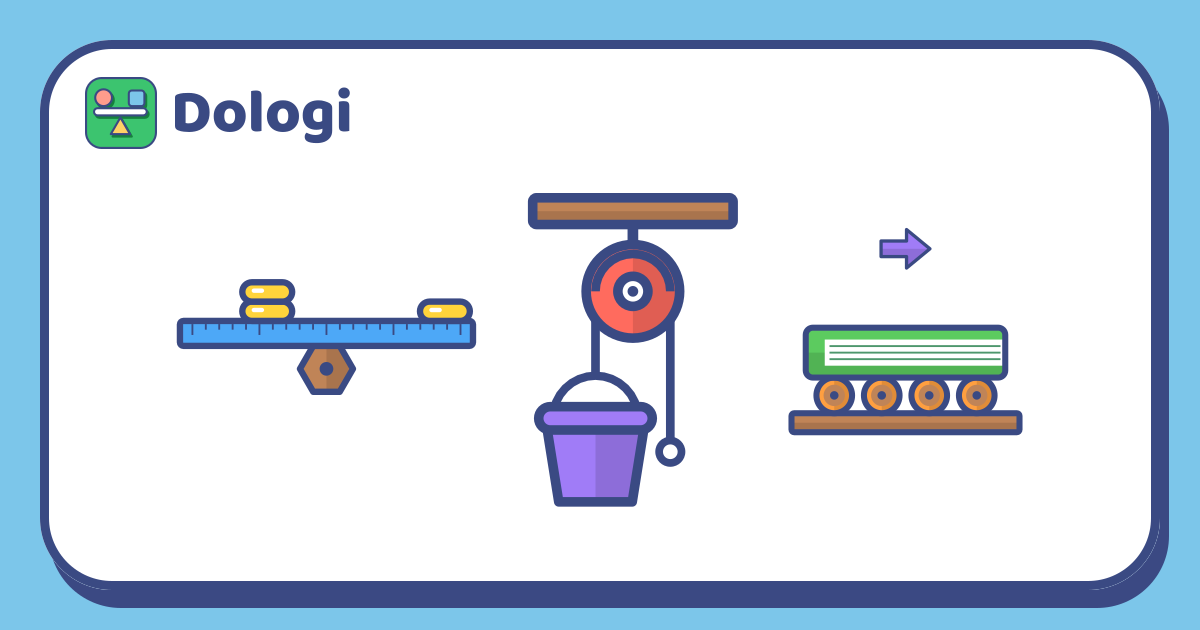
On a seesaw, a small child can lift a grown-up, as long as the grown-up sits close to the middle. Ask your child why, and you'll usually hear "because I pushed really hard!" The real answer is more interesting, and you can test it at the kitchen table.
Levers, pulleys and wheels are called simple machines. They don't add strength: they change how hard or which way you push, in exchange for pushing further. Here are three experiments for children aged roughly 5 to 12, a home-made way to measure "how hard" and a small puzzle.
What you need
- A 30 cm ruler, a round or six-sided pencil and a few coins of the same kind.
- A few more pencils, a fairly heavy book and a toy car.
- Two empty cotton reels, two pencils that fit through them, string and a small bucket or basket with a few toys inside.
- A rubber band and some sticky tape.
The rubber band is your force meter. Hook it to whatever you are pulling and pull slowly until the object just starts to move, then your child measures the stretched band with the ruler. The longer the band, the harder the pull. No real units, but perfect for comparing "harder" and "easier".
The lever: a ruler on a pencil
Tape the pencil to the table so it can't roll. Lay the ruler across it with the 15 cm mark on the pencil: the empty ruler balances. The pencil is the pivot, the point the lever turns around.
- Put one coin at each end. It still balances.
- Stack two coins 5 cm from the pivot, on the 10 cm mark. Ask: "Where does one coin have to go on the other side?" Let your child try. It balances at 10 cm from the pivot, on the 25 cm mark.
- Look for the rule together. Two coins times 5 cm makes 10, one coin times 10 cm also makes 10. Each side counts as weight times distance from the pivot, and the ruler balances when both sides are equal.
Then feel it with a finger. Put five coins on one end and move the pivot close to them. Press the other end: the coins lift easily, but your finger travels a long way while they rise a little. Move the pivot away and press again: harder, and your finger travels less. Every lever makes this deal: less force, more distance.
Coin puzzle (one coin is one weight, distances in cm from the pivot):
- Three coins sit 4 cm to the left. Where do two coins go on the right?
- Four coins sit 3 cm to the left. Where does one coin go?
Answers: 6 cm (3 × 4 = 2 × 6 = 12) and 12 cm (4 × 3 = 1 × 12 = 12). Coins aren't tiny points, so a real ruler may need a millimetre or two of nudging.
The pulley: lifting a bucket
Push a pencil through an empty cotton reel. Tie string to both ends of the pencil and hang it from a door handle or the back of a chair: the reel is the pulley wheel, and it should spin freely. Run a long string over the reel, tie one end to the bucket handle and the rubber band to the other end.
- Hook the band straight onto the bucket handle, lift the bucket and measure the stretch.
- Pull down through the pulley and measure again. The stretch is about the same, maybe a little longer. A single fixed pulley doesn't make the bucket lighter; it changes direction: you pull down, the bucket goes up. Pulling down is easier, because you can use your own weight.
- For ages 9 and up, add a moving pulley. Push the second pencil through the second reel and hang the bucket from this pencil. Tie the string to the top support, run it down under the lower reel, back up over the top reel and down to the band. The bucket now hangs on two strands. The band stretches less, but your hand has to pull about 20 cm to lift the bucket 10 cm.
Extra question: why does the bucket feel much heavier if the string runs over a broom handle instead of the reel? The string rubs on the wood. That rubbing is friction, and a turning wheel avoids it.
The wheel: a book on pencils
Lay the book on the table, hook the rubber band on the cover and pull until it slides. Measure. Now put four or five round pencils under the book like logs and pull again: the band hardly stretches. The pencils roll instead of rubbing.
Your child will soon spot a problem: the pencils come out at the back and must be moved to the front. A wheel on an axle fixes that, because it stays with the load. Finish with the toy car: pull it on its wheels, then on its roof.
| Machine | What it does | Try at home | Spot it around you |
|---|---|---|---|
| Lever | Lifts a heavy load with a smaller push, if you push further | Ruler on a pencil, coins | Seesaw, scissors, bottle opener |
| Pulley | Changes the direction of a pull; two strands share the load | Cotton reel, string, bucket | A flagpole, a crane |
| Wheel and axle | Rolls instead of rubbing, so there's less friction | Book on pencils, toy car | Bikes, trolleys, suitcases |
Predict, measure, explain
Before each test, ask: "Will the band stretch more or less this time? Why?" Afterwards, compare with the guess and let your child explain. Change one thing at a time and repeat each pull two or three times.
| Rough age | What to try |
|---|---|
| 5–6 | Seesaw with coins, "harder" or "easier", car on its wheels and on its roof |
| 7–9 | Measure the band with the ruler, find balance points, fixed pulley |
| 10–12 | Weight times distance, the coin puzzle, moving pulley, compare the distance the hand moves with the distance the load moves |
These ages are only a rough guide; every child is different.
In Dologi, older children can try the "Balance the beam" puzzle in the Math topic. It uses the same rule as the ruler and coins: each weight counts as its number times how many hooks from the middle it hangs, and your child makes both sides count the same.
In short
- Simple machines don't add strength: they trade a smaller push for a longer distance, or change the direction of the push.
- A ruler on a pencil shows the lever rule: weight times distance must be equal on both sides.
- A cotton reel makes a pulley, and pencils under a book show why wheels beat sliding.
- A rubber band works as a force meter: predict, measure the stretch, then explain.
Read more: Take it apart to understand it: exploring how everyday things work