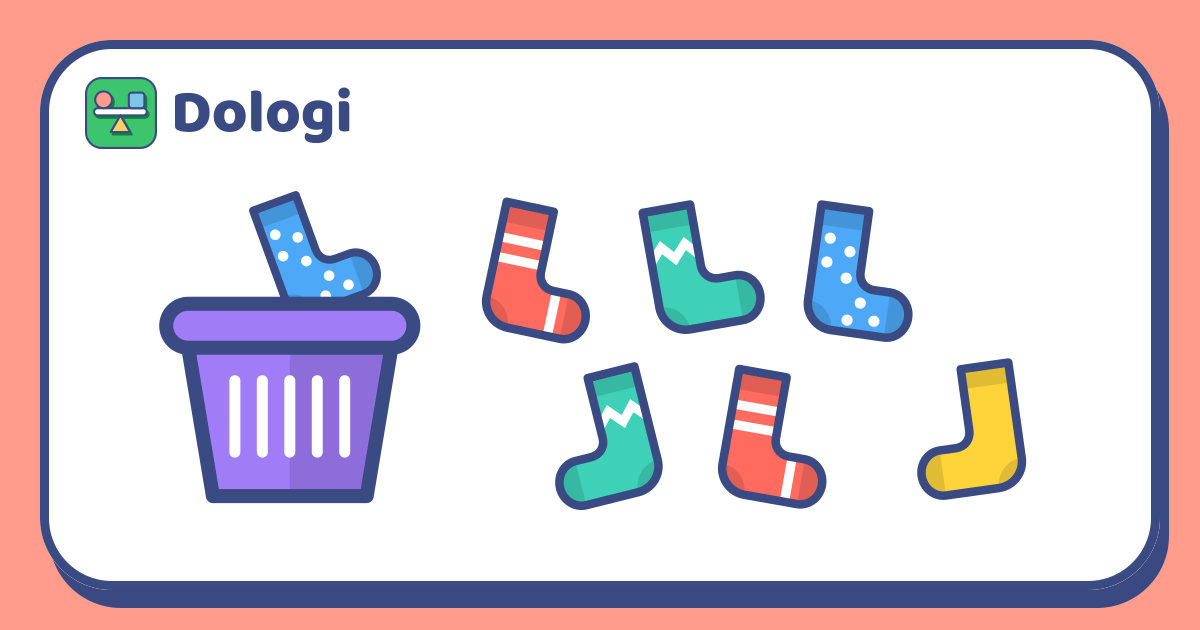
At the bottom of every basket of clean laundry there is a heap of single socks. Somebody has to pair them, and that somebody can be your child.
It is a real job, which children like, and it is also a sorting lesson. To find a pair your child has to look at colour, pattern and size, decide which of them matter, and choose a way of searching that doesn't take all afternoon.
What really makes a pair
Two socks are a pair when everything about them matches: the colour, the pattern and the size.
- Two blue socks are not a pair if one has dots and the other has stripes.
- Two striped socks are not a pair if one is yours and the other is your child's.
Hold up two socks and ask: "Are these a pair? What is the same? What is different?" The words matter here: plain, striped, dotted, long, short, thick, thin. A child who can name the features can search for them.
Three ways to search
| Way | How it works |
|---|---|
| One at a time | Pick up a sock and hunt through the heap for its partner |
| Sort first | Make small heaps by colour, then pair up inside each heap |
| Line them up | Lay every sock in a row and scan along it |
Try a different way on each laundry day and ask afterwards: "Which was quickest? Why?" With a big heap, sorting first usually wins. Looking through a small heap of blue socks is far easier than looking through everything, and that is the whole idea of sorting: it makes the next search smaller.
Games with the sock heap
Beat your record. How many pairs can you make in one minute? Write the number down and try to beat it next week.
The odd sock detective. Before the game, hide one sock. When all the pairs are made, one sock is left over. Ask your child to describe the missing partner without seeing it: "It must be small, blue and dotted."
Guess my sock. Choose a sock in your head and give clues: "It is long. It has stripes. It is not red." Your child points to it, then takes a turn giving clues.
Pairs by touch. Put three pairs of clearly different thickness in a pillowcase. Can your child find a pair with their hands alone?
Counting in twos
Socks come in twos, so the heap is full of numbers.
- Count the finished pairs in twos: 2, 4, 6, 8.
- "There are six pairs. How many socks is that?"
- "There are 15 socks in the heap. How many pairs can we make? Will one be left over?"
The last question leads to a nice discovery: with an odd number of socks, one sock is always left alone.
| Rough age | What to try |
|---|---|
| 4–5 | Four or five very different pairs; saying what is the same about two socks |
| 6–7 | The whole heap; checking pattern and size as well as colour; counting pairs in twos |
| 8–9 | Two ways of searching and comparing the times; the odd sock detective |
| 10 and up | Guess my sock with "not" clues; sorting the whole wash by owner and type, and explaining the system |
Ages are only a rough guide, and every child is different.
In Dologi, "Match the pairs" puzzles in the Logic topic include a version with socks, where children join each sock to the one with the same pattern.
In short
- Pairing socks is a real household job and a sorting exercise at the same time.
- A pair matches in colour, pattern and size, and naming those features makes them easier to find.
- Sorting into small heaps first makes the search quicker.
- The heap also offers counting in twos and the surprise of the sock left over.
Read more: Sorting by two features at once: colour and shape