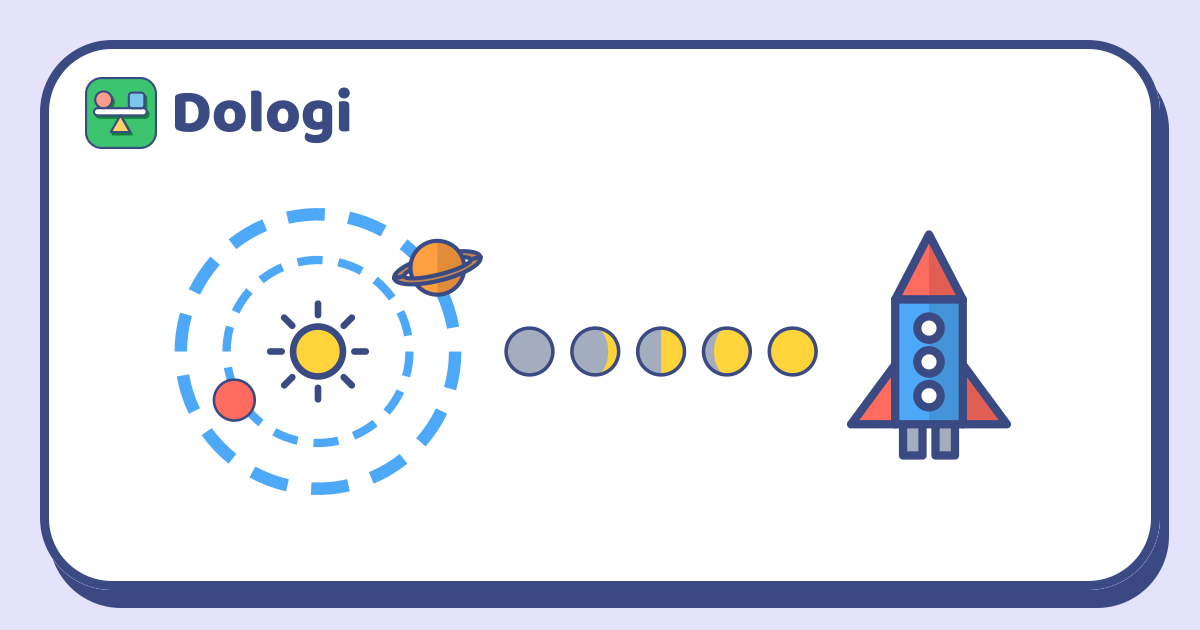
Lots of children love space. They want to know why the moon changes shape, which planet is the biggest, and how a rocket gets off the ground. That curiosity is a great starting point for puzzles: your child picks up a few facts about the sky while practising elimination, putting things in order and counting carefully.
This post has four sets of original puzzles. Each one has a suggested age, two levels of hints and the answer. All you need is paper, a pencil and a few cards cut from an old cereal box.
How to use these puzzles
- Pick by your child, not by age. The ages are only a rough guide. If a puzzle feels easy, move on; if it feels hard, go back one.
- Read it out, then wait. Give your child time to think before offering a hint. A quiet moment doesn't mean they're stuck.
- Hint in steps. Each puzzle has two hints: the first points to where to look, the second gets closer to the answer. Start with the first.
- Ask "how do you know?" When your child answers, even correctly, invite them to explain. That's where most of the thinking happens.
Guess the planet from clues
Warm-up (about 6–8). You read, your child guesses. It helps to draw the sun and the eight planets first so they have something to look at.
- I'm the closest planet to the sun. Which planet am I?
- People call me "the red planet" because my rocks and dust are reddish orange.
- I'm the biggest planet.
- I have the largest, brightest rings. You can see them even through a small telescope.
- I have water and air, and I'm where you live.
Answers: 1 Mercury, 2 Mars, 3 Jupiter, 4 Saturn, 5 Earth.
Logic puzzle (about 8–10). Three cards lie face down on the table: left, middle and right. Under each card is a planet: Mercury, Mars or Saturn.
- The planet closest to the sun is directly to the left of the planet with rings.
- The red planet is not on the right.
Which card is which planet?
- Hint 1: the first clue says two cards are side by side. Where could they be?
- Hint 2: there are only two options: Mercury and Saturn on the left and middle, or on the middle and right. Test each one against the second clue.
Answer: Mars on the left, Mercury in the middle, Saturn on the right. If Mercury and Saturn were on the left and middle, Mars would have to be on the right, which breaks the second clue.
Put the moon shapes in order
About 6–9. Draw a circle on each of five cards and shade part of it in pencil. The white part is the lit part of the moon:
- Card A: almost all white, with just a small dark sliver at the edge.
- Card B: all dark.
- Card C: half white.
- Card D: all white.
- Card E: a thin white crescent.
Shuffle the cards and ask your child to put them in order from new moon to full moon.
- Hint 1: at new moon we can barely see the moon at all. Which card looks like that?
- Hint 2: after that, the lit part gets a little bigger each night. Order the cards from the smallest white part to the largest.
Answer: B, E, C, A, D. The moon doesn't make its own light: we see the part the sun is shining on. Over about a month, the lit part we can see grows to a full moon and then shrinks again. The puzzle only looks at how big the lit part is, because whether the bright side is on the left or the right depends on which half of the Earth you live in.
To check the answer in real life, look at the moon together on a few evenings in a week and draw its shape each night in a box on the calendar.
Count the shapes in a rocket
About 6–8. Draw a rocket exactly like this: the body is a tall rectangle, the nose is a triangle, there's a triangle fin on each side of the body, three round windows on the body, and two small rectangles underneath for the engines.
Ask: how many circles, how many triangles, how many rectangles? How many shapes altogether?
- Hint 1: count one kind of shape at a time, colouring each shape as you count it.
- Hint 2: count from top to bottom: nose, windows, fins, body, engines.
Answer: 3 circles, 3 triangles, 3 rectangles, 9 shapes altogether.
Harder version (about 8–10). Draw a line across the body to split it into two sections. Now how many rectangles are there? Answer: 5. Two small sections, the whole body (still a rectangle), and the two engines. Lots of children forget to count the big shape that contains the small ones, just like when counting triangles.
Countdowns and star pictures
Countdown to launch (about 7–10). Find the missing numbers:
- 10, 8, 6, …, 2, …
- 20, 15, 10, …, 0
- 10, 9, 7, 4, …
- Hint 1: how much goes down each time?
- Hint 2: in the third one, the amount isn't the same each time. It grows.
Answers: 1 is 4 and 0 (down 2 each time). 2 is 5 (down 5 each time). 3 is 0 (down 1, then 2, then 3, then 4).
Join the stars (about 6–9). Swap roles: your child draws seven or eight stars on paper, numbers them in order and decides in advance what picture they'll make. You guess the picture before joining the dots, then join them in order to check. To make it harder, your child can number in twos (2, 4, 6…) or count backwards. Setting the puzzle means planning the whole picture first, which is a puzzle in itself.
If your child enjoys counting shapes and spotting patterns like these, the Space and Patterns topics in Dologi have plenty more picture puzzles to practise at their own level.
In short
- Space is a topic lots of children love: use it to practise elimination, ordering and careful counting.
- Pick puzzles to suit your child, hint in steps, and always ask "how do you know?"
- The moon puzzle can be checked by watching the real moon over a few evenings.
- Let your child set puzzles too, for example by drawing and numbering stars for you to join.
Read more: How many triangles? Shape-counting puzzles for children