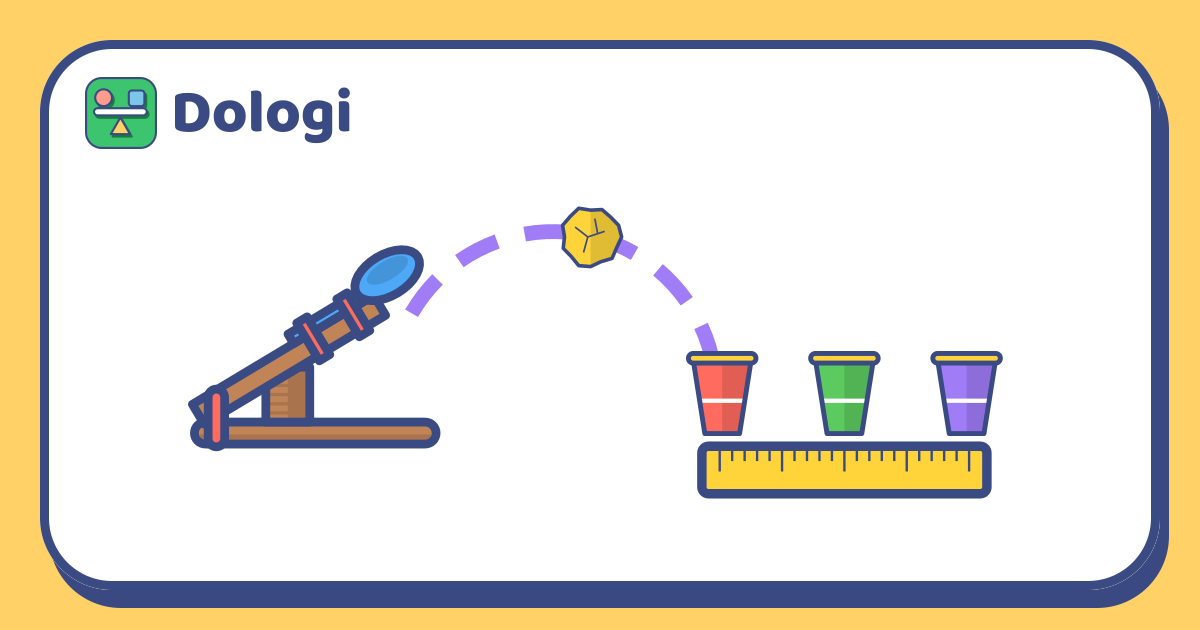
A plastic spoon, a few craft sticks and some rubber bands. Ten minutes later there is a catapult on the table, and the first paper ball sails across the room to a burst of laughter.
Then the question arrives on its own: "How far did it go?" That is when the game turns into a lesson in measuring: where to measure from, what to measure with, why two shots that felt the same landed in different places, and how to adjust the catapult so the ball drops into a cup.
What you need
| Item | What it is for |
|---|---|
| 1 plastic spoon | The bucket that holds the ammunition |
| 8–10 craft sticks | The base and the throwing arm |
| 4–5 small rubber bands | Tying the sticks and fixing the spoon |
| Paper balls, cotton balls, pom-poms | Light, soft ammunition |
| 3 paper cups | Targets at three distances |
| Masking tape, a tape measure | A launch line and measuring |
Keep the ammunition light and soft: a sheet of scrap paper scrunched to the size of a grape is about right. The range has one rule: aim only at the cups.
Build the catapult in ten minutes
- Stack 6 craft sticks and wrap a rubber band tightly around each end. This is the block.
- Lay 2 more sticks on top of each other and band them together at one end only. They open out into a V.
- Slide the block between the two sticks of the V, about a third of the way along from the tied end.
- Wrap a rubber band in an X shape where the block meets the two sticks, so the block cannot slip.
- Lay the spoon handle along the top stick, with the bowl at the free end, and fix it with two rubber bands.
Press the spoon down and let go: the top stick springs up and flicks the ball away. The block is the fulcrum of a lever: press one end and the other jumps up. Children around 6–7 often need an adult to wrap the bands tightly; from about 8 most can build it themselves.
For a quicker version, band the spoon handle to the side of a small box with the bowl above the lid, then pull the bowl back and let go.
Set up a range with cups as targets
- Put the catapult on the floor or a long table, with a strip of tape just in front of it as the launch line. Place it in exactly the same spot every time.
- Stand three paper cups in a line: near, middle and far. Take a few test shots first so you know roughly how far it reaches.
- The near cup scores 1 point, the middle 2 and the far 3. Everyone gets five shots.
How to measure a shot properly
What to measure with. Children of 6–7 can use hand spans or craft sticks laid end to end. Have parent and child measure the same distance with their own hand spans: two different numbers. That is the easiest way to see why people need a shared unit such as the centimetre. From about 8, use a tape measure laid on the floor.
From where to where. From the launch line to where the ball first lands, not where it rolls to. One person watches the landing and marks it straight away with a coin.
How many times. Three shots for each setup. No two shots are exactly alike, and three show where the catapult usually lands, not one lucky try. For more even shots, draw a line on the bottom stick and press the spoon down to it every time.
Record and read the results
Here is an example table that tries a block of 4, 6 and 8 sticks, with everything else kept the same:
| Block | Shot 1 | Shot 2 | Shot 3 |
|---|---|---|---|
| 4 sticks | 95 cm | 102 cm | 98 cm |
| 6 sticks | 120 cm | 131 cm | 125 cm |
| 8 sticks | 118 cm | 140 cm | 109 cm |
Read the table together with a few questions:
- Which shot went furthest? (8 sticks, shot 2: 140 cm.)
- Which setup landed in almost the same spot every time? (4 sticks: the three shots are only 7 cm apart, while the 8-stick shots are 31 cm apart.)
- A cup stands 125 cm from the line. Which setup would you choose? (6 sticks: all three shots landed around 125 cm.)
Children of 10–12 can also work out the average: about 98 cm for 4 sticks, 125 cm for 6 and 122 cm for 8. The setup with the longest shot does not have the highest average. This is only an example; your catapult may behave differently, and the numbers you measure are the ones to trust.
Adjust the catapult to shoot further or more accurately
Change one thing at a time, take three shots and compare with the old table. Ask your child to predict first.
| What changes | A question to ask first |
|---|---|
| Pressing the spoon halfway or all the way down | Does pressing further always mean a longer shot? |
| A taller or shorter block | Will the ball fly in a high arc, or low and flat? |
| Paper ball, cotton ball, pom-pom | Does slightly heavier ammunition go further or less far? |
Far and accurate are two different goals. For distance, pick the setup with the biggest average. For accuracy, pick the one whose shots land close together, then move the cup to match.
| Approximate age | What to try |
|---|---|
| 6–7 | Shoot at the near, middle and far cups; measure in hand spans or craft sticks |
| 8–9 | Measure in centimetres with a tape measure; record three shots for each setup in a table |
| 10–12 | Choose one thing to change, predict first, work out the average and the spread between shots |
Ages are only approximate; every child is different.
In Dologi, "Put in order" puzzles in the Math topic ask children to put pencils in order from shortest to longest, or numbers from smallest to largest: the same thing your child does when sorting shots by distance to find the longest and the shortest.
In short
- Craft sticks, rubber bands and a plastic spoon are enough for a catapult; the block is the fulcrum of a lever.
- Measure from the launch line to where the ball first lands, three shots for each setup.
- Everyone's hand span is different, so your child will see for themselves why centimetres are useful.
- Change one thing at a time; the longest shot and the most accurate setup are often not the same.
Read more: Paper planes: a distance contest and the search for a better fold