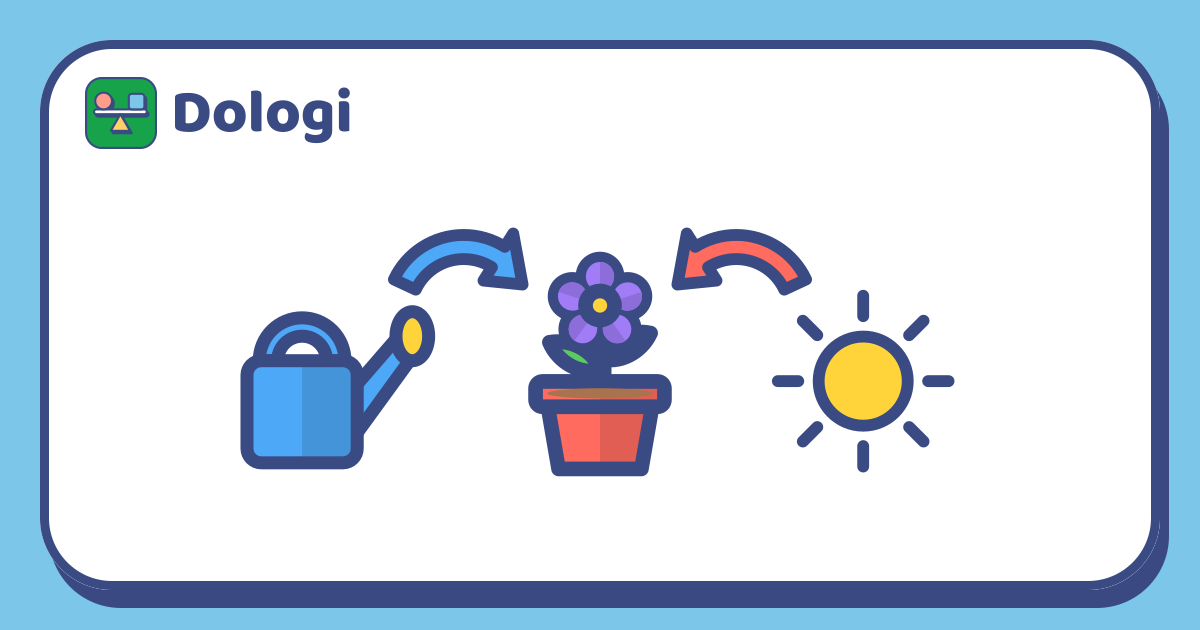
"Why are the plant's leaves drooping?" A child might say "because it's sad". An older child might say "because nobody watered it". And a child who has started to think in systems might add: "We went away for the weekend, it was hot, and the pot is by the window." Each answer is a step further in seeing how things are connected.
Systems thinking sounds like a grown-up idea, but its heart is simple: things around us are linked, and a change in one place often causes changes somewhere else. This article explains the idea in plain words and suggests everyday ways to practise it with children, from age 4 onwards.
What is systems thinking?
A system is a group of things that affect each other: a plant, the water, the sunlight and the person who looks after it; a family getting ready in the morning; a class sharing toys.
Systems thinking means looking at the links, not only at the separate pieces. It includes a few simple habits:
- Seeing chains: this happens, which leads to that, which leads to something else.
- Seeing more than one cause: a result often comes from several things at once.
- Seeing loops: sometimes the effect comes back and changes the cause.
- Thinking before acting: "If I change this, what else will change?"
Young children already notice simple causes ("I pushed the tower, it fell"). Systems thinking grows from there, step by step.
Chains of effects at home
The easiest place to start is with short chains your child can see with their own eyes.
- The plant: we water it, the soil gets wet, the roots drink, the leaves stand up again.
- The tap: someone forgets to turn it off, the sink fills, water spills onto the floor, we have to mop.
- The toys on the stairs: a toy is left on a step, someone trips, the toy breaks.
- The ice cube: we take it out of the freezer, the room is warm, it melts into a puddle.
After something happens, ask: "And then what happened?" and "What happened before that?" You are helping your child stretch a single cause into a chain of two, three or four links.
Draw a circle of effects together
Drawing makes links visible. You only need paper and a pencil.
- Pick a small, familiar topic: our plant, breakfast, the cat, the school bag.
- Draw it in the middle of the page.
- Ask "What does it need?" and "What does it change?" Draw each answer around the centre: water, sun, soil, the person who waters it.
- Draw arrows between things that affect each other. Let your child decide which way each arrow points.
- Play "what if?": cover one drawing with your finger. "What if there's no sun for a week? Which arrows stop working?"
Keep it short and playful. A drawing with four pictures and four arrows is plenty for a 5-year-old. Older children can add more and find arrows between the outside pictures too.
Loops that come back
Some chains come back to where they started. These are loops, and children understand them well when they come from daily life.
- A tiring loop: going to bed late, feeling tired in the morning, getting ready slowly, rushing all day, feeling too wound up to sleep early again.
- A helpful loop: putting toys away in their boxes, finding them quickly next time, having more time to play, being happy to tidy up again.
- A friendly loop: sharing a snack with a friend, the friend shares next time, both enjoy playing together more.
Draw the loop as a circle with arrows going round. Then ask: "Where could we break this loop?" or "How can we keep this good loop going?" Children often come up with surprisingly practical ideas, and an idea they find themselves is easier to stick to.
Questions to try at each age
Ages are rough guides; every child is different, so start where your child is.
| Approximate age | What children can often do | Questions to try |
|---|---|---|
| 4–6 | Link one cause to one effect they can see | "What happened when…?" "What do you think will happen if…?" |
| 7–9 | Follow a chain of several steps, notice more than one cause | "And then what?" "What else helped this happen?" |
| 10–12 | Spot loops and side effects, plan ahead | "What could go wrong if we change this?" "Does this come back to the start?" |
A few tips that help at any age:
- Ask, don't explain straight away. Let your child make a guess first, even a wrong one.
- Check together. If you can test it safely (two cups of water in the sun and the shade), test it.
- Use real moments. A spilled drink or a dead battery is a better lesson than an invented example.
In Dologi, short puzzles in the Logic and Patterns topics ask children to follow a rule from one step to the next. Drawing circles of effects at home takes that same step-by-step thinking into real life.
In short
- Systems thinking means seeing how things affect each other, not just looking at each piece alone.
- Start with short chains your child can see: water, plant, leaves; tap, sink, floor.
- Draw a circle of effects together and play "what if?" by covering one picture.
- Talk about loops from daily life and ask where to break the bad ones and how to keep the good ones going.
Read more: If… then…: teaching children to reason through everyday moments