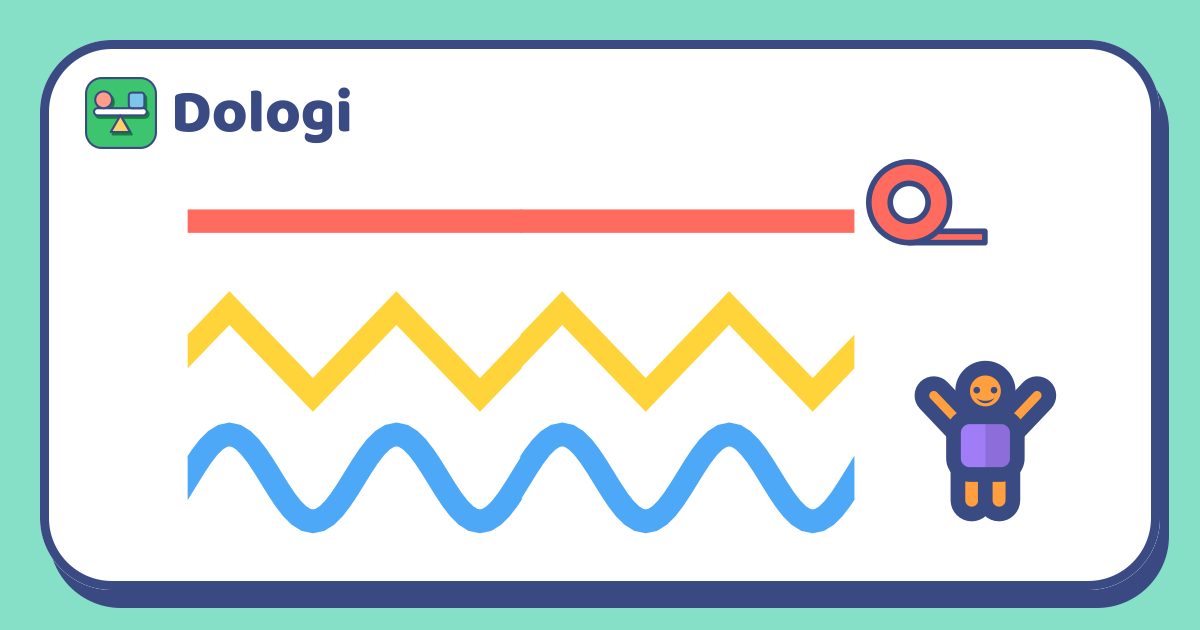
A roll of masking tape and a few metres of floor. Stick down one line, and the hallway is a tightrope.
Walking on a line looks like a game for the legs, but most of the work happens in the head. The target is narrow, the body has to slow down, and the eyes have to stay on the way ahead. It is a calm sort of concentration that children can feel in their whole body.
Sticking the lines
- Use paper masking tape. It usually comes off floors cleanly. Try a small piece in a corner first.
- Make three lines: a straight one, a zigzag and a wavy one. The wavy line is made from short pieces that overlap.
- Let your child help. Tearing the pieces, deciding where the corners go and marking the start and the finish with a cross are all part of the game.
Bare feet or socks with grips are best, and the route should be clear of sharp furniture corners.
Seven ways to walk a line
| Way | How | What it adds |
|---|---|---|
| Heel to toe | Each step puts the heel against the toes of the other foot | The basic balance task |
| On tiptoe | Heels never touch the floor | A smaller base to balance on |
| Sideways | Small steps to the side, feet never crossing | A new direction for the body |
| Backwards | Slowly, feeling for the tape with the toes | Balance without seeing the way |
| Carrying | A soft toy on the head, or a paper ball on a spoon | A steady upper body and divided attention |
| Slow motion | The slowest walker wins | Holding back the urge to rush |
| Eyes up | Look at a picture at the end of the line, not at your feet | Trusting the feet |
Agree on what happens after a slip: stepping off the line means going back two steps, not back to the start. That keeps the game friendly.
Adding thinking to the walking
- Count the steps. How many heel-to-toe steps does the straight line take? Guess first, then count. Now you try: why do you need fewer?
- Which line is longest? The zigzag and the straight line can start and finish at the same places. Count steps on both. Children are often surprised by how much longer the zigzag is.
- Signs on the line. A cross of tape means "stop and clap twice", a double line means "jump". The walker has to watch for the signs and remember what they mean.
- Freeze. Walk while the music plays and stand like a statue when it stops, still on the line.
Three lines, three kinds of difficulty
The straight line asks for steady balance. The zigzag adds corners, where the walker has to stop, turn and start again. The wavy line never lets the feet rest, because every step needs a small correction.
Ask your child afterwards which line was hardest, and why. Putting that into words is thinking about their own movement.
| Rough age | What to try |
|---|---|
| 4–5 | The straight line, first normally and then heel to toe; carrying a soft toy in both hands |
| 6–7 | The zigzag and the wavy line; backwards on the straight line; counting steps |
| 8–9 | A toy on the head or a ball on a spoon; the slow-motion contest; comparing the lines in steps |
| 10 and up | Designing a course with signs for the family; backwards on the zigzag |
Ages are only a rough guide, and every child is different.
In Dologi, "Follow the string" puzzles in the Focus topic ask children to follow a tangled string with their eyes to find out which balloon an animal is holding. It is the same staying on one line, done with the eyes.
In short
- Masking tape on the floor gives a straight, a zigzag and a wavy line to balance on.
- Heel to toe, sideways, backwards, carrying something and slow motion all change the challenge.
- Counting steps and adding signs bring numbers and rules into the game.
- Corners and curves make a line harder, and talking about why helps children notice their own movement.
Read more: An indoor obstacle course with cushions and chairs