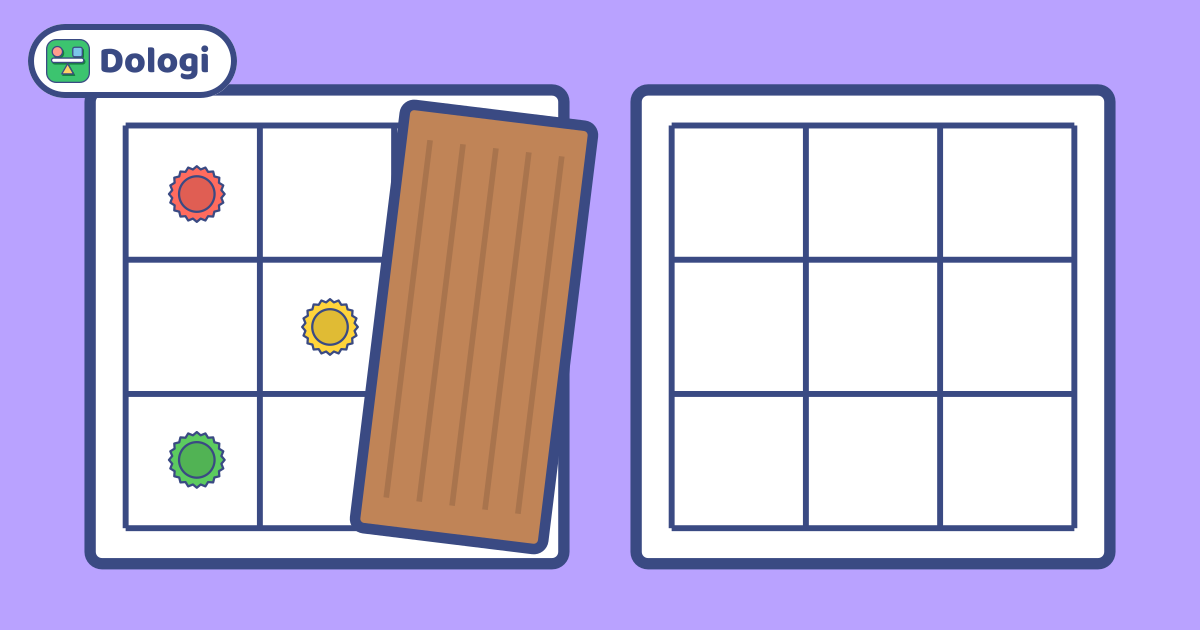
Put a few colored bottle caps on a grid drawn on paper. Your child looks for ten seconds. Then you cover it. Now they rebuild what they saw: which corner was the red cap in, which square had the yellow one?
All you need is paper, a pen, a few bottle caps and a piece of card, so it works at the dinner table, on a train or in a waiting room. Kids from 4 to 10 can all play; just change the grid size and the number of caps. Your child practices remembering positions, the same skill they use to remember where they left things, copy from the board at school or read a map.
What you need
- Two three-by-three grids drawn on paper, with squares about 2 inches wide so a cap fits. One grid is for the model, one is for your child's copy.
- Bottle caps in several colors, or buttons, large beans or coins.
- A piece of card or a book to cover the model.
How to play
- Place three caps in any three squares of the model grid.
- Your child looks while you count slowly out loud: "One, two, three... ten."
- Cover the model.
- Your child places caps on the empty grid next to it, in the squares they just saw.
- Lift the card, put the two grids side by side and compare them square by square.
Comparing side by side matters: your child sees for themselves what's right and what's off, with no grading from you. Count "how many caps you got right" rather than saying "that's wrong."
Levels by age
| Age | Grid | Caps | What's added |
|---|---|---|---|
| 4 | 3 × 3 | 2–3, all one color | Remember places only |
| 5–6 | 3 × 3 | 4, two colors | Remember places and colors |
| 7–8 | 4 × 4 | 5–6, many colors | Still ten seconds to look |
| 9–10 | 5 × 5 | 7–8, many colors | Five seconds to look, or two grids in a row |
Raise one thing at a time: more caps, or more colors, or a bigger grid, or less time. Two perfect rounds in a row means move up a level; lots of mistakes means step back.
Memory tricks for your child
After each round, ask: "How did you remember?" Then gradually suggest these:
- Whisper the positions: "Red in the top left corner, yellow in the middle, green in the bottom corner." Naming places sticks better than just looking.
- Scan row by row: "Top row has two caps, middle row one, bottom row none." Go in order instead of looking all over the place.
- Look for a shape: three caps on a diagonal, four caps making an L. One shape is easier to remember than four separate spots.
- Remember the gaps: when the grid is nearly full, remembering the empty squares is faster.
Whispering names helps in other games too. Follow my route uses the same trick of naming each stop to remember a path.
Variations
- What moved? Your child looks for ten seconds, you cover it and move one cap to another square. Uncover it, and your child points to the cap that moved.
- Swap roles: your child sets it up and you remember. Kids love being the judge, and to judge fairly they have to remember their own layout.
- Things from around the house: swap caps for a spoon, an eraser, a toy car. Different objects are easier to remember than identical caps.
- A floor grid: make a big grid on the floor with masking tape and use cushions and stuffed animals. Your child has to walk around to rebuild it, perfect for active kids.
- Mirror rebuild (ages 9–10): rebuild the grid with left and right swapped. Your child has to remember and flip the picture in their head at the same time.
The Memory topic in Dologi has a puzzle called Put it back: "Remember where each thing is. Then put each one back." Its hint is the row-by-row trick: while you look, go row by row and say what's in each one, and remember that some squares stay empty.
In short
- Draw two grids, set out a few caps on the model, let your child look for ten seconds, cover it, and have them rebuild it on the empty grid.
- Uncover and compare the grids side by side, counting the caps they got right rather than pointing out mistakes.
- Add caps, colors and grid size step by step before cutting the looking time.
- Teach your child to whisper positions, scan row by row and spot shapes; swap roles and try the "what moved?" version.
Read more: Memory and focus games, Follow my route