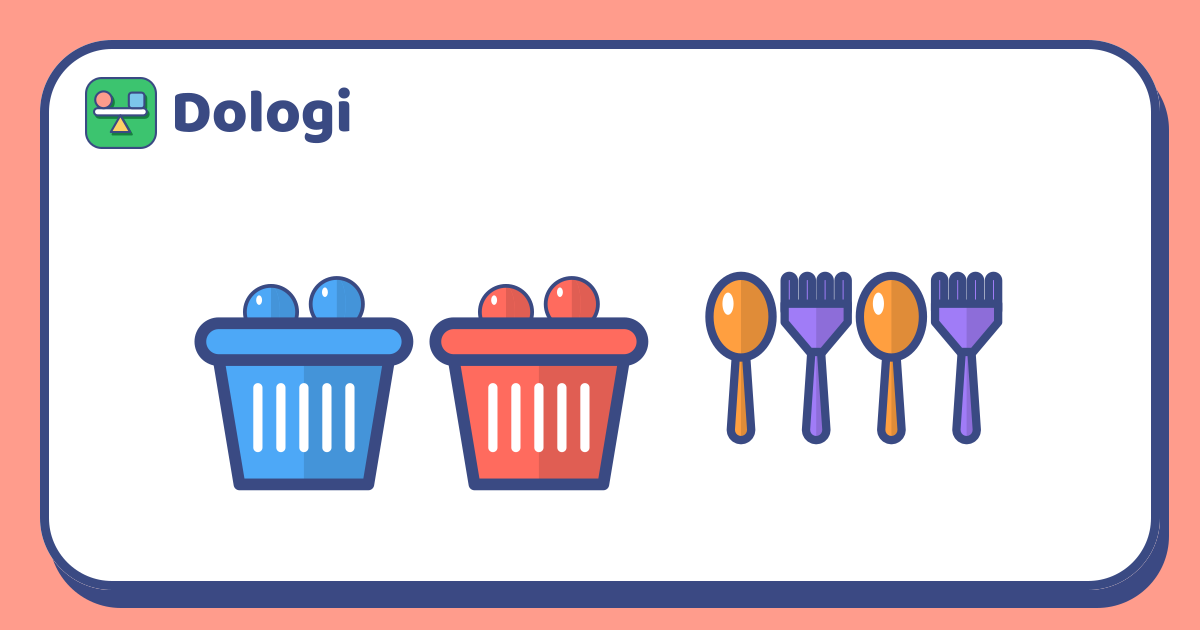
Many parents of 4-year-olds wonder whether it's too early for "thinking exercises". It isn't, as long as they don't look like exercises. At this age, children practise thinking whenever they put things into groups, find two that match or notice what comes next. Tidying up, folding laundry and setting the table are full of chances to do just that.
This article goes through the thinking skills that often appear around age 4, with short games of 5 to 10 minutes that use things you already have. An adult playing alongside matters more than any special toy.
What many 4-year-olds can do
The table shows what many children can do at around 4. These are rough guides only: every child has their own pace, quick in some skills and needing more time in others.
| Skill | Around age 4, many children can | Suggested game |
|---|---|---|
| Sorting | Group things by one feature, such as colour or size | Two coloured baskets |
| Matching | Find two things that are exactly the same | Sock pairs |
| Patterns | Continue a simple repeating pattern like AB | Spoon, fork, spoon, fork |
| Memory | Remember three objects they have just seen | Three-item tray |
| Picture puzzles | Put together a picture cut into four to six pieces | Cut-up picture card |
| Position words | Understand on, under, in and out | Where is the teddy? |
If your child can't do one of these yet, that's fine. Play the easiest version and come back to it in a few weeks.
Sorting and matching: two baskets and sock pairs
Two coloured baskets. Put out two baskets or boxes, one blue and one red, or mark them with a sheet of coloured paper. Tip out a handful of toys in those two colours and say, "Red toys go in the red basket, blue toys in the blue basket." Sort the first few together, then let your child carry on.
When that feels easy:
- Sort by size. Big things in one basket, small things in the other. Same toys, new rule.
- Find the one that doesn't fit. Slip in a yellow toy. Where should it go? Your child might suggest a third basket, which is a great idea.
- Guess the rule. You sort a few toys without saying why, and your child works out what you're doing.
Sock pairs. After the wash, tip the clean socks onto the bed and ask your child to find the pairs. Start with just three or four pairs that look very different. Later, mix in socks that are almost the same, so your child has to look closely at the stripes, dots or heel colour. Ask, "How do you know these two go together?"
First patterns: spoon, fork, spoon, fork
Patterns often begin with the simplest kind: two things taking turns. When you set the table, lay out a row: spoon, fork, spoon, fork, and stop. Ask, "What comes next?" Say the pattern aloud together, like a little song: "spoon, fork, spoon, fork…" Hearing the rhythm helps your child feel what repeats.
Ways to keep it going:
- Make the row longer. Your child adds the next three or four items on their own.
- Use the body. Clap, stamp, clap, stamp. A pattern can be sounds and movements, not just objects.
- Your child starts. They lay out two items and you continue. If you get it wrong on purpose, they can put you right.
Keep to two items that take turns for now. Longer patterns like ABB or ABC usually come a little later.
Memory and space: a three-item tray, picture pieces, on and under
The three-item tray. Put three familiar things on a tray, for example a cup, a ball and a key. Name each one with your child, then cover the tray with a cloth. Secretly take one away, lift the cloth and ask, "What's gone?" If naming it is hard, put the missing item next to two others and let your child point to it. Swap roles so your child hides and you guess.
Cut-up picture card. Take an old greeting card or a big picture from a magazine, glue it onto card and cut it into four large pieces. Your child puts the picture back together. Once four pieces feel easy, cut another picture into five or six. Keep the whole picture nearby at first so your child can check.
Where is the teddy? Take a teddy and a box. Put the teddy on the box, under the box, in the box and out of the box, saying each word as you do it. Then switch: you give the word ("Put the teddy under the chair"), and your child places it. Later your child hides the teddy and tells you where it is using those words.
How to play with a 4-year-old
- Keep it short, 5 to 10 minutes. Stop while your child is still having fun.
- Play alongside. Sort, match and guess with your child. Showing is usually clearer than explaining.
- Use everyday moments. Tidying toys, pairing socks and setting the table are all practice, no extra time needed.
- No testing, no rushing. When your child makes a mistake, say "Let's look again together" rather than "Wrong".
- Ask how they knew. Even a short answer like "because it's red" means your child is thinking about the rule.
If your child likes these games, the Patterns and Memory topics in Dologi have puzzles of the same kind that start very easy and get harder little by little. A few minutes on a screen, with you nearby, is one more way to practise and doesn't replace playing with real things.
In short
- Around age 4, thinking grows through short games with real things and an adult playing along.
- Two baskets for sorting, sock pairs for matching, a spoon-and-fork row for patterns, a three-item tray for memory.
- Tidying up, laundry and setting the table are ready-made thinking games.
- Age milestones are only rough guides; if a game is too hard, play an easier version for a while.
Read more: Thinking activities for 5-year-olds: a game at home for each skill and What can children do at each age? Thinking milestones from 4 to 10