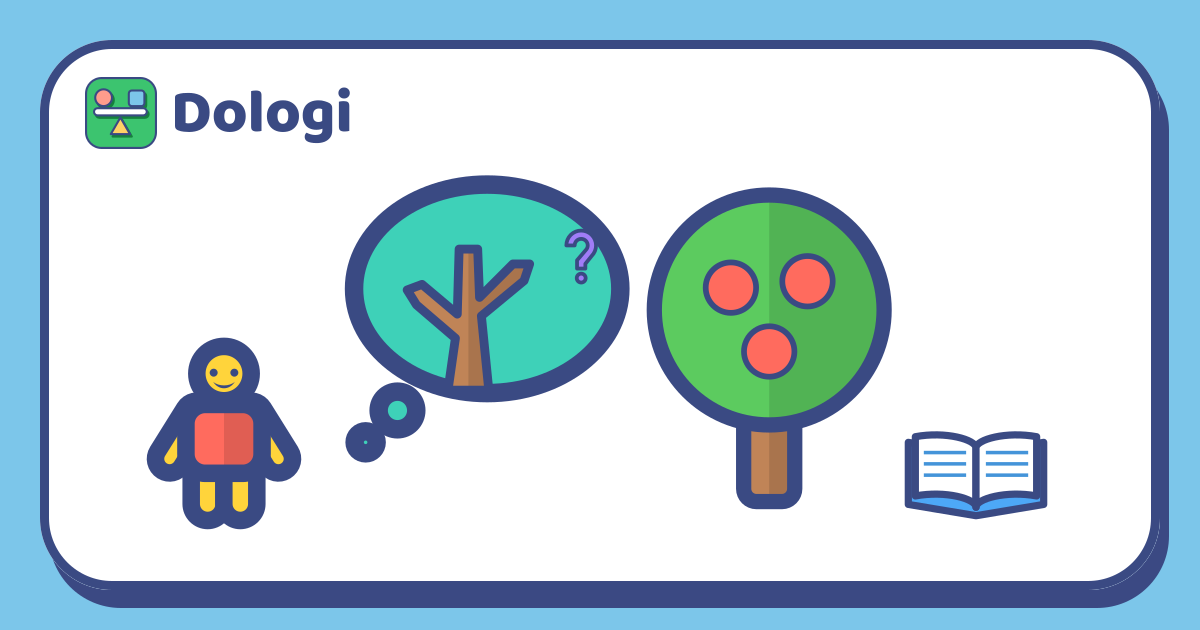
"Mom, what if trees had no leaves?" You can't test a question like that for real: nobody is going to strip a tree bare to see what happens. But it can still be answered, by running the experiment in your head. Scientists call this a thought experiment, and they use it whenever the real test is impossible, too expensive or too dangerous.
For children of roughly 7 to 12, thought experiments are a game that fits them well: no equipment, playable on a walk or at the dinner table, and it teaches the most important move in science: working out what follows from a condition, then telling apart what you know for sure from what you're guessing. This article suggests how to play with three questions, a two-column sheet and three examples that have been tried out in advance.
Three questions, always in order
A thought experiment starts with "What if…" and changes one thing only. Everything else stays as it really is. Then you ask three questions, always in this order:
- "What changes straight away?" Only the direct consequences. If trees had no leaves, there would be no shade under a tree and no leaves to rake in fall.
- "And what does that lead to?" Go one step further, then another. With no leaves, what would a tree use to make its food? What would leaf-eating caterpillars live on?
- "Why do you think so?" This one makes your child say their reasons out loud. "Because trees that lose their leaves in winter stay alive" is a good reason, and also a place to keep talking: how long does a bare winter tree survive without leaves?
You don't need to know the answers. Your job is to ask "and then?" and "why?", and now and then to add a condition: "Remember, every tree in the world has no leaves, not just the one in the garden."
The two-column sheet: sure and guessing
Once you've played out loud a few times, add a sheet of paper with two columns: Sure and Guessing. For every consequence your child names, ask "are you sure about this, or guessing?" and write it in the right column.
| If trees had no leaves | Sure | Guessing |
|---|---|---|
| No shade under trees | ✓ | |
| No fallen leaves to rake in fall | ✓ | |
| Trees would slowly die | ✓ | |
| Leaf-eating caterpillars would have no food | ✓ | |
| The air around us would be different | ✓ |
The "Sure" column is what follows directly from the condition. The "Guessing" column is what needs extra knowledge before you can say it: are leaves really where a tree makes its food, can caterpillars eat something else? That column shows your child exactly what they don't know yet, which is the reason to open a book in the last step.
Many children put everything in the "Sure" column at first. Ask again: "Have you seen this with your own eyes, or did you work it out?" One step of reasoning still counts as sure; three or four steps is already a guess.
Three worked examples
Here are three "What if…" questions that have been tried out, with a few consequences for you to hint at when your child gets stuck. Don't read them all out; let your child look first.
What if the floor were as slippery as ice? Sure: walking normally would end in a fall, because your feet couldn't grip to push you forward; a chair would slide away at the lightest push. Guessing: people would move by holding the walls and pushing off, or by crawling; slippers would get spikes or rough soles; furniture would have to be fixed to the floor. A good closing question: "So what normally stops us from slipping?" Your child will reach the idea of friction without needing its name.
What if a day were twice as long? Change one thing: the sun rises and sets at half the speed, so both daytime and night last twice as long. Sure: a day would have more hours of sunlight and more hours of dark. Guessing: daytime would get hotter because the sun shines for longer, and nights colder; people would sleep in two shifts; plants would get more sunlight but also have to last through longer nights. The nice thing about this one is that it leads to "what is a day, anyway?", a chance to talk about the Earth turning.
What if no tree anywhere had leaves? Discussed above, but older children can push it further: if trees slowly died, where would the animals that live in them go, and would soil wash away in the rain without roots to hold it? Each step is an arrow on paper: leaves → the tree's food → the tree → the animals in it. That chain of arrows is the map of the experiment.
A few more "What if…" questions to keep in reserve: what if people had no thumbs, what if the rain never stopped, what if nothing could float on water, what if everything weighed half as much.
Check it against a book
A thought experiment is only complete when it comes back to the facts. Take the "Guessing" column, pick the one or two lines your child is most curious about, and look them up together in their science book or ask a teacher: are leaves really where a tree makes its food? What keeps a tree alive through a leafless winter?
Once you've checked, mark each line: guessed right, guessed wrong, or still unclear. A wrong guess isn't a loss. Ask "what information were you missing when you guessed that?", because that is exactly what a scientist asks when a result doesn't match the prediction. You can keep the two-column sheets in a folder; after a few months, your child will see their "Sure" column getting longer.
These age bands are rough guides. Around 7–8, play out loud with questions one and two, and choose conditions you can picture (no leaves, a slippery floor). Around 9–10, add the two-column sheet and the book check. Around 11–12, let your child invent the "What if…" themselves, draw a chain of arrows five or six steps long and look for the place where the chain might break.
Putting events in cause-and-effect order also turns up in Dologi: the "What happened first?" puzzle in the Logic topic shows your child the pictures of a short story and asks them to put them in order, which one came first and which one followed.
In short
- A thought experiment changes exactly one thing, keeps everything else the same, then asks three questions in order: what changes straight away, what that leads to, and why you think so.
- A two-column sheet, "Sure" and "Guessing", shows your child what they can work out and what knowledge they're missing.
- Three starters: trees with no leaves, a floor as slippery as ice, a day twice as long.
- Finish by looking up the "Guessing" column in a book; a wrong guess is the moment to ask "what information was missing?"
Read more: Making a hypothesis: teaching children to guess with a reason, then test it