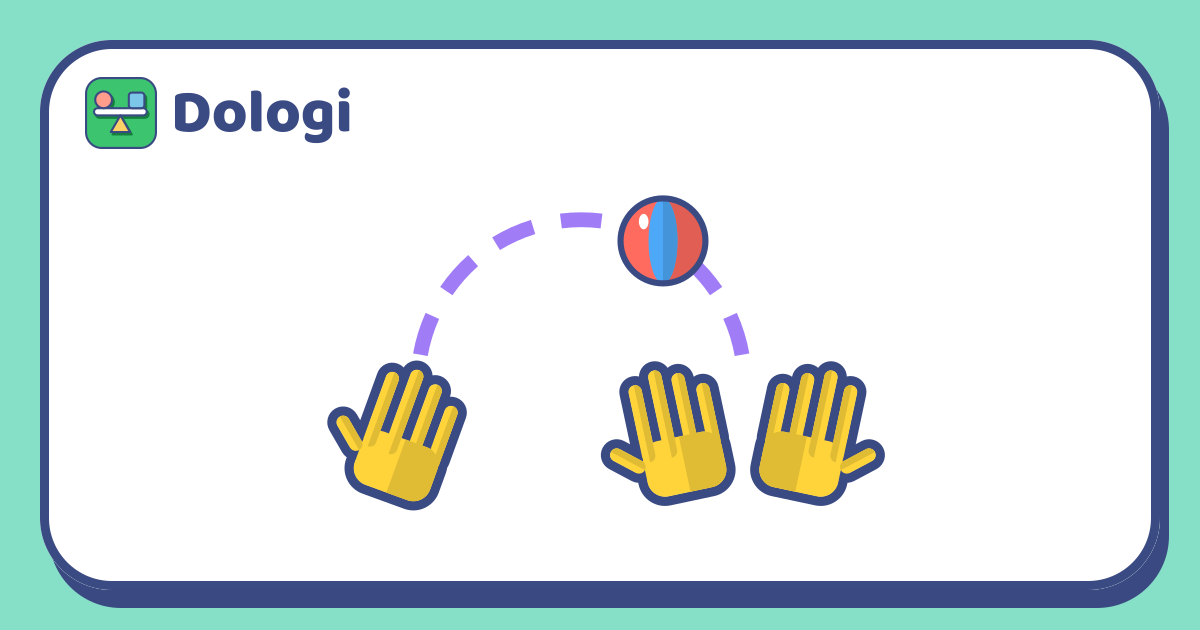
"Again! Throw it higher this time!"
Throwing comes early, but catching takes much longer. To catch a ball, your child has to watch it from the moment it leaves your hand, guess where it will come down, and move both hands there at just the right time. It is attention, timing and coordination all in one second.
The good news is that it can be practised in a hallway or a garden with one soft ball and a few minutes a day. This article covers how to choose a ball, a step-by-step path from rolling to one-handed catches, a simple way to count progress, and some games to keep it fresh.
Start with the right ball
The ball decides how hard the game is. For beginners, it should be big, soft and slow.
- Big and soft first: a fabric ball, a soft foam ball or a beach ball that is not fully blown up. It is easy to see and doesn't hurt if it hits a face.
- Easy to grip: a small beanbag or a pair of rolled-up socks doesn't bounce out of the hands, which helps with one-handed catches later.
- Smaller and bouncier later: a tennis-sized ball only once two-handed catches are easy.
Indoors, use soft balls only, move breakable things and stay away from windows and stairs.
From rolling to catching
Go through these steps in order, and stay on each one until it feels easy.
- Roll it. Sit on the floor facing each other with legs apart and roll the ball back and forth. Your child learns to watch the ball all the way into their hands.
- Bounce it. Stand a couple of steps apart and bounce the ball once so it comes up to your child's hands. The bounce slows the ball down and gives more time.
- Hug catch. Toss a big ball gently underarm towards the chest. Your child traps it against their body with both arms.
- Two hands. With a smaller ball, your child catches with hands only, fingers spread like an open bowl.
- One hand. Start with a beanbag, first with the hand your child writes with, then with the other hand.
Throw underarm, gently, in a soft arc, and aim for the chest. A good throw is half of a good catch.
Keep your eyes on the ball
Most dropped catches happen because the eyes leave the ball too early. A few tricks help:
- Ready hands: before every throw, your child holds both hands up and open in front of their chest. Say "Ready?" and throw only when the hands are up.
- Call the colour: use a ball with coloured patches. As it arrives, your child says which colour is facing them. To do that, they have to look at the ball until it is in their hands.
- Soft hands: show how the hands move back a little as the ball arrives, as if catching an egg. Stiff hands make the ball bounce out.
- Look, not guess: later, stop saying "Ready?" and vary the height a little, so your child has to watch each throw instead of expecting the same one.
Count catches in a row
Counting turns practice into a game.
- Count every catch aloud together. When the ball falls, the count goes back to zero. You throw, your child catches, and you share one score.
- The stepping-back rule: mark a starting spot on the floor with a sock or a piece of tape. After five catches in a row, your child takes one step back. After a drop, one step forward again. The distance grows exactly as fast as your child improves.
- Your own record: note the longest run of the day and try to beat it tomorrow, rather than comparing brothers and sisters.
Games to keep it fresh
Once catching is steady, change one thing at a time:
- Clap before you catch: one clap while the ball is in the air, then two.
- Weaker hand only: catch with the hand your child doesn't write with.
- One bounce: throw it high so it bounces once before the catch.
- Category catch: with each throw, the thrower names a category (animals, fruit, colours) and the catcher says one word from it after catching. Thinking and moving at the same time is harder than it sounds.
- Wall catch: for playing alone, throw a ball gently against an outdoor wall and catch it on the way back.
When catching is hard
Many young children close their eyes or turn their head when a ball comes towards them. That is a natural reaction, not a lack of courage.
- Go back to a softer, bigger, slower ball, or even a scarf, which floats down slowly.
- Stand closer and throw more gently.
- Praise the watching, not only the catching: "You kept your eyes on it the whole time!"
- Keep sessions short and stop while it is still fun.
Children learn to catch at very different ages. If you have questions about your child's coordination or eyesight, your child's teacher or doctor is the right person to ask.
| Rough age | What to try |
|---|---|
| 3–4 | Rolling on the floor; one bounce before the catch; hug catch with a big soft ball |
| 5–6 | Two-handed catches from a short distance; counting catches to ten together |
| 7–8 | One hand with a beanbag; the stepping-back rule; clap before you catch |
| 9 and up | The weaker hand; category catch; wall catch; throwing for younger children |
Ages are only a rough guide, and every child is different.
In Dologi, the Focus topic has puzzles such as "Follow the cup": cups move around and your child keeps their eyes on the one that hides an object. It asks for the same thing as catching: following something that moves, all the way to the end.
In short
- Catching trains the eyes, timing and both hands to work together.
- Start with a big, soft, slow ball and go from rolling to bouncing, hugging, two hands and one hand.
- Ready hands and calling the colour help the eyes stay on the ball.
- Count catches in a row, step back after five, and compare only with your own record.
Read more: Keep the balloon up: a playful focus game for the living room