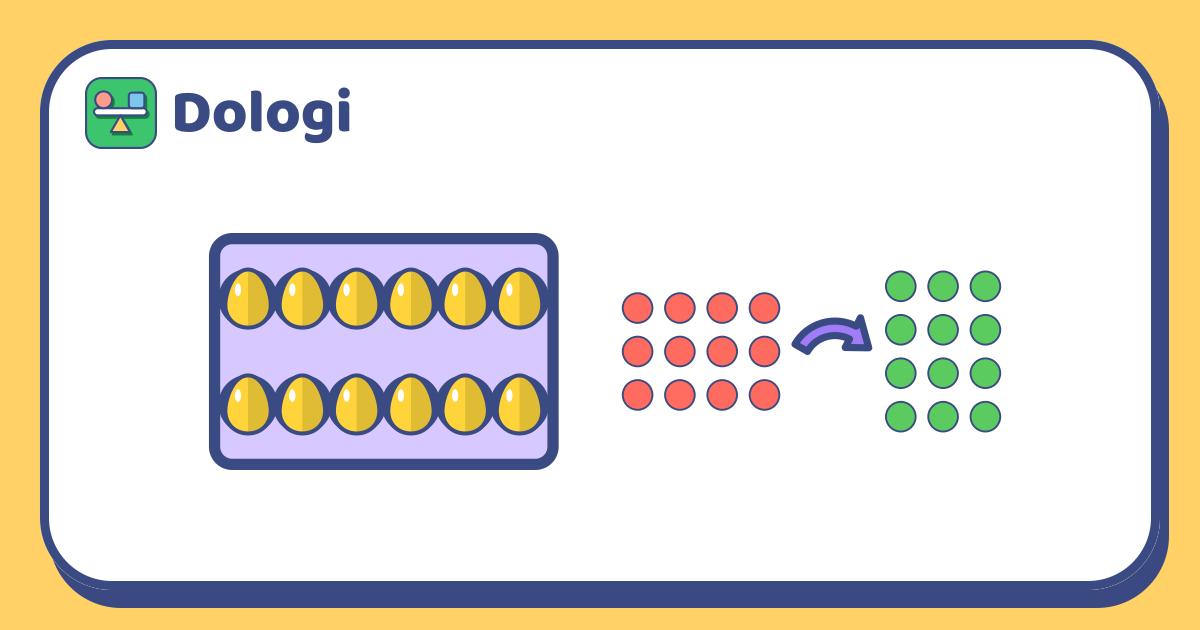
Sooner or later, times tables come home. Some children chant them happily, others get stuck at 7 × 8 and decide they are "bad at maths". Parents then wonder: should we drill the tables until they stick, or slow down and explain? The good news is that you do not have to choose. Children do need to know the facts by heart in the end, but recall comes much more easily, and lasts much longer, when it rests on understanding.
This article offers a simple order: first equal groups, then patterns, then memory. Each step has activities you can do with things you already have at home.
Why understanding comes first
A child who has only memorised "seven eights are fifty-six" as a string of sounds has nothing to fall back on when the string slips. A child who knows that 7 × 8 means seven groups of eight (or eight groups of seven) can rebuild the answer: "7 × 8 is double 7 × 4, and 7 × 4 is 28, so 56."
Understanding also makes the job smaller. A table from 1 × 1 to 10 × 10 has 100 facts. Once a child sees that 3 × 4 and 4 × 3 give the same answer, only 55 different facts are left. Add the easy tables (× 1, × 2, × 5 and × 10), and only 21 facts remain to learn, all made from the numbers 3, 4, 6, 7, 8 and 9.
Step 1: equal groups
Multiplication is a quick way of adding equal groups. Before any symbols, let your child build and count groups:
- Plates and snacks. Four plates, three crackers on each. "How many crackers altogether?" Your child may count one by one at first. Later, they will count "3, 6, 9, 12".
- Egg boxes. A box of twelve holds two rows of six. Fill it with eggs, buttons or pasta: "How many rows? How many in each row?"
- Groups around the house. Wheels on three bikes, legs on four chairs, fingers on two hands. Ask: "How many groups? How many in each group?"
Then lay the groups out in neat rows. A rectangle of objects, three rows of four, is called an array. Turn it a quarter turn and it becomes four rows of three, with exactly the same number of objects. This one picture explains why 3 × 4 = 4 × 3, and it is worth showing more than once.
A small note: schools do not all read "3 × 4" the same way. Some read it as "three groups of four", others as "four, taken three times". The answer is 12 either way, which is exactly what the array shows.
Step 2: find the patterns
Once groups make sense, help your child notice that each table has its own shortcut. Discovering these is more useful than being told them, so ask "What do you notice?" before explaining.
| Table | Pattern to notice | Example |
|---|---|---|
| × 2 | Doubles; the answers are the even numbers | 2 × 8 = 8 + 8 = 16 |
| × 10 | The number with a 0 on the end | 10 × 6 = 60 |
| × 5 | Half of × 10; answers end in 5 or 0 | 5 × 8 is half of 80: 40 |
| × 4 | Double, then double again | 4 × 7: 14, then 28 |
| × 3 | × 2 plus one more group | 3 × 8 = 16 + 8 = 24 |
| × 6 | × 5 plus one more group | 6 × 7 = 35 + 7 = 42 |
| × 8 | Double three times | 8 × 7: 14, 28, 56 |
| × 9 | × 10 minus one group | 9 × 6 = 60 − 6 = 54 |
The nine times table hides another pattern children love: 9, 18, 27, 36, 45, 54, 63, 72, 81, 90. The tens digit goes up by one while the ones digit goes down by one, and from 18 to 90 the two digits always add up to 9.
Skip counting (counting in 2s, 3s, 5s…) belongs here too. Climb the stairs counting in threes, or clap every fourth number. It links adding and multiplying in a playful way.
Step 3: then remember, a little at a time
When your child understands the facts and has strategies for them, it is time to make them quick. Memory grows with short, regular practice, not with long sessions.
- A few facts at a time. Choose two or three facts for the week, for example 6 × 7, 7 × 8 and 6 × 8. Mix them with facts your child already knows.
- Five minutes is enough. A few questions in the car or while setting the table work better than half an hour at the desk.
- Dice multiplication. Roll two dice and multiply the numbers. Whoever says the answer first scores a point. To practise one table, roll a single die and multiply by that table's number, for example always by 7.
- Make a number in rectangles. Give your child 12 or 24 buttons: "How many different rectangles can you make?" For 12, there are 1 × 12, 2 × 6 and 3 × 4 (and the same ones turned around).
- Ask "How did you get it?" Strategies are worth sharing. If your child says "6 × 7 is 42 because 6 × 6 is 36 and one more 6", that is real understanding.
- Keep a "facts I know" list. Ticking off facts shows progress and makes the 21 hard ones feel smaller and smaller.
What to avoid
- Timed tests before understanding. Speed pressure can make children anxious and push them to guess. Speed comes after confidence.
- Reciting the whole table to find one fact. Chanting "7, 14, 21…" until reaching 7 × 8 is a good start, but encourage using a strategy instead.
- Comparisons. Children learn tables at different rates. Many meet multiplication in the early primary years, and every child needs a different amount of time.
- "I was never good at maths." Children pick up on our attitudes. Say instead, "This one is tricky. Let's find a way to work it out."
In Dologi, the "Number line hops" puzzles in the Math topic ask children to follow a rabbit making equal hops along a number line. Each hop is the same size, which is skip counting in action, a small but useful step towards multiplication.
In short
- Children do need to know their times tables by heart, but memory lasts longer when it rests on understanding.
- Start with equal groups and arrays made from everyday objects. Turning an array shows that 3 × 4 = 4 × 3.
- Then find each table's pattern, so a forgotten fact can be rebuilt from one you know.
- Finally practise a few facts at a time, in short and regular games, without timers.
Read more: Patterns in numbers: odd and even, counting in twos and skip counting.