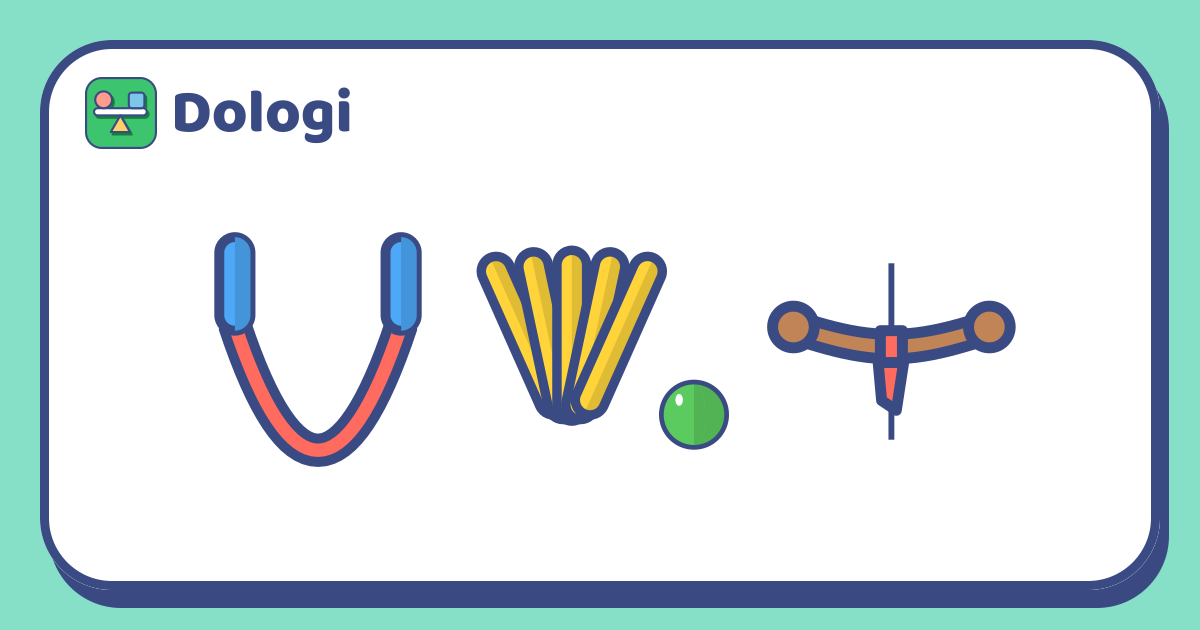
"Twenty-three, twenty-four, twenty-five… oops! Again!"
Before screens and plastic toys, children played with whatever was at hand: a rope, a few sticks, a ball or a small fruit. Many of those games are still played in schoolyards around the world, and they are worth teaching at home. They need almost nothing, they get children moving, and each one quietly trains something: rhythm, attention, careful hands, or playing fairly as a team.
Jump rope: rhythm and counting
Jumping rope looks simple, but it asks children to feel a rhythm and jump at exactly the right moment. Build up in small steps:
- Rope on the ground. Lay the rope straight and jump over it, forwards, backwards and sideways.
- The wiggly snake. Two adults crouch and wiggle the rope along the ground; your child jumps over without touching it.
- The swinging rope. Swing the rope gently from side to side, low, like a pendulum. Your child jumps each time it comes past.
- The turning rope. Two people turn a long rope in full circles. Your child starts standing in the middle, then learns to run in.
- Their own rope. Most children manage a short rope on their own somewhere between about six and eight.
Count every jump out loud. Children love beating their own record, and counting in rhythm (one jump, one number) is good practice for younger ones. Older children can count in twos, or count backwards from twenty.
Jump on a flat, non-slippery surface, wearing shoes, with enough space around.
Stick-and-ball jacks: focus and careful hands
Children in Vietnam play a game called chơi chuyền with about ten thin sticks and a small ball, often a small round fruit. It belongs to the same family as jacks, which children play in many countries with small pieces and a ball. The idea:
- Hold the sticks in one hand and drop them on the floor.
- Toss the ball up, pick up one stick with the same hand, and catch the ball before it falls. Keep going until all the sticks are picked up.
- Next round: pick up two sticks each time, then three, and so on, up to all ten at once.
- If you miss the ball or touch a stick you didn't pick up, it's the next player's turn.
For younger children, use a bouncy ball and let it bounce once before catching. That gives more time and makes the game possible from about five.
The game asks a lot of attention: eyes on the ball, hand on the sticks, and both at once. It also hides some maths. In the "threes" round, ten sticks make three groups of three, with one left over. Ask: "How many times will you pick up three? What happens to the last one?" Families have their own rules for leftovers, and deciding together is part of the fun.
Tug of war: teamwork and fairness
Tug of war needs a long, thick rope, a ribbon tied in the middle, and a line on the ground. Draw two more lines, one step either side of the middle. The team that pulls the ribbon past their own line wins.
Children quickly learn that pulling together, at the same moment, matters more than pulling hard. A shared count ("one, two, three, pull!") is a good first lesson in teamwork.
Fairness is the other lesson. Ask the children to make two even teams: "Is it fair if all the big children are on one side?" Swapping players between rounds is a nice piece of reasoning.
Safety points:
- Play on grass or a soft surface.
- Never wrap the rope around a hand, wrist or body.
- An adult gives the signal to start and to stop.
- When a game ends, both teams stop pulling; nobody lets go suddenly.
Simple rules for younger children
| Rough age | What to try |
|---|---|
| 4–5 | Jumping over a rope on the ground and the wiggly snake; picking up sticks one at a time with a bouncing ball; a short tug of war on grass |
| 6–7 | The swinging and turning rope; counting jumps; jacks with "ones" and "twos" |
| 8–9 | Their own rope; counting in twos; all the jacks rounds; picking even teams |
| 10 and up | Rope tricks and long jumping rhymes; inventing new jacks rounds; agreeing rules as a group |
Ages are only a rough guide, and every child is different.
In Dologi, the Focus topic has puzzles such as "Follow the cup", where cups move around and your child keeps their eyes on the one that hides an object. It's the same steady attention that catching the ball in jacks needs.
In short
- Jump rope trains rhythm and timing; build up from a rope on the ground and count every jump.
- Stick-and-ball jacks trains attention and careful hands, with groups of one, two and three sticks hiding a little maths.
- Tug of war is about pulling together and making fair teams, with clear safety rules.
- Keep the rules simple for younger children and let older ones agree on their own.
Read more: Hopscotch: counting, hopping and keeping your balance