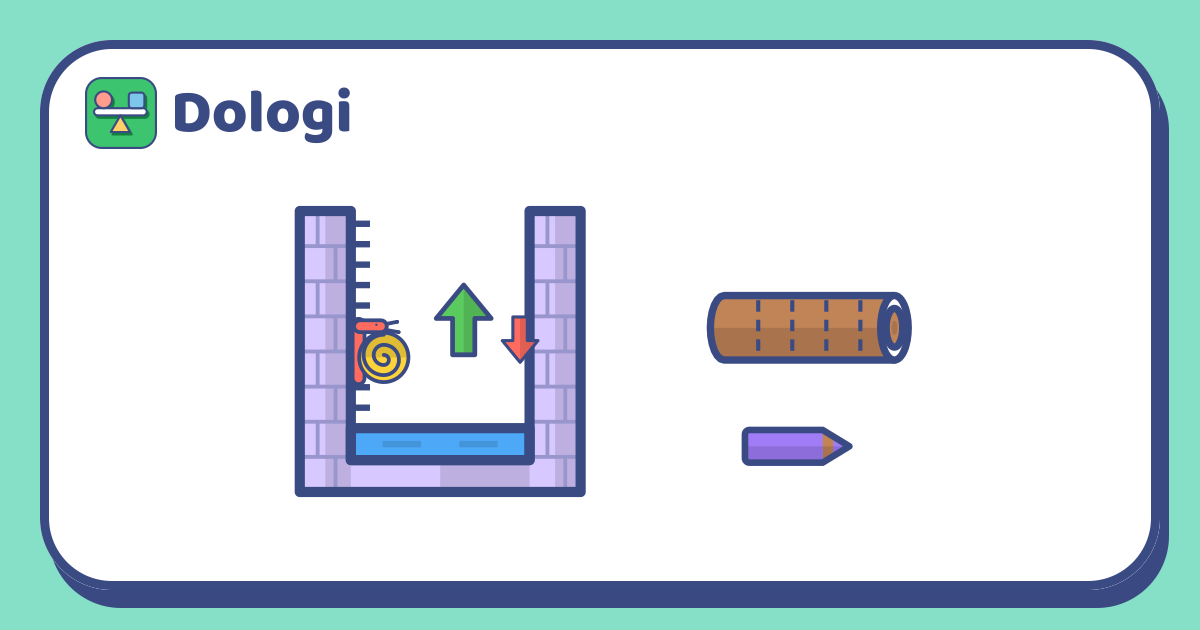
"A snail climbs 3 metres by day and slips back 2 metres at night. How many days to climb out of a 10-metre well?" Most people, adults included, say "10" straight away, and it's wrong. Puzzles like this are wonderful for children of around 8 to 12 because the trap isn't the arithmetic. The trap is answering too fast. The cure is a habit that's useful far beyond puzzles: slow down and draw it.
Below are eight classic tricky puzzles in three groups, each told in our own words. The tables give the question, the answer most people blurt out, and a hint. The full answers, and a way to act each one out, are in the fifth section. Let your child give their first answer, then say: "Draw it and check."
Why the quick answer is so tempting
When we read a word problem, our brain grabs the numbers and reaches for the most obvious sum: 10 metres and 1 metre a day makes 10 days; 5 pieces means 5 cuts. These puzzles are built so that the obvious sum looks right but misses one detail.
That's why the best hint is not "think harder" but "show me". A quick sketch, a row of dots, a piece of string or a few sticks make the missing detail visible. Many children are surprised by how often a drawing beats their first answer, and that surprise is the lesson.
Counting the gaps, not the things
| Puzzle | The question | Tempting answer | Hint |
|---|---|---|---|
| 1 | You saw a log into 5 pieces. Each cut takes 2 minutes. How long does it take? | 10 minutes | Draw the log and mark where the saw goes |
| 2 | A straight fence is 10 metres long, with a post every 2 metres, including both ends. How many posts? | 5 posts | Draw a line, put a dot every 2 squares and count the dots |
| 3 | You read from page 12 to page 20 of a book, including both pages. How many pages did you read? | 8 pages | Write the page numbers one by one and count them |
| 4 | A clock strikes 4 times at 4 o'clock, and it takes 6 seconds from the first strike to the last. How long does it take at 8 o'clock? | 12 seconds | Draw 4 strikes as dots: how many gaps are there between them? |
These four share one idea: there are things (pieces, posts, pages, strikes) and there are gaps between them, and the two numbers are not the same.
Day and night, doubling
| Puzzle | The question | Tempting answer | Hint |
|---|---|---|---|
| 5 | A snail is at the bottom of a 10-metre well. Each day it climbs 3 metres, each night it slips back 2 metres. On which day does it get out? | Day 10 | Draw the well with a mark every metre and follow the snail day by day |
| 6 | A patch of water lilies doubles in size every day. It covers the whole pond on day 10. On which day did it cover half the pond? | Day 5 | Start from day 10 and go backwards one day |
Traps in the wording
| Puzzle | The question | Tempting answer | Hint |
|---|---|---|---|
| 7 | A pencil and an eraser cost 12 coins together. The pencil costs 10 coins more than the eraser. How much is the eraser? | 2 coins | If the eraser cost 2, how much would the pencil cost, and what would the total be? |
| 8 | 3 children make 3 paper boats in 3 minutes. How many children are needed to make 6 boats in 6 minutes? | 6 children | How long does one child take to make one boat? |
Puzzle 7 is a good one to try on the whole family. Ask everyone to say their answer before working anything out, then check together by putting each answer back into the question.
Answers and how to check with string and sticks
- 8 minutes. Five pieces need only 4 cuts. Check: lay 5 sticks end to end; the gaps between them are the cuts.
- 6 posts. The fence has 5 gaps of 2 metres, and one more post than gaps. Check: lay a piece of string on the floor and put a toy every two steps along it.
- 9 pages. 20 − 12 = 8 counts the gaps; both end pages are read, so add one. Check: open a real book and count page by page.
- 14 seconds. 4 strikes have 3 gaps, so each gap is 2 seconds. 8 strikes have 7 gaps: 7 × 2 = 14. Check: clap 4 times while someone times you, then clap 8 times.
- Day 8. After 7 days and 7 nights the snail is at 7 metres. On day 8 it climbs 3 metres, reaches 10 and is out before night comes. Check: use a ruler or a strip of paper with 10 marks and move a coin up 3 and down 2.
- Day 9. If it doubles every day, it was half the size the day before it was full. Check: draw a pond as a strip of 16 squares and colour 1, 2, 4, 8, 16 squares on days 6 to 10.
- 1 coin. If the eraser cost 2, the pencil would cost 12 and the total would be 14. The eraser costs 1 and the pencil 11: 11 + 1 = 12, and 11 is 10 more than 1. Check: use 12 counters and split them into two piles where one pile has 10 more.
- 3 children. Each child makes 1 boat in 3 minutes, so 2 boats in 6 minutes. 3 children make 6 boats. Check: act it out with a timer and paper, or with counters for boats.
When your child has the right answer, ask them to explain where the quick answer went wrong. Being able to say "the trap was that there are fewer cuts than pieces" is worth more than the answer itself. Then invite them to make up a puzzle of the same kind for you: a row of trees, a ladder with rungs, a train with carriages.
In Dologi, the "Number line hops" puzzles in the Math topic train the same careful counting: you count the hops, not the marks on the line.
In short
- In these puzzles, the arithmetic is easy; the trap is answering before picturing the situation.
- The best hint is "Draw it": a row of dots, a sketch of the well, a strip of squares.
- Many traps are about gaps versus things: pieces and cuts, posts and spaces, strikes and pauses.
- Check every answer by putting it back into the question, then let your child invent a puzzle of the same kind.