Lots of children love anything with wheels: they count the carriages on a passing train and name every vehicle in the street. You can turn that love into puzzles. Your child still plays with the things they like, but now they have to count, follow a route and check clues to find the answer.
This article has four sets of original puzzles, from easier to harder, each with a suggested age, two levels of hints and the answer. All you need is paper, a pencil, some bottle caps and a few toy vehicles if you have them.
Getting ready
- Pick puzzles to suit your child. The ages are rough guides; every child is different.
- Build it with real things. Bottle caps for wheels, yarn for track, toy cars in boxes drawn on paper.
- Give hints in steps. Hint 1 points to where to look, hint 2 gets closer. Let your child try for a while first.
- Ask "how do you know?" even when the answer is right.
Counting wheels
Warm-up (around 4–5). A car park has 2 bicycles, 1 tricycle and 1 car. How many wheels are there altogether?
- Hint 1: Put a bottle cap next to each vehicle for every wheel.
- Hint 2: Count on instead of starting again: the two bicycles make 4, then add the tricycle, then the car.
Answer: 11 wheels: 4 + 3 + 4 = 11.
Harder (around 7–8). A car park has only bicycles and cars, 5 vehicles in all. You count 14 wheels. How many of each?
- Hint 1: Pretend all 5 are bicycles. How many wheels would that be?
- Hint 2: Swapping one bicycle for a car adds how many wheels?
Answer: 3 bicycles and 2 cars. Five bicycles would have 10 wheels, 4 short. Each swap adds 2 wheels, so you swap 2. Check: 3 × 2 + 2 × 4 = 14.
Which station will the train reach?
Draw a track on paper or lay yarn on the floor. At each switch the track splits into two branches. One branch has a bar across it: the train can't go past a bar, so it takes the other branch.
First puzzle (around 5–6). The track runs to one switch. The top branch goes to a red station with a circle sign, the bottom branch to a blue station with a triangle sign. The top branch has a bar. Where does the train go?
Answer: the blue station with the triangle sign. Then move the bar to the bottom branch and ask again: one bar is enough to change where the train ends up.
Two switches (around 6–8). The train reaches switch 1 first.
| Switch | Left branch goes to | Right branch goes to | Bar on |
|---|---|---|---|
| 1 | switch 2 | switch 3 | right branch |
| 2 | Circle station | Triangle station | left branch |
| 3 | Square station | Star station | right branch |
Your child draws a map from the table and follows the train.
- Hint 1: Start at switch 1. Which branch does the train take?
- Hint 2: Ask the same question at the next switch. A switch the train never reaches can be ignored.
Answer: Triangle station. At switch 1 the right branch is blocked, so the train goes left to switch 2. There the left branch is blocked, so it goes right to Triangle station. Switch 3 is only there to distract.
Working backwards (around 7–8). Same map. To send the train to Star station, at which switches do you move the bar to the other branch?
Answer: switches 1 and 3. The train must go right at both, and both currently block the right branch. Switch 2 stays as it is, because the train never goes through it.
Who parks where?
First puzzle (around 5–6). Three spaces in a row: left, middle, right. Three cars, red, green and yellow, one in each space.
- The green car is in the right space.
- The yellow car is right next to the green car.
- Hint 1: Start with the car whose space a clue tells you exactly.
- Hint 2: Which space is right next to the right-hand space?
Answer: red on the left, yellow in the middle, green on the right.
Harder (around 7–8). Four spaces, numbered 1 to 4 from left to right. Four vehicles: a purple bicycle, a red car, a green car and a yellow tricycle.
- The purple bicycle is at one end.
- The red car is right next to the green car, on its left.
- The yellow tricycle is not next to the purple bicycle.
- The yellow tricycle is somewhere to the right of the red car.
- Hint 1: The bicycle has only two possible spaces. Try each one.
- Hint 2: For each try, put the two cars side by side, then see where the tricycle fits clues 3 and 4.
Answer: 1 purple bicycle, 2 red car, 3 green car, 4 yellow tricycle. With the bicycle in space 1, the tricycle can't be in space 2, so the cars take 2 and 3 and the tricycle takes 4: every clue fits. With the bicycle in space 4, the tricycle can't be in space 3, so the cars take 2 and 3 and the tricycle is left with space 1, to the left of the red car: that breaks clue 4.
The vehicle that doesn't belong
First puzzle (around 4–5). Bicycle, motorbike, car, boat. Which one doesn't belong?
The usual answer is the boat: it has no wheels and travels on water. If your child picks another one with a sensible reason, that counts too.
Two answers (around 6–8).
| Vehicle | Kind | Colour | Wheels |
|---|---|---|---|
| A | car | red | 4 |
| B | bicycle | red | 2 |
| C | car | blue | 4 |
| D | car | red | 4 |
Which one doesn't belong? There are two correct answers.
- Hint 1: Look at one feature at a time: kind, colour, wheels.
- Hint 2: For each feature, is one vehicle different from the other three?
Answer: B, the only one that isn't a car and has 2 wheels, and C, the only blue one. Different features make different groups, so your child should always say which feature they're looking at.
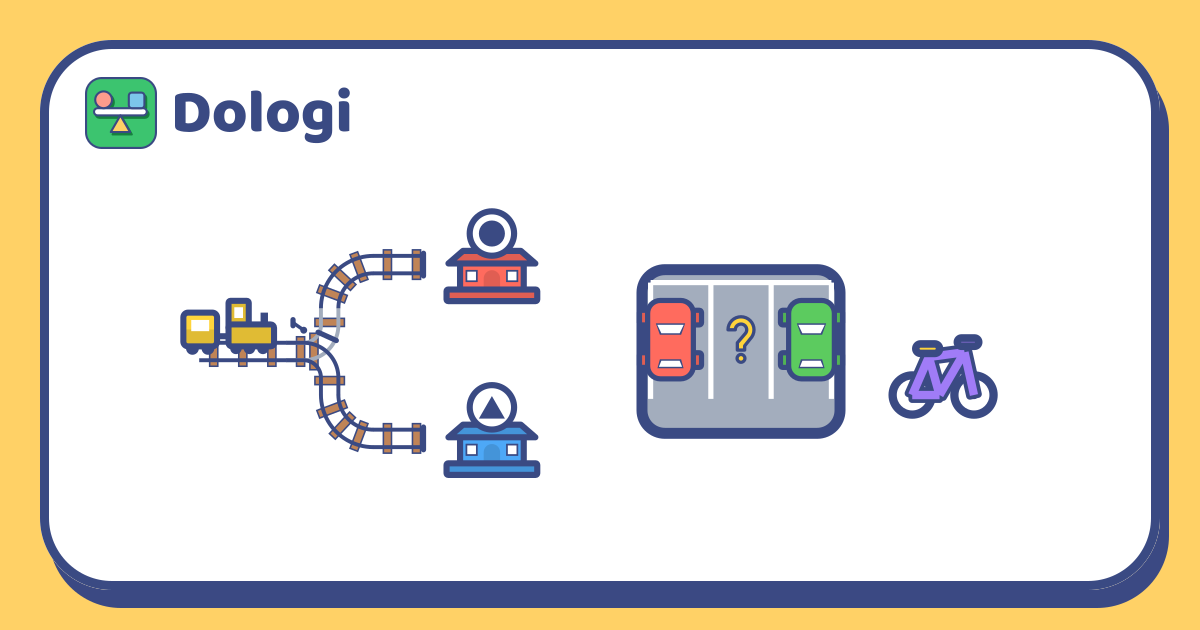
In Dologi, the Space topic has a puzzle type called "Which station?": your child follows the track from the train, takes the open branch at every switch instead of the one with a bar, and picks the station the train will reach.
In short
- A love of vehicles is an easy way in to counting, following routes, checking clues and sorting.
- Build puzzles with real things: bottle caps, yarn, toy cars in drawn boxes.
- Give hints in steps, and ask "how do you know?" even when your child is right.
- Swap roles: your child places the bars or writes parking clues for you to solve.
Read more: Puzzles for 4-to-5-year-olds with answers: odd one out, counting dots, shadow matching