The walk to the shop is "boring" and "too far". The same walk with a card in the hand and nine things to find is over before anyone has complained.
Walk bingo turns walking into looking. Children slow down, lift their eyes and start to notice what is on the route: the bird on the wire, the red door, the snail on the wall.
Making the card before you leave
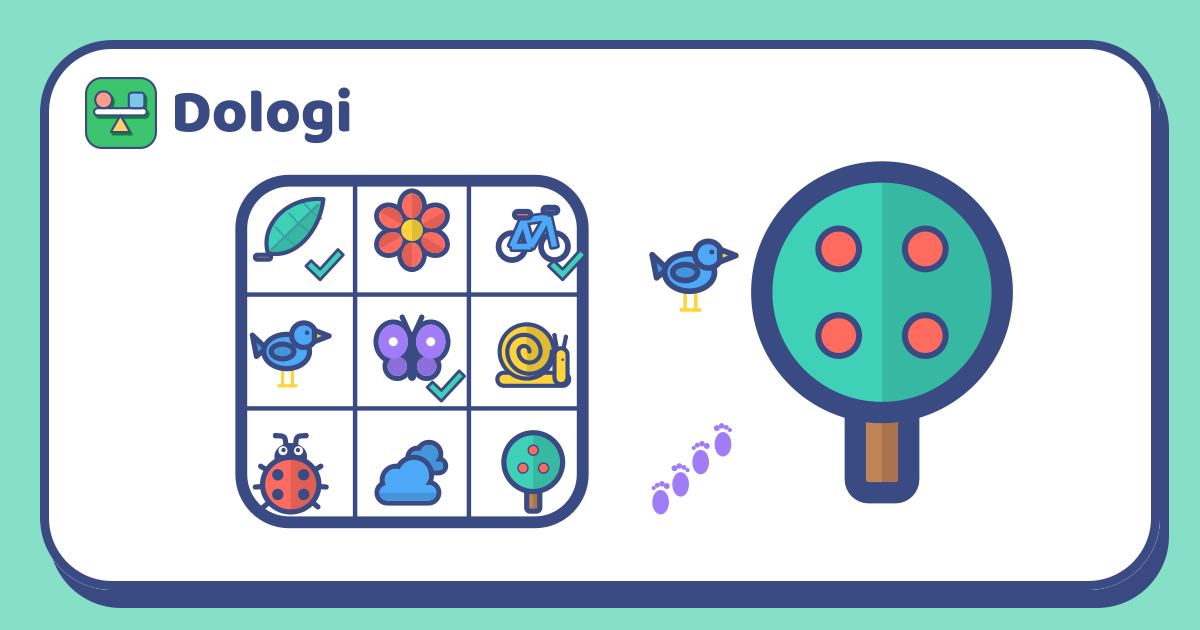
- Draw three rows of three squares on a piece of card. Clip it to something stiff and tie a pencil to it.
- Choose the nine things together. Think about this particular route and mix easy things (a tree, a car) with harder ones (a feather, a snail, something yellow).
- Draw a small picture in each square. No words are needed, and your child can draw some of them.
Two rules for the road, agreed before you set out. Look, don't pick: flowers and leaves stay where they are. And stop to tick: the card is only for standing still, never for crossing a street.
How to play
- When your child spots something on the card, they point, say what and where it is, and tick the square: "A bird, on the fence!"
- Three ticks in a row is bingo. On a long walk, go for the whole card.
- With several children, share one card as a team. It keeps the walk friendly.
Six kinds of squares
| Kind of square | Example | What it practises |
|---|---|---|
| A thing | A bicycle, a leaf | Recognising things in a busy scene |
| A thing with a feature | A red car, a flower with five petals | Looking at details |
| A number | Three birds together, a door with a 7 | Counting on the move |
| A shape | Something round, a triangle | Finding shapes in real things |
| A sound | A dog barking, a bell | Listening as well as looking |
| A comparison | A leaf bigger than your hand | Comparing sizes |
Start with plain things and add one new kind of square at a time.
A card for every day
The game stays fresh because the card changes.
- By weather. A rainy-day card has a puddle, an umbrella and a snail. A sunny-day card has a shadow, a butterfly and someone in a hat.
- By place. The park, the market, a bus ride and the way to school all need different squares.
- By time of year. Walk the same route a few months later and ask what should come off the card and what should go on.
When you get home
A few questions turn the card into a conversation.
- "What did we find first? What was the hardest?"
- "Was there something we saw many times?" Older children can keep a tally on the back of the card.
- "Which three things shall we put on the next card?"
The last question asks for a prediction. Is a snail likely on a dry day? Will there be birds at noon? Thinking about what is likely or unlikely on a walk is an early taste of probability.
| Rough age | What to try |
|---|---|
| 4–5 | Six to nine easy pictures; ticking anything that is found |
| 6–7 | Three in a row; squares with a colour or a number |
| 8–9 | Sound and comparison squares; a tally of how often each thing appeared |
| 10 and up | Designing the family's card with one rare square; saying beforehand what is likely and unlikely |
Ages are only a rough guide, and every child is different.
In Dologi, the Focus topic includes "Spot the difference" puzzles where children compare two scenes and tap what has changed. It is the same patient looking, on a screen and for a few minutes.
In short
- A card of nine pictures made before the walk gives children something to look for.
- Look, don't pick, and stop to tick: two rules that keep the game safe and kind to the neighbourhood.
- Squares can ask for things, features, numbers, shapes, sounds or comparisons.
- Changing the card with the weather, the place and the time of year keeps the game new.