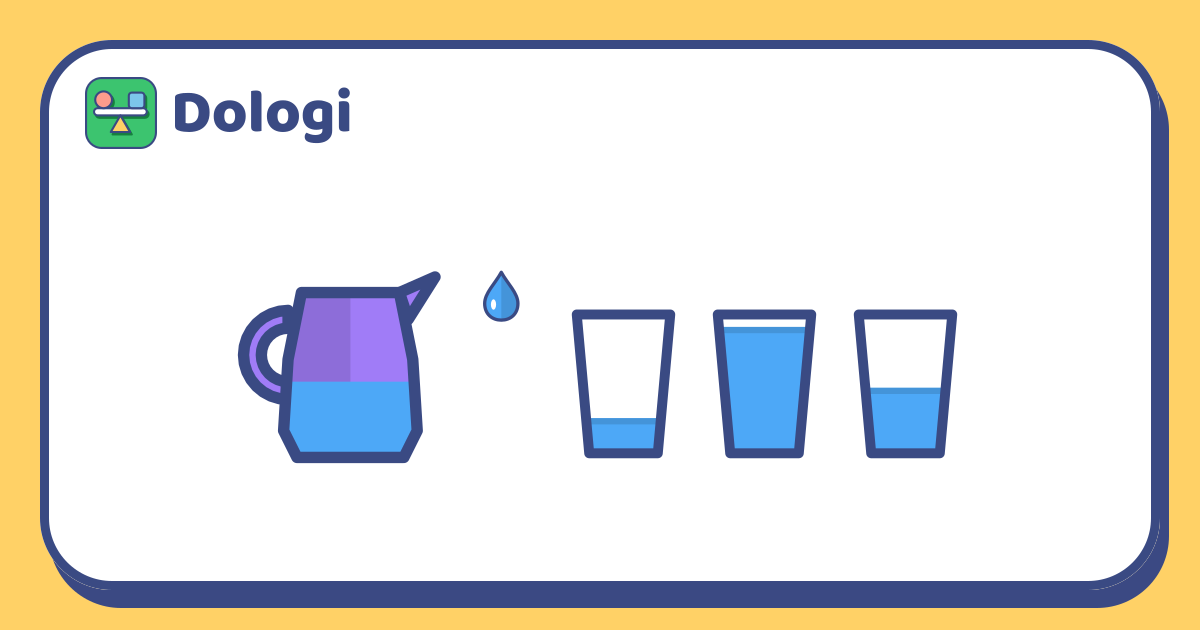
"This one has more! No wait… it's the same?"
Children love water, and pouring it from one container to another is more than splashing. It's an early lesson in measuring: how much fits, which holds more, what "half full" means. All you need is a tray or a bath, a towel and a few containers of different shapes.
Setting up
- A large tray, a washing-up bowl, the bath, or a spot outside.
- A small jug children can hold with one hand.
- Containers of different shapes: cups, bowls, plastic bottles, a measuring cup, spoons, a funnel.
- Towels for the spills, which are part of the game.
Never leave a young child alone with water, even a shallow tray.
Pouring and filling
Pouring takes practice: holding the jug steady, tipping slowly, stopping in time.
- Fill to the line. Put a strip of tape on a cup. Can your child fill it exactly up to the tape?
- Half full. Ask for a cup "half full", then "nearly full", then "nearly empty". These words become clear when children make them with their own hands.
- Through the funnel. Pour into a bottle with a narrow neck, first without a funnel, then with one.
Which holds more?
Put two containers of different shapes side by side, such as a tall bottle and a wide bowl. Ask: "Which one holds more water?" Then find out together.
- Pour across. Fill one to the top and pour it into the other. If it overflows, the first held more. If there's room left, the second holds more.
- Count in cups. Fill each one using a small cup and count: "The bottle takes five cups, the bowl takes four." Measuring with the same small cup is a first step towards measuring in litres later.
Guessing first, then checking, is the heart of the activity. Children often get it wrong at first, and that's exactly what makes the checking interesting.
The tall glass surprise
Here's a simple experiment. Pour the same amount of water into two identical glasses. Your child agrees they're the same. Now, while your child watches, pour one of them into a tall, thin glass. Ask: "Is there more water now, less, or the same?"
Many children under about six or seven say the tall glass has more, because the water is higher. Don't correct them. Pour it back into the first glass and ask again. Children usually work this out in their own time, often around six to eight, and it's fascinating to see the moment it clicks: "It's the same water, it just looks taller!"
Making amounts equal
Line up three glasses with different amounts of water.
- Put them in order from least to most.
- "Can you make them all the same?" Your child pours from one to another until the levels match.
- "Share this jug fairly between three cups." Sharing water equally is harder than sharing biscuits, and a good puzzle.
Bring it into the kitchen too: measuring cups and spoons when you cook together use the same ideas.
| Rough age | What to try |
|---|---|
| 3–4 | Filling and pouring; full and empty; pouring through a funnel |
| 5–6 | Fill to the line; half full; which holds more, guess then check |
| 7–8 | Counting in cups; the tall glass experiment; three glasses in order |
| 9 and up | Measuring cups and millilitres; sharing a jug equally; designing their own "which holds more" challenge |
Ages are only a rough guide, and every child is different.
In Dologi, "Put in order" puzzles in the Math topic sometimes show glasses with different amounts of water to line up from least to most, the same comparing your child does at the water tray.
In short
- A tray, a jug and different containers make a small maths lab.
- Pouring to a line or "half full" turns words like full and empty into something children can do.
- "Which holds more?" is best answered by guessing first, then pouring across or counting cups.
- The tall glass surprise shows that the same amount can look different; let children discover it in their own time.
Read more: Water jug puzzles for children: measuring with two containers