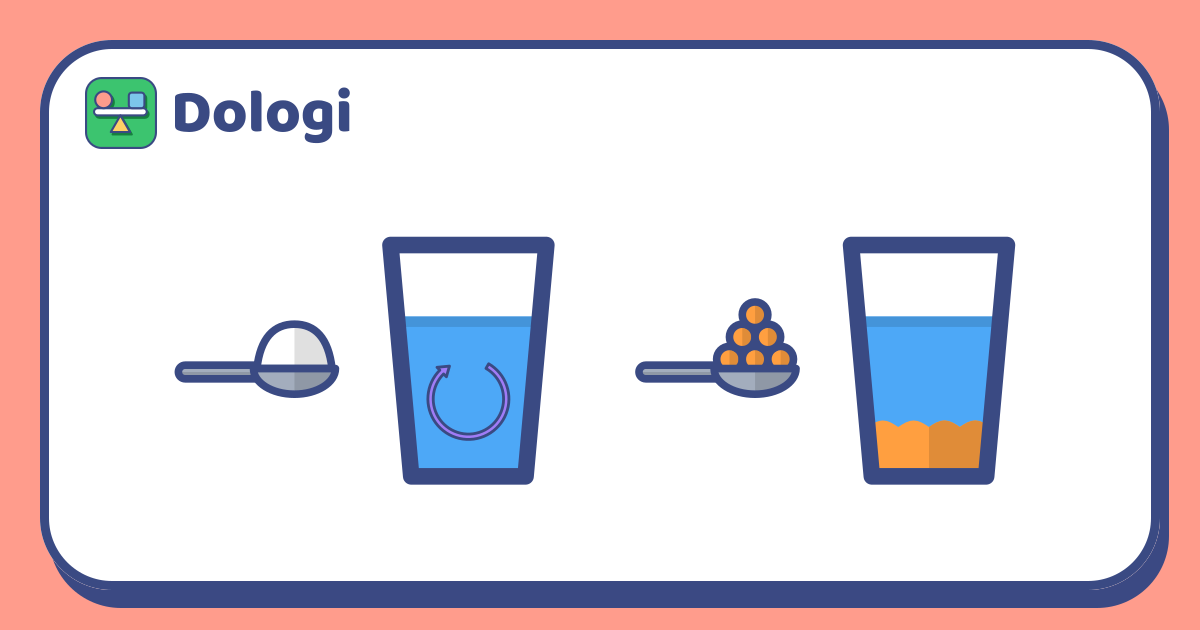
Your child stirs a spoonful of sugar into a glass of water, and a few seconds later it's gone. The water looks just as clear as before. So where did the sugar go? Meanwhile, a spoonful of sand can be stirred and stirred and still sits stubbornly at the bottom. Why do two things that look so alike behave so differently?
A dissolving experiment needs only a few glasses and some kitchen basics, yet it practises exactly the habits of a scientist: guess first, test, look closely, write it down, then try again with one small change. This article walks you through it step by step, from a simple version for five-year-olds to harder questions for nine- and ten-year-olds.
What you need
- Four or five clear glasses, each with the same amount of water (mark the level with a strip of tape so they match).
- A few things to test: sugar, salt, clean sand, flour and a few grains of rice. Instant coffee or cocoa powder work too, if you have them.
- A small spoon so each test uses the same amount, and a separate stirring stick for each glass.
- A sheet of paper for a chart, coloured pencils and a cloth.
With younger children, you pour the water and they scoop and stir. It's also a good moment to share a scientist's habit: only taste things that are food, from a clean cup, and ask a grown-up first.
Guess first, then stir
Before each glass, ask your child: "Do you think this will disappear completely, or will we still be able to see it?" Write the guess in the chart. Then add one spoonful, stir about twenty times, look closely, leave the glass for five minutes and look again.
| What we added | My guess | Just after stirring | After five minutes |
|---|---|---|---|
| Sugar | Dissolves | Clear water, no grains | Still clear |
| Salt | Doesn't dissolve | Clear water, no grains | Still clear |
| Sand | Doesn't dissolve | Cloudy, sand swirling | Sand on the bottom, water clear again |
| Flour | Dissolves | Cloudy white | Some settles, water still a bit cloudy |
| Rice | Doesn't dissolve | Grains sink | Grains still there |
Children who can't write yet can draw a tick for "dissolves" and a cross for "doesn't dissolve". The "after five minutes" column really matters: some things look as if they have dissolved while you stir, and only show their true nature once the water is still.
What does "dissolve" mean?
Explain it simply: when sugar dissolves, it doesn't vanish. It breaks up into pieces so tiny that our eyes can't see them, and they spread evenly through the whole glass.
How can we tell the sugar is still there? Your child can taste a drop of the sugar water: it's still sweet. Or wait for the last part of this article, when the sugar comes back on a plate.
Sand is different. Sand grains don't break up in water, so after stirring they just float around for a moment and then sink to the bottom. Flour sits somewhere in between: its very fine particles make the water cloudy, and many of them drift for quite a while before slowly settling. That's a great moment to ask: "If the water is cloudy, has it dissolved?"
Warm or cold, stirring or waiting?
Once your child can sort things into "dissolves" and "doesn't", ask the next question: "How could we make sugar dissolve faster?" Change only one thing at a time and keep everything else the same, so the test is fair.
- Warm water and cold water: two glasses with the same amount of water, one cold and one warm that you prepare (warm to the touch, never boiling). Add the same spoonful of sugar, stir at the same speed, and count the stirs until no grains are left.
- Stirring and waiting: two identical glasses, one spoonful of sugar each. Stir one and leave the other alone. How long does the still glass take?
- Big lumps and small grains: a sugar cube and a matching amount of granulated sugar. Which dissolves first?
Your child can record the results as a number of stirs or minutes on a clock. Older children can turn them into a simple bar chart.
How many spoonfuls before it stops?
This challenge suits children from about eight. Add salt to a glass of water one spoonful at a time, stirring well after each one, and make a tally mark for every spoonful. At some point, no matter how much you stir, grains stay on the bottom: the water is "full" and can't take any more.
Then ask: "If we used warm water, do you think it would take more spoonfuls or fewer?" Try again with the same amount of warm water and compare the tally marks. Your child will discover that a good experiment often leads straight to the next question.
Making sugar and salt reappear
Pour a little strong salt water (or sugar water) onto a dark plate and leave it somewhere airy, ideally sunny. Look at it together once a day. After a few days, the water evaporates and small grains of salt appear on the plate, sometimes as neat little cubes you can see clearly with a magnifying glass.
It's the perfect answer to the question at the start: the salt never went anywhere; it was just hiding in the water. When the water leaves, the salt stays behind.
Sorting things into "dissolves" and "doesn't dissolve" is how scientists group objects by their features. In Dologi, the "Two rings" puzzles in the Logic topic also ask children to sort objects by their features.
In short
- Sugar and salt dissolve in water; sand and rice don't; flour clouds the water and slowly settles, which is well worth talking about.
- Always ask for a guess first, then look twice: right after stirring and after a few minutes of stillness.
- Test warm against cold and stirring against waiting, changing only one thing at a time.
- Let salt water dry on a plate for a few days to see that what dissolved was there all along.
Read more: Fair test experiments for ages 7–11: change only one thing at a time