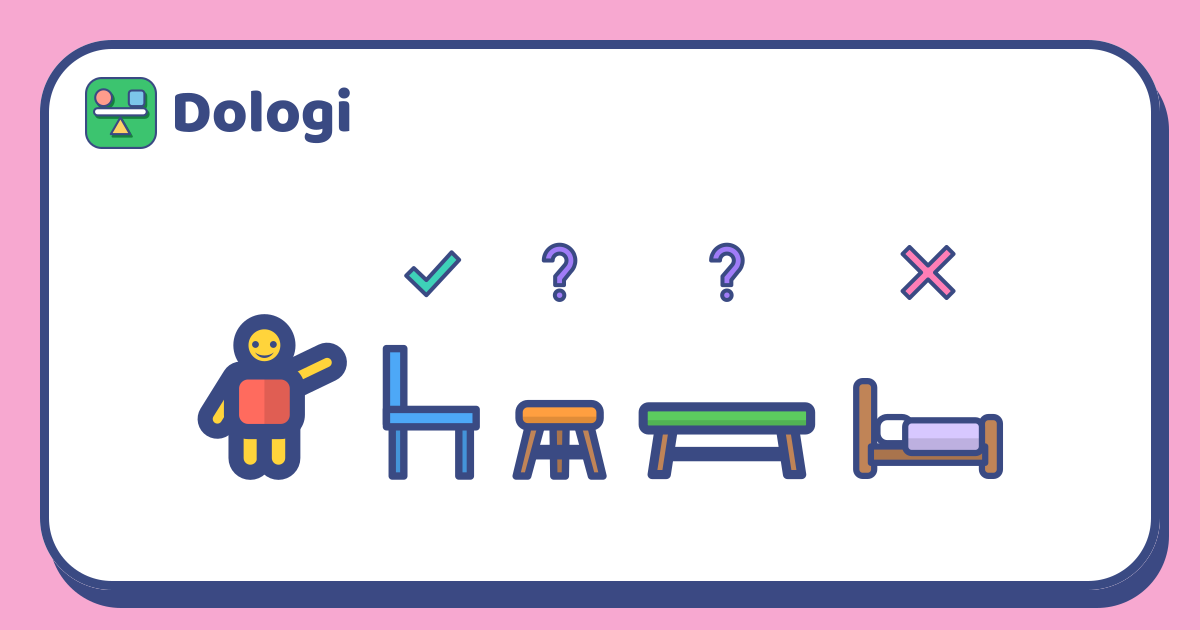
Ask your child "What is a chair?" and you will probably hear "It's for sitting." That answer is not wrong, but it lets in far too much. You can sit on a bed, on the stairs, on the floor and on a big rock at the beach. None of them is a chair.
Defining a word clearly is a small thinking skill with a big reach. To do it, a child has to listen to exactly what was said, look for the features that matter and leave out the ones that don't. This article gives you a simple recipe for definitions, a way to test them with counterexamples, and a few games that work at the dinner table or in the car. It suits children aged roughly 7 to 12; younger children can join the games with easier words.
Why a good definition is worth practicing
When children explain what a word means, they usually describe one use ("a cup is for drinking") or one example ("a pet is like our cat"). That is a natural first step. A clearer definition asks for more: it has to fit every chair and leave out everything that is not a chair.
Practicing this helps in several places:
- Listening. Your child learns to notice when a sentence says more, or less, than it seems to.
- Learning at school. Science and math are full of definitions: what counts as an insect, a triangle, a mammal. A child who knows how definitions work finds them easier to remember and to check.
- Arguing fairly. Many family disagreements are really about what a word means. "You promised we'd go to the park!" often turns on what "go to the park" includes.
A simple recipe: group, then difference
A useful definition has two parts. Many dictionary entries follow the same shape.
- The group. What bigger family does it belong to? A chair is a piece of furniture you sit on.
- The difference. What sets it apart from the others in that family? It is made for one person, and it has a back.
Put together: "A chair is a seat for one person, with a back." Now compare it with its neighbors:
| Thing | Same group? | What is different |
|---|---|---|
| Stool | A seat | No back |
| Bench | A seat | Made for several people |
| Sofa | A seat | Soft, for several people |
| Bed | Furniture | Made for lying down |
Try the recipe on other words. A spoon is a piece of cutlery with a small, shallow bowl at the end. A puddle is water lying on the ground, small and left by rain. Your child doesn't need perfect wording. What matters is naming a group and then a difference.
Test it with counterexamples
A counterexample is one case that breaks a rule. It is the quickest way to improve a definition, and children love finding them.
Take your child's first try and play detective together:
- "A chair is for sitting." Counterexample: a bed. Improve: "a chair is furniture made for sitting, not for lying down."
- "A bird is an animal that flies." Two counterexamples: a bat flies but is not a bird, and a penguin is a bird that doesn't fly. Improve: "a bird is an animal with feathers and a beak."
- "A fruit is something sweet." Counterexample: a lemon. Improve it together; a simpler answer is fine if it is honest about what it leaves out.
Take turns. Let your child hunt for counterexamples to your definitions too, and admit it when they catch you. The aim is not to win but to make the definition better each round.
Argue about the borderline cases
Some things sit right on the edge of a word, and that is where the best conversations happen. Pick one and ask: "Is it a chair? Why, or why not?"
- Is a stool a chair? Many people say no, because it has no back. Others say a bar stool clearly counts.
- Is a bench a chair? It is a seat with no back, but for several people.
- Is an armchair a chair? Is a beanbag? Is a car seat?
There is often no single right answer. Different families, and different languages, draw the line in different places. The skill is in the reasons: "I think a stool isn't a chair, because a chair needs a back." Encourage your child to use the definition you built together, or to change the definition and explain why.
A quick way to keep it organized is to sort things into three piles on paper: "definitely yes", "definitely no" and "we disagree". The last pile is not a failure. It shows where the word is fuzzy.
A guessing game with definitions
Once the recipe is familiar, turn it into a game.
- One player thinks of an everyday object and gives a definition with a group and a difference, without saying the word: "It's a kitchen tool. It has holes, and you use it to drain pasta."
- The others guess. If several things fit, the definition was too loose, so the player adds one more difference.
- Swap roles.
For younger players, keep to objects in the room. Older children can try harder words such as "island", "neighbor" or "holiday", where the group is less obvious.
In Dologi, the "Sort into groups" and "Two rings" puzzles in the Logic topic ask your child to place things by their features. In "Two rings", each thing goes into the ring whose label fits it, or into the shared middle when it fits both, which is the same "does it belong?" question in picture form.
In short
- A clear definition has two parts: the group a thing belongs to, and what sets it apart from the others in that group.
- Counterexamples are the fastest way to improve a definition: look for a case that fits the words but not the idea, or the other way around.
- Borderline cases such as stools and benches are great for practicing reasons, not for finding one right answer.
- A guessing game with definitions turns all of this into a few minutes of fun at the table or in the car.
Read more: The 20 questions game: guessing an object with yes-or-no questions, Sorting and comparing: the first thinking skills children use, Teaching children to give reasons: "I think so because…"