Your child works out an answer, then hears a friend say something different and quickly says "Oh, me too". At the dinner-table quiz, they wait to hear what their older sibling says before they answer. Many parents notice this and wonder whether their child lacks confidence.
Wanting to match the group is very common in children, and it is not always a problem. This article helps you tell when changing an answer is good thinking and when it is just avoiding being different, with a few games you can play at home to help your child say what they think and explain why.
Why children switch to the group's answer
There are many reasons a child changes their answer to match someone else's:
- They want to belong. Saying the same as everyone else feels safe, especially among friends.
- They assume others know better. An older sibling, a classmate who is "good at math", or a grown-up seems more likely to be right.
- They are not sure how they got their answer. If a child cannot say why they chose something, it is easy to let go of it.
- They are afraid of being wrong in front of others. Being wrong alone feels worse than being wrong together.
None of these mean something is wrong with your child. They are signs of a skill still growing: trusting your own reasoning while still listening to others.
A good change of mind and a change to fit in
Changing your mind is not the problem. Good thinkers change their minds all the time when they hear a better reason. What matters is why the answer changed.
| Changing with a reason | Changing to fit in |
|---|---|
| "I heard my friend's reason and checked again: they're right." | "Everyone chose B, so I'll choose B." |
| Your child can say what new information they heard | Your child cannot say why they changed |
| It happens after thinking again | It happens straight away, as soon as they hear others |
| Your child is still comfortable if they turn out to be wrong | Your child mostly cares about being the same as everyone else |
You can say this to your child directly: "It's fine to change your mind when you hear a good reason. Did you hear a new reason, or did you just see that others chose differently?"
Hold up your cards together
When answers are said one by one, whoever goes last is easily swayed by those before them. A simple fix is for everyone to answer at the same time.
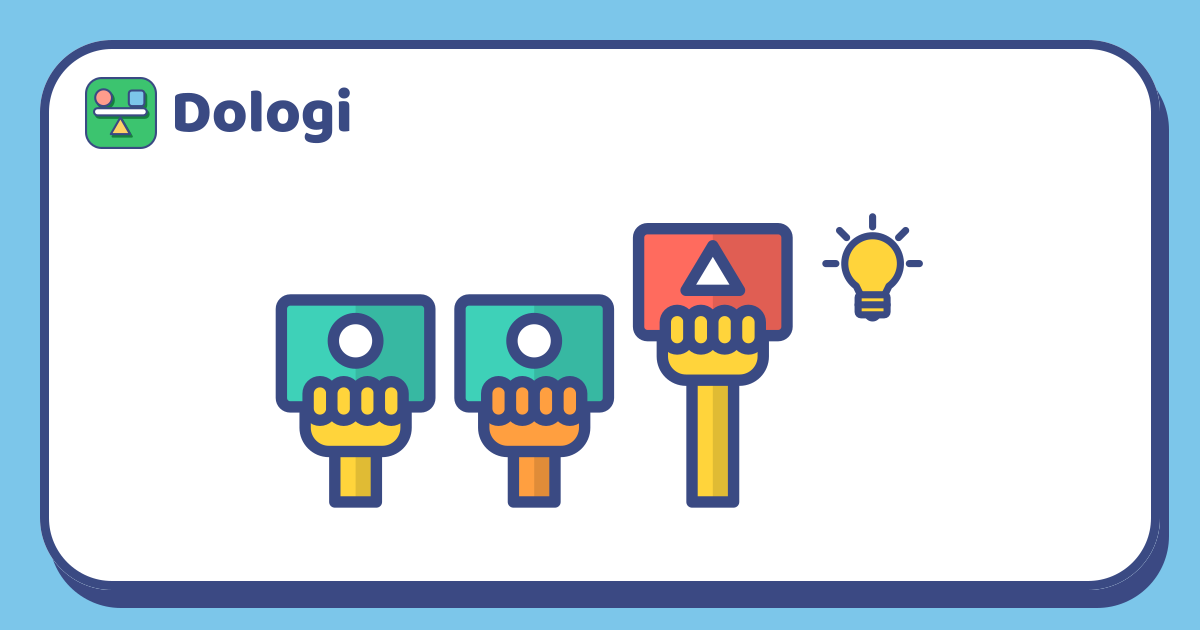
- Make answer cards. Each person gets two or three pieces of card of different colors, or with different shapes drawn on them: a circle, a triangle, a square.
- Ask a question with a few options. "Which is heavier, the apple or the bunch of keys?", "Which cup holds more water?", or a picture puzzle from a book.
- Everyone thinks quietly. Count to five together; nobody says anything yet.
- Hold up your cards together. On "one, two, three", everyone raises their chosen card at once.
- Explain before you check. Each person gives their reason, then you check together by weighing, pouring or counting.
When the cards go up at once, your child has to decide for themselves before seeing anyone else's choice. After a few rounds, many children start to enjoy being the only one holding a different card.
Practice saying "I think differently because…"
Children often go along with others because they don't know how to disagree politely. Give them a few phrases to use:
- "I think differently because…"
- "I chose this one because I saw…"
- "I'm not sure yet, can I count again?"
- "Your reason makes sense, so I'll change my answer."
The last phrase matters as much as the first ones. You want your child to know both ways: keeping their answer when they have a reason, and changing it when they hear a better one. Both are good thinking.
Read the phrases out together a few times, then use them for real in family games. When your child uses one, notice it: "You explained why you think differently, that was very clear."
Parents choose the wrong answer on purpose
A gentle way to practice is for you, the grown-up, to be the "majority".
- Pick an obvious wrong answer in an easy question, say it confidently, and get another adult to agree. See whether your child keeps their answer.
- If your child keeps it, ask: "Two people chose differently from you. Why do you still think you're right?" Then check together.
- If your child switches to match you, don't laugh or say "Got you!". Reveal it gently: "Actually, I chose wrong on purpose. Your first answer was right. What made you change it?"
- Praise the reason, not just the right answer. If your child keeps an answer that turns out to be wrong but explains clearly, you can still say: "You explained your reason clearly. Let's check together where it went wrong."
Use this trick occasionally and keep it light, so your child doesn't start to feel that every answer from a grown-up is a trap.
Puzzles you solve alone are also a good place to build trust in your own thinking. In the Logic topic of Dologi, your child chooses each answer for themselves, without seeing anyone else's choice. Afterwards, you can ask "How did you choose that one?" and let them explain.
In short
- Changing an answer to match the group is common in children. It is not the same as lacking confidence.
- Changing your mind is fine when there is a new reason. What matters is why the answer changed.
- Answer at the same time with cards, and give reasons before checking.
- Practice "I think differently because…" and "Your reason makes sense, so I'll change", and praise clear reasons, not just right answers.
Read more: Teaching children to give reasons: "I think so because…"