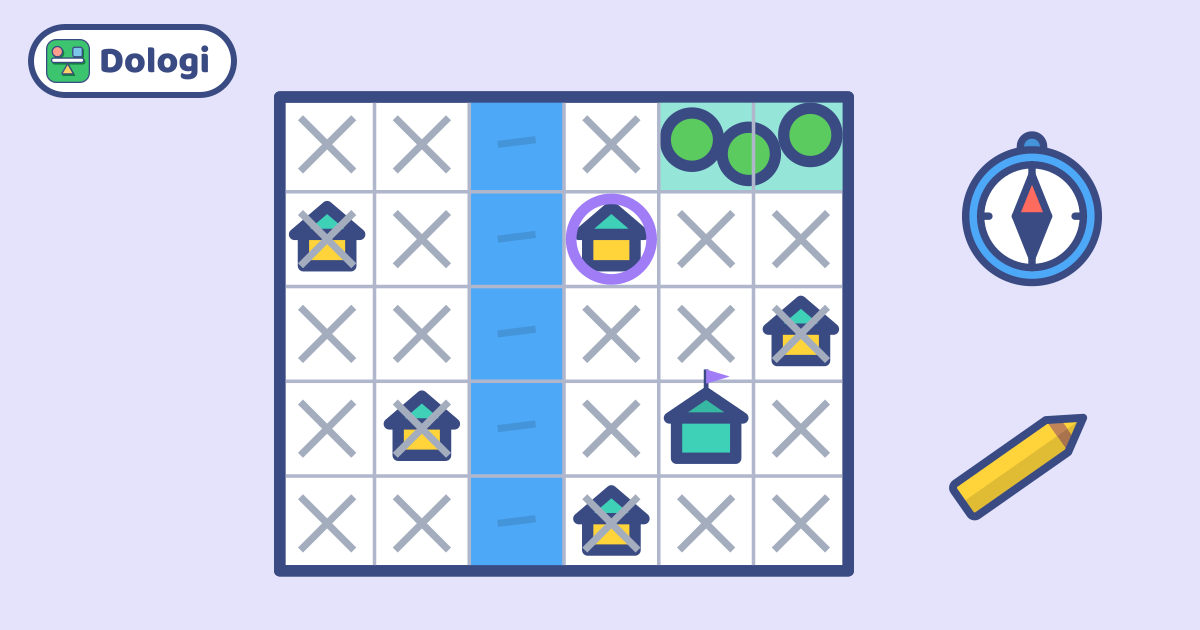
This is like guessing squares on paper, but instead of guessing blindly, your child gets clues: "east of the river," "not next to the school," "two steps from the park." Each clue crosses out a few squares, until only one spot is left. Children aged 7 to 12 practice reading directions on a map, counting distances and reasoning by elimination. When the roles swap, they also have to figure out which clues are just enough.
Getting ready
- A grid map. Drawing your own is quickest: six columns and five rows, columns labeled A to F from left to right and rows 1 to 5 from top to bottom. Add a river, a park, a school and a few houses. Older kids can use a real map of your neighborhood or park with a grid drawn over it.
- A north arrow in the corner. The convention: up is north, right is east.
- A pencil and eraser for crossing out squares.
- A folded slip of paper: the secret keeper writes the secret square on it before starting.
How to play
- The secret keeper picks a square and writes it on the folded slip.
- Each turn, they give one clue.
- The guesser crosses out every square that can't match that clue.
- When only one square is left, the guesser names it. Open the slip to check.
- Count how many clues it took. Swap roles for the next round.
A sample game, step by step
The map has six columns A–F and five rows 1–5. The river runs down column C. The park covers two squares, E1 and F1. The school is in E4. The secret square isn't in the river, the park or the school, so there are 22 squares to start with.
| Clue | Crossed out | Left |
|---|---|---|
| 1. "It's east of the river." | Every square in columns A and B | 12 squares: D1, D2, E2, F2, D3, E3, F3, D4, F4, D5, E5, F5 |
| 2. "It doesn't share a side with the school." | E3, D4, F4, E5 | 8 squares: D1, D2, E2, F2, D3, F3, D5, F5 |
| 3. "Exactly two steps across or up and down gets you to the park." | D1, E2, F2 (only one step), D3, D5, F5 (farther) | 2 squares: D2, F3 |
| 4. "It's not on the edge of the map." | F3 | 1 square: D2 |
In clue 3, "two steps" means counting squares moved across or up and down, never diagonally, to the nearest park square. From D2 to E2 is one step, and up to E1 is the second.
Clues you didn't need
A great question after a game: "Could we have left out a clue?" Try it with the game above:
- Leave out clue 1 and use only 2, 3 and 4: still just D2. Every square west of the river is too far from the park. So clue 1 wasn't needed.
- Leave out clue 2: D2 and E3 are left.
- Leave out clue 3: D2, E2 and D3 are left.
- Leave out clue 4: D2 and F3 are left.
So clues 2, 3 and 4 are enough. And some clues are wasted from the start: "it's not in the river" crosses out nothing, because the secret square could never be in the river anyway.
Swap roles: your child writes just enough clues
This is the hardest and best part. Your child picks the secret square, then writes clues following three rules:
- Every clue must cross out at least one square.
- In the end exactly one square must be left, and it must be the one written down.
- The fewer clues, the better.
Let your child test the clues on their own map before reading them out. If two squares are left at the end, they need one more clue that tells those two apart.
Kinds of clues
| Kind | Example | Ages |
|---|---|---|
| Direction | "North of the school," "west of the river" | 7 and up |
| Next to | "Next to the park," "not sharing a side with any house" | 7 and up |
| Rows and columns | "In an even-numbered row," "not in the school's column" | 8 and up |
| Distance | "Exactly three steps from the school" | 9 and up |
| Combined | "East of the river but not in row 1" | 10 and up |
Take it outside
With a real neighborhood or park map, the secret square is a real place: a bench, a big tree, the back gate. After guessing, walk there together to check. Your child reads the map and matches it to the real streets at the same time.
The Space topic in Dologi has a puzzle called Secret map message: "Read the message with the code key. Draw the path from the circle to a star." Just like the secret-spot game, your child has to understand each direction and trace it to exactly the right place on the map.
In short
- A grid map with a north arrow; the secret keeper gives one clue at a time and the guesser crosses out squares until one is left.
- Sample game: east of the river, not next to the school, two steps from the park, not on the edge, and only D2 remains.
- Leave out one clue at a time to find the ones you didn't need; a clue that crosses out nothing is wasted too.
- Swap roles: your child writes just enough clues, and each one must cross out at least one square.
Read more: Reading simple maps with your child, How to teach your child to use a compass