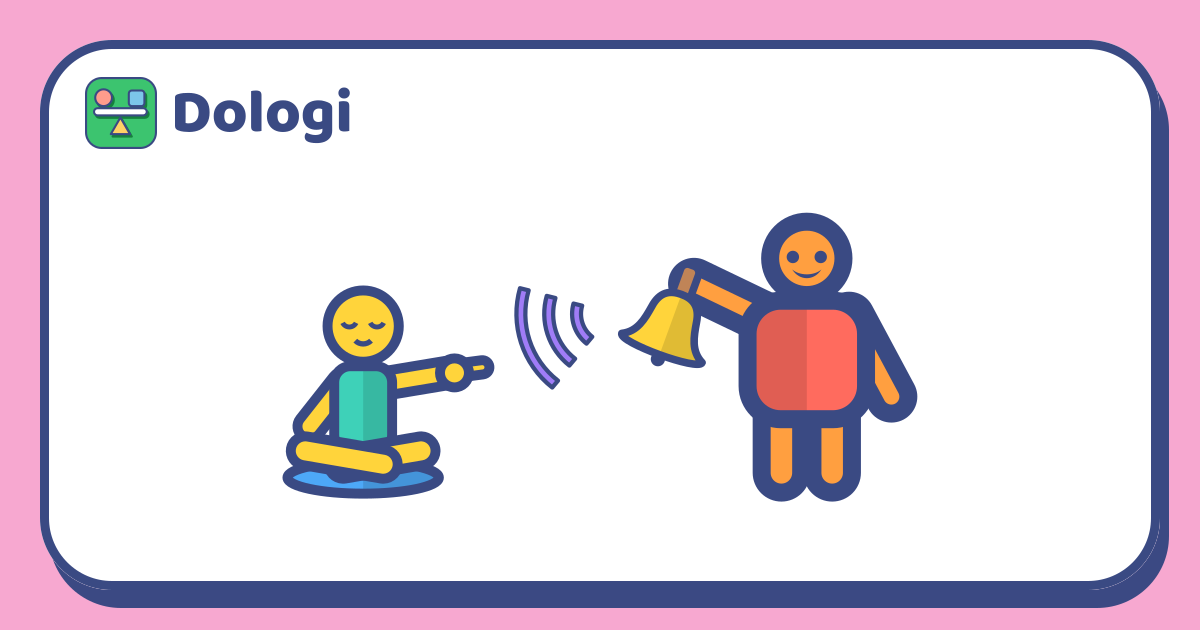
Close your eyes for a moment and listen. You can probably tell, without looking, that the kettle is to your left and a car is passing outside on your right. We work out where sounds come from all day long, mostly without noticing. For children, this everyday skill can become a quiet, absorbing game that needs nothing more than a bell and a bit of floor space.
This article explains a simple version of the game for children aged roughly 4 to 9: your child sits with eyes closed, you make a sound somewhere in the room, and they point to where it came from. Below you will find how to set it up, how to play the first rounds and how to make it harder over time.
Why a pointing game is worth a few minutes
Finding a sound with eyes closed asks a child to do several things at once:
- Wait and pay attention. The sound comes only once, so your child has to stay still and ready.
- Turn sound into a place. Our two ears hear a sound slightly differently depending on where it comes from, and the brain uses that difference to point us in the right direction. Your child does not need to know this to play, but older children often enjoy talking about it afterwards.
- Build a map of the room in their head. To point at "the corner by the window", your child has to picture the room while their eyes are shut.
- Check their own guess. When they open their eyes, they can see straight away how close they were, and adjust next time.
It is also calm by design: everyone has to be quiet for it to work, which makes it a good choice before bedtime or after a busy afternoon.
Setting up: a clear room and a calm start
- Clear the floor. Move toys, bags and chairs away from the middle of the room. A clear space keeps everyone relaxed.
- A spot in the middle. A cushion or folded blanket in the center of the room gives your child a clear "home" to sit on.
- Eyes closed, no pressure. Your child can simply close their eyes or cover them with their hands. A scarf over the eyes is only for children who like it; never insist.
- Things that make one clear sound: a small bell, a closed box with a handful of rice or dried beans, a bunch of keys, two spoons tapped together, a sheet of paper to crumple.
- The adult moves, the child stays. You walk quietly to different places; your child stays seated the whole time.
Before the first round, let your child hear each sound once with eyes open, so they know what to listen for.
How to play the first rounds
- Your child sits on the cushion and closes their eyes.
- You tiptoe to one corner of the room and wait until everything is quiet.
- Make one short, clear sound: ring the bell twice, or shake the box.
- Your child points to where they think the sound came from, and keeps pointing.
- They open their eyes and look along their arm: where are you standing?
Then swap roles. Most children love being the one who tiptoes around with the bell.
Ask about the guess rather than just saying "right" or "wrong": "What made you point there?" A child who says "it sounded on my left side and far away" is learning to describe what they noticed, which is half the fun.
Making it harder, step by step
Once your child points to the four corners easily, change one thing at a time.
| Change | How to do it | What it adds |
|---|---|---|
| Softer sounds | Ring the bell gently, or rustle paper instead of shaking the box | Closer attention |
| Closer positions | Stand at the middle of a wall, not only in the corners | Finer judgment of direction |
| High and low | Make the sound near the floor, then above your head | Listening for up and down, usually harder than left and right |
| One ear covered | Your child presses a hand over one ear, then tries again | A chance to talk about why we have two ears |
| Two sounds in a row | Bell in one place, then the box in another | Remembering order and position |
| A moving sound | Walk slowly around the room ringing softly; your child's finger follows | Tracking a sound over time |
| Follow the bell | Hide a small toy, ring the bell next to it once, then your child opens their eyes and goes to find it | Turning a guess into action |
With one ear covered, many children notice that pointing gets harder. Let them discover this themselves, then ask what they think the second ear is for.
What to try at different ages
Ages are only a rough guide; every child is different.
| Age (rough guide) | Good starting point |
|---|---|
| 4–5 | Loud, clear sounds from the four corners; eyes covered with hands; three to five rounds |
| 6–7 | Softer sounds, positions along the walls, swapping roles, two sounds in a row |
| 8–9 | High and low, one ear covered, moving sounds, finding a hidden toy by following the bell |
Keep rounds short and stop while your child is still keen. If you are ever unsure whether your child is hearing well, for example they often seem not to notice sounds or cannot tell where they come from in everyday life, it is worth mentioning to a doctor rather than trying to judge it through a game.
If your child enjoys listening games, the Listening topic in Dologi has short puzzles where they compare high and low or long and short sounds, recognize instruments and notice when a tune changes. It can sit alongside games like this one, which are at their best when the whole family plays.
In short
- Sit your child in the middle of a cleared room with eyes closed, make one clear sound from a corner, and ask them to point.
- Let them open their eyes to check, ask what made them choose that spot, then swap roles.
- Make it harder one step at a time: softer sounds, closer positions, high and low, one ear covered, moving sounds, a hidden toy.
- Keep it calm, short and playful; the adult moves around, the child stays seated.
Read more: Listening skills for children: sound games to play at home, Pictures in the mind: helping your child "see" shapes, objects and paths with eyes closed