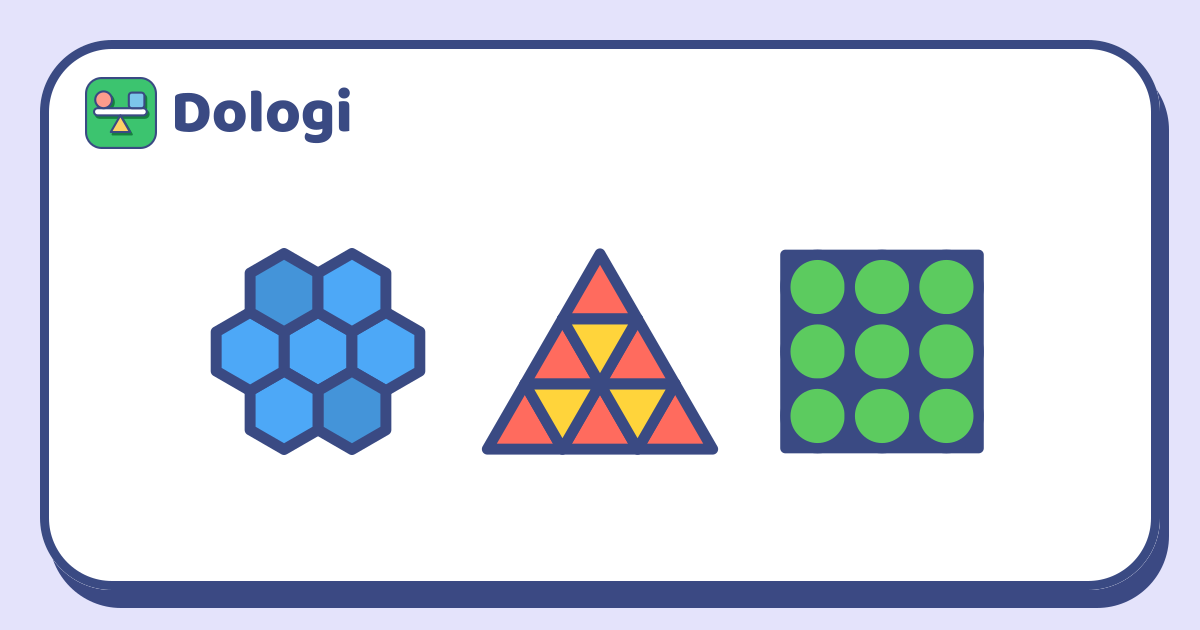
Look down at a tiled floor, a brick wall or a honeycomb. The shapes fit together perfectly: no gaps, no overlaps. Now imagine tiling a floor with round tiles. It doesn't work: there would be little gaps everywhere.
Which shapes can cover a flat surface on their own, and why? Children can find out for themselves with paper, scissors and a bit of patience. Covering a surface like this is called tiling.
What tiling means
A shape tiles when many copies of it can cover a flat surface:
- with no gaps between the pieces,
- with no overlaps (no piece on top of another),
- as far as you like in every direction.
Squares on a chessboard are the simplest example. Bricks in a wall are another.
Test some shapes
Cut out ten or more copies of each shape from card, or draw around a template. Then try to cover a sheet of paper:
| Shape | Covers with no gaps? |
|---|---|
| Square | Yes |
| Rectangle | Yes, in rows or like bricks |
| Equilateral triangle | Yes, pointing up and down in turn |
| Hexagon (six equal sides) | Yes, like a honeycomb |
| Circle | No, gaps between every three circles |
| Pentagon (five equal sides) | No, gaps or overlaps appear |
| Octagon (eight equal sides) | Not alone, but yes with small squares in the gaps |
Let your child predict before each test: "Do you think this one will work?"
Why some shapes fit and others don't
The secret is in the corners. Where tiles meet at a point, their corners have to fill a full turn around that point, with nothing missing and nothing left over.
- Squares: four corners fit around a point.
- Triangles: six corners fit around a point.
- Hexagons: three corners fit around a point.
- Pentagons: three corners leave a gap, four overlap. They never fit exactly.
Children don't need angles in degrees to see this. Put tiles around one point and look: does the last one fit, leave a gap, or squash in on top?
Hunt for tiles
Once your child knows what to look for, tiling is everywhere:
- Bathroom and kitchen floors. Squares, rectangles, sometimes octagons with small squares.
- Brick walls and pavements. Rectangles in staggered rows, or zigzags.
- Honeycombs and some pictures of insect eyes. Hexagons.
- Fabric and wrapping paper. Many repeating patterns are tilings in disguise.
Take photos or draw what you find, and try to copy the pattern with paper shapes.
Invent a tile that still fits
Here is a lovely trick for older children:
- Start with a square of card.
- Cut a wiggly piece out of one side.
- Slide that piece straight across and tape it to the opposite side.
- Draw around your new shape many times on paper. It still fits together with no gaps.
Add eyes, fins or feathers, and your tiles become a shoal of fish or a flock of birds.
Ideas by age
Ages are rough guides; every child is different.
- Around 4–5: cover a sheet with square sticky notes, compare with paper circles, find square tiles at home.
- Around 6–7: test triangles and hexagons, predict before testing, a tile hunt with photos or drawings.
- Around 8 and up: explain the corners rule, try pentagons and octagons, invent a sliding tile.
In Dologi, the Space topic has "Fill it up" puzzles: children turn blocks and drag them onto a board until every empty square is filled, with no gaps and no overlaps. It's tiling on a small board.
In short
- A shape tiles when copies of it cover a surface with no gaps and no overlaps.
- Squares, triangles, hexagons and rectangles tile; circles and regular pentagons don't.
- The corners meeting at each point must fill a full turn exactly.
- Hunt for tilings around you and invent your own tile that still fits.
Read more: Tangram for children: make animals and houses from seven pieces