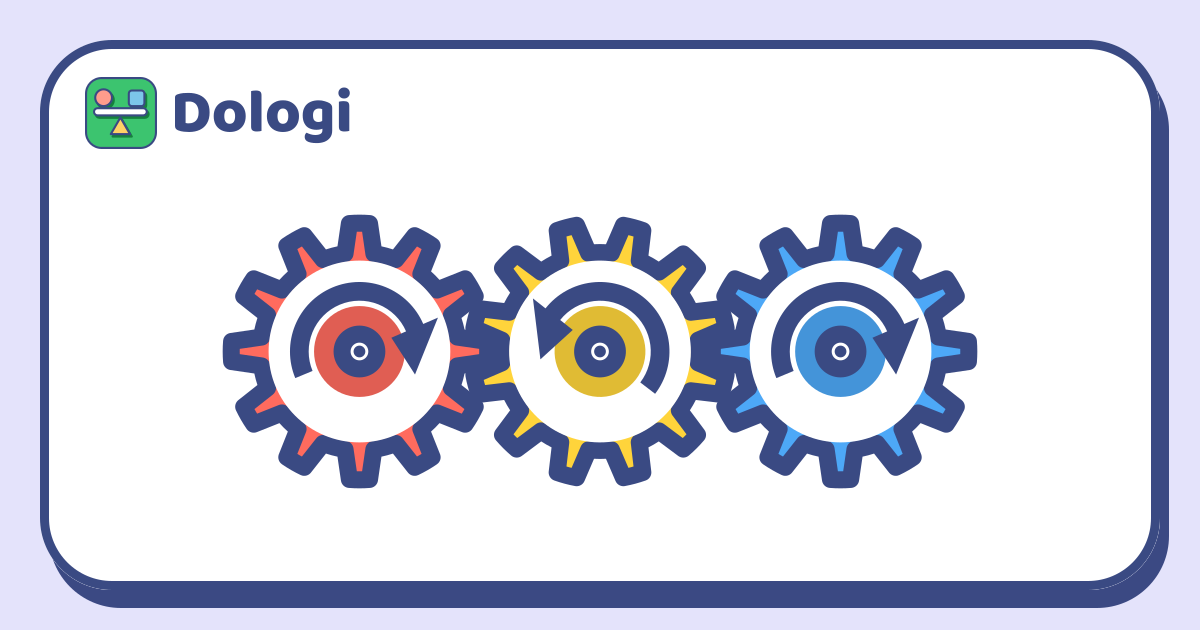
Turn one gear and the gear next to it turns too. But which way? Many children guess "the same way" and are surprised when it spins the other way. That surprise is the start of a good puzzle.
Below: how to make simple gears from card, then puzzles that get harder step by step, from two gears to long rows, loops that jam and gears of different sizes. Every puzzle comes with its answer. It suits children aged roughly 6 to 12.
Making paper gears
You need:
- A piece of thick cardboard from a delivery box, as the base board.
- Thinner card, such as a cereal box, for the gears.
- A cup or jar lid to draw around, a pencil and scissors.
- Paper fasteners (split pins) or push pins for the center of each gear.
- A marker to draw an arrow on each gear.
Steps:
- Draw around the cup to make several circles of the same size.
- Draw teeth around the edge of one circle, like a child's drawing of the sun: about 12 even bumps all the way around. Cut it out, then trace it to make the others, so all the teeth match.
- Make a hole in the middle of each gear and fix it loosely to the board, so it spins easily. An adult does the cutting and pinning with younger children, and keeps the pins out of small hands.
- Draw a big arrow on each gear so it's easy to see which way it turns.
If your paper teeth keep slipping, try this: peel one flat layer off a strip of corrugated cardboard so the ridges show, and glue the strip around a round lid. The ridges work as teeth and catch each other well.
Two gears, then three
Place two gears so their teeth fit into each other. Before anyone turns them, ask: "If I turn this one clockwise, the way clock hands go, which way will the other one turn?" Then try it.
Answer: the other gear turns the opposite way, counterclockwise. To see why, point to the spot where the two gears touch. There, the teeth of both gears move together in the same direction, say downwards. Moving down on its right side makes the left gear turn clockwise; moving down on its left side makes the right gear turn counterclockwise.
Now add a third gear to the row. Ask again before turning: which way will the third one go?
Answer: the same way as the first. Gear 1 turns clockwise, gear 2 counterclockwise, gear 3 clockwise again.
Finding the rule for a long row
Now don't turn anything; just predict. If you don't have enough gears, draw a row of circles on paper and draw arrows instead. Gear 1 always turns clockwise.
| Gears in a row | The last gear turns... |
|---|---|
| 4 | ? |
| 5 | ? |
| 8 | ? |
| 11 | ? |
Answers: 4 gears: counterclockwise. 5 gears: clockwise. 8 gears: counterclockwise. 11 gears: clockwise.
The rule: the directions take turns. Gears in odd places (1st, 3rd, 5th…) turn the same way as the first gear; gears in even places (2nd, 4th, 6th…) turn the other way. So your child only needs to know whether the number is odd or even.
A good follow-up question: "Would a bigger gear in the middle change anything?" The direction rule stays the same. A gear's size changes how fast it turns, not which way.
Loops that jam
Now arrange the gears in a ring, so the last one also touches the first.
- Three gears, each touching the other two, in a triangle. Can they turn?
- Four gears in a square, each touching its two neighbors. Can they turn?
Answers: the triangle jams. If gear 1 turns clockwise, gear 2 must turn counterclockwise, and then gear 3 clockwise. But gear 3 also touches gear 1, so it should turn the opposite way to gear 1: counterclockwise. It can't do both, so nothing moves. The square of four turns freely: going around the ring, the directions take turns and arrive back at gear 1 the right way.
The rule: a closed ring of gears can only turn if it has an even number of gears. Card gears are loose, so the triangle may wobble or slip instead of locking firmly; the feeling that "something is fighting" is what to notice.
One more for the same rule: put one gear in the middle and three gears around it, each touching only the middle one. The middle gear turns clockwise. Answer: all three outer gears turn counterclockwise, the same way as each other.
For older children: how fast?
Each tooth of one gear pushes one tooth of the other, so you can work out speed by counting teeth.
- A gear with 30 teeth turns once. How many times does a 10-tooth gear touching it turn? Answer: 3 times, because 30 teeth go past and the small gear needs 10 for each turn.
- A 30-tooth gear turns a 10-tooth gear through a 20-tooth gear in the middle. How many times does the last gear turn for one turn of the first, and which way? Answer: 3 times, and the same way as the first. The middle gear turns one and a half times and passes on 30 teeth, so it changes the direction but not the result.
These ages are only a rough guide; every child is different. Around 6 to 7, two or three real gears and lots of turning are plenty. Around 8 to 10, the long rows and loops on paper. Around 11 to 12, the counting puzzles.
Gears around the house
Go on a gear hunt together: a hand whisk with a turning handle, a wind-up toy, a bicycle. Ask your child to predict, then turn slowly and look.
A bicycle is a nice surprise: the pedal gear and the back wheel gear turn the same way. They don't touch; a chain wraps around both. A loop of string or a rubber band around two lids does the same, and if you cross the band into a figure of eight, the second lid turns the other way.
In Dologi, the "Spinning gears" puzzles in the Space topic work just like the paper rows: starting from the gear with the arrow, your child works out which way the gear with the question mark turns. Harder levels add gears that branch out and gears joined by belts.
In short
- Card gears pinned loosely to a cardboard board make a good prediction puzzle; ask "which way?" before every turn.
- Two touching gears turn opposite ways, so in a row the directions take turns: odd places like the first gear, even places the other way.
- A closed ring of gears only turns if it has an even number of gears; a triangle of three jams.
- Size changes speed, not direction; older children can count teeth to work out how many turns.
Read more: Take it apart to understand it: exploring how everyday things work