Your child finds a leaf in the park and asks: "What tree is this from?" Nature guides often answer with a key: a short chain of yes-or-no questions such as "Is the edge toothed?" or "Is it long and narrow?". Follow the answers, and you arrive at a name.
Building a key yourself is a great project for children aged about 7 to 12. To make one, your child has to look closely, choose features that everyone can see, and put the questions in order. This article walks you through it with leaves, then with animal picture cards, and shows how to test the key on someone else.
What is a yes-or-no key?
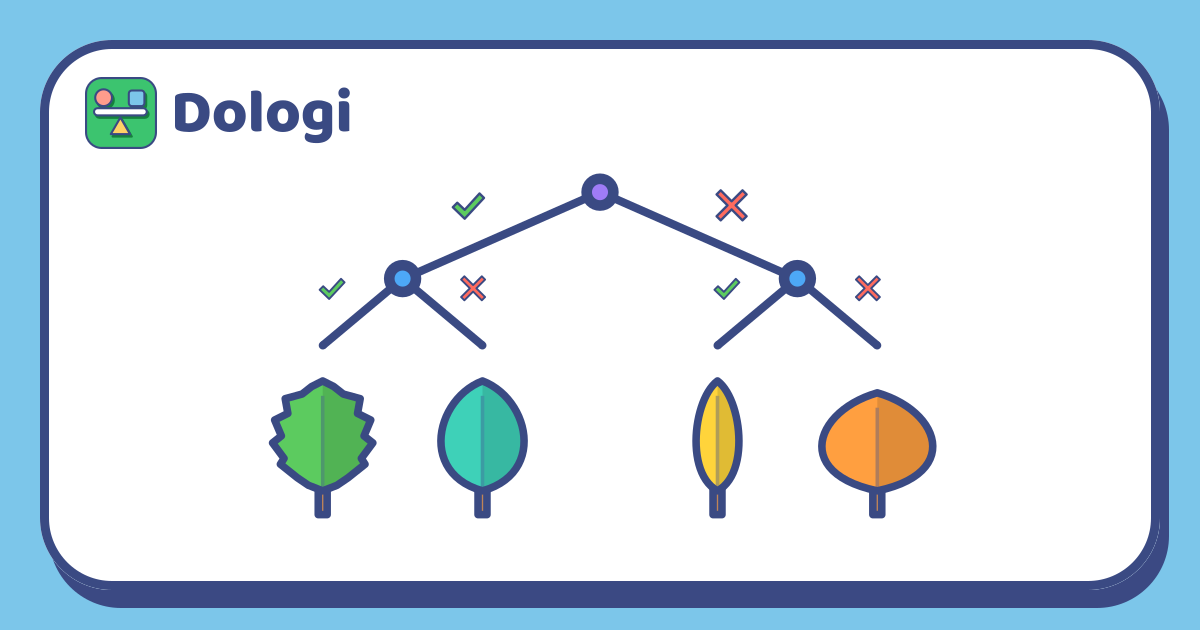
A key is a list of questions, each with only two answers, yes or no. Each answer sends you to a new question, until only one thing is left. Drawn on paper, it looks like a tree that splits in two at every question.
| Question | Yes | No |
|---|---|---|
| 1. Is the edge toothed, like a saw? | Toothed leaf | Go to question 2 |
| 2. Is it long and narrow? | Narrow leaf | Go to question 3 |
| 3. Is it almost round? | Round leaf | Oval leaf |
With these three questions, anyone can tell four kinds of leaf apart, even someone who has never seen them before. Scientists use much longer keys built on the same idea.
Collect and look closely
- Go for a walk and collect about ten fallen leaves that look different from each other. Pick them up from the ground rather than off plants, and let an adult check what goes in the bag.
- At home, spread them on a large sheet of paper. A magnifying glass helps if you have one.
- Ask your child to describe each leaf out loud: the edge, the shape, the tip, the stalk, the veins, the color, whether it is one leaf or lots of small leaflets on one stalk.
Write the features on sticky notes. This list becomes the raw material for the questions.
What makes a good question
The hardest part of making a key is choosing questions. Talk about them together:
| Not so good | Better | Why |
|---|---|---|
| Is it pretty? | Is the edge toothed? | Everyone answers a good question the same way |
| Is it big? | Is it longer than your hand? | "Big" depends on what you compare with |
| Is it green? | Does it have several leaflets on one stalk? | Leaves change color, the shape stays the same |
| Is it an oak leaf? | Does the edge have deep rounded bumps? | A key must work without already knowing the answer |
A simple test for each question: you and your child answer it for every leaf, separately. If you disagree about a leaf, the question needs to be clearer.
Build the key step by step
- Put all the leaves in one pile. Your child chooses one question that splits the pile into two.
- Write the question on a card at the top of a big sheet. Put the "yes" leaves to the left, the "no" leaves to the right, and draw a branch to each pile.
- Repeat with each pile. Choose a new question for each pile, until each leaf sits alone at the end of a branch.
- Name each leaf. If you don't know its real name, make one up from what you see: "zigzag leaf", "spoon leaf". You can look up the real names later.
Older children can try to make the key short. A question that splits a pile into two halves saves questions: with eight leaves, a well-balanced key reaches any leaf in three questions, while a key that peels off one leaf at a time can need seven.
Test the key on someone else
A key is only finished once someone else can use it. Ask another family member to pick a leaf in secret, then follow the key from the top, answering each question out loud.
- Did they reach the right leaf? Your child can be proud of a key that works.
- Did they get stuck? Find the question where it went wrong and reword it together.
- Bring a new leaf. It isn't in the key. Where does it end up? Your child will need to add a new question to give it its own branch.
The same key for animals
Picture cards of animals work just as well, and you can use them on a rainy day. Questions might be "Does it have feathers?", "Does it live in water?", "Does it have more than four legs?".
Animals bring useful surprises. "Can it fly?" sounds like a good question for birds, until your child meets a penguin, which has feathers and can't fly. A bat flies but has no feathers. Each surprise teaches the same lesson: choose features that are always true for the group, and check every card against each question.
Deciding which side a thing belongs on by looking at one clear feature is also the core of "Sort into groups" puzzles in the Logic topic in Dologi, where children put things together by what they have in common.
In short
- A key is a chain of yes-or-no questions that leads to the name of a leaf, an animal or any object.
- Good questions are about features everyone can see and answer the same way.
- Split the pile in two with each question and draw the key as a branching tree.
- A key is finished when someone else can use it, and a new leaf means a new branch.
Read more: The 20 questions game: guessing an object with yes-or-no questions