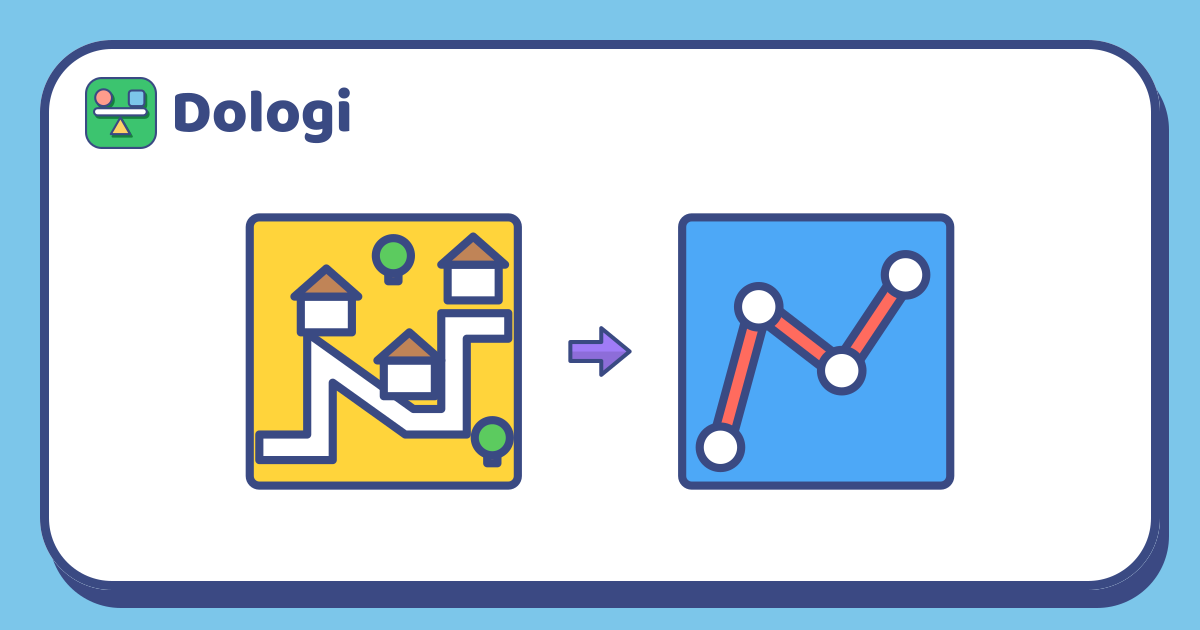
A train map is one of the most useful pictures in a city, and it is almost empty. No buildings, no parks, no real distances: just colored lines and dots. Yet it tells a passenger everything they need: where to get on, where to change and where to get off.
Leaving out what doesn't matter is a skill called abstraction. It is one of the core ideas of computational thinking, and it also helps with math, writing and everyday problem solving. This article explains it simply and gives five activities for children aged around 8 to 12. All you need is paper, a pencil and a few minutes.
What abstraction means
Abstraction means keeping the details that matter for a question and dropping the rest. The key words are "for a question". The same place can be drawn in many ways, and which details matter depends on what the drawing is for.
| Purpose | Keep | Leave out |
|---|---|---|
| Taking the train | Stations, lines, where lines meet | Streets, buildings, real distances |
| Walking to school | Turns, crossings, landmarks | Colors of houses, names of stores you don't pass |
| Cycling to the park | Hills, cycle paths, busy roads | Bus stops, store windows |
| Planning seats at a party | Who sits next to whom | The shape of the chairs |
A good abstraction is not a worse picture. It is a picture that is better for one job.
Street map or train map?
If you have a street map and a train map of the same city, in a guidebook or printed out, put them side by side. If not, draw a simple version of your own neighborhood together: houses, trees, the road, a store.
Then ask:
- What does the train map leave out? Your child will list plenty: buildings, parks, rivers, street names.
- Why can it leave them out? Because a passenger only needs the order of stations and where to change.
- What would go wrong if you used the train map to walk? You might think two stations are close when they are far apart.
Make a dot map. Choose a familiar trip (home to school, or to a grandparent's home). Your child draws only a dot for the start, a dot for each turn or stop, and a line between them. Next time you make the trip, take the dot map along. Is it enough to find the way? If not, which detail was missing?
Draw it in ten lines, then five, then three
This drawing game shows abstraction in a way children remember.
- Choose an animal, such as a cat.
- Your child draws it with ten lines. Count the lines out loud as they go.
- Draw it again with only five lines.
- Then with three.
Ask the family to guess each drawing. The three-line cat often still works: two pointy ears and a curved tail are enough. Then talk about which lines survived each round. Those are the details that make a cat a cat. A circle for the body can go; the pointy ears cannot.
Swap roles: you draw, your child sets the number of lines. Try harder subjects (a bicycle, a house, an elephant) and notice that some things need more lines than others.
Cross out what doesn't change the answer
Word problems are often full of details that don't affect the answer. Try this one together:
At a fair, a 9-year-old in a red cap buys 3 tickets at 4 coins each. The fair opens at 10 o'clock and has 12 rides. How many coins does the child pay?
Ask your child to cross out every detail that doesn't change the answer: the age, the red cap, the opening time and the number of rides. What is left is 3 tickets at 4 coins each, so the answer is 12 coins.
Now change only the question: "Each ticket is good for one ride. How many rides does the child miss?" Suddenly the 12 rides matter: 12 − 3 = 9. This is the most important lesson about abstraction: a detail is not useless in itself; it is useless for this question.
Play "What would you keep?"
A quick game for the car or the dinner table. You name a thing and a purpose; your child says which details to keep.
- A bus route, for a passenger who wants to know where to get off.
- A recipe, for someone who only wants to know what to buy.
- A soccer match, for a friend who only wants to know who won.
- A book, for a classmate deciding whether to read it.
There is no single right answer. What matters is the reason: "I'd keep the stops in order, because that's how you know when to get off."
Why programmers care about it
Computers can only work with the information people give them, so programmers decide what to keep. A weather app shows a sun or a cloud, not a photo of the sky. A game about a soccer team stores each player's position and speed, not their favorite food. Choosing what to keep and what to drop is a large part of designing any program, long before the code is written.
In Dologi, the "Color the map" puzzles are a small exercise in abstraction: the shape and size of each region don't matter, only which regions touch each other, because touching regions need different colors.
In short
- Abstraction means keeping the details that matter for a question and dropping the rest.
- Which details matter depends on the purpose: a train map and a walking map of the same place keep different things.
- Drawing in fewer and fewer lines, and crossing out extra details in word problems, make the idea concrete.
- Always ask for the reason: "Why can we leave that out?"
Read more: What is computational thinking? Four skills children use even without a computer · Word problems: helping your child understand what the question is asking