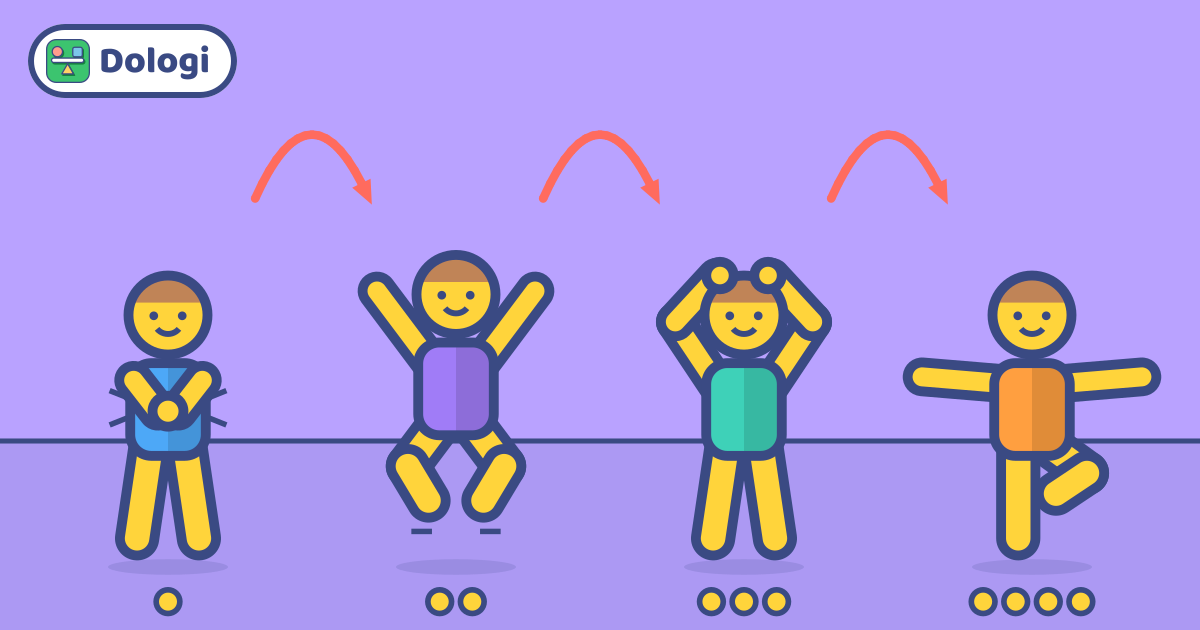
Some memory games need no paper, no sitting still, and still have the whole family laughing. "Add one move" is one of them: the first person makes a move, the second repeats it and adds their own, the third repeats both and adds another. The chain keeps growing, and by turn eight or ten everyone has to really concentrate.
It works for kids roughly 4 to 12, indoors or out, with two players or a whole class. Here's how to play, ideas for moves, what to do when someone forgets, tricks for long chains, and a few versions for older kids.
How to play
- Stand or sit in a circle.
- The first player makes one move, like a single clap.
- The second player claps once, then adds a new move, like touching their nose.
- The third player claps, touches their nose, then adds one more.
- Keep going around the circle, adding one move each turn.
- When someone forgets, count how long the chain got. That's the group record. Next round, try to beat it.
With 4 and 5 year olds, do their turn together with them, and a chain of four or five moves is already a great result.
Move ideas
Pick moves that are clear, different from each other, and safe indoors:
| Type | Moves |
|---|---|
| Hands | Clap, snap, both arms up, wave, fold arms |
| Legs | Stomp, jump in place, stand on one leg, tiptoe |
| Body | Spin around, bow, lean to one side |
| Face and head | Wink, nod, shake head, touch ear, touch nose |
| Sounds | "Boop!", a soft whistle, tap the floor |
In a small apartment or late in the evening, skip the jumps and stomps. Quiet indoor movement games has more ideas that won't bother the neighbors.
Forgot? The group helps, nobody's out
In a lot of memory games, forgetting knocks you out. Not in this one:
- Nobody is eliminated. The group slowly shows the chain again, the player repeats it, then adds their move.
- The record belongs to everyone, so everyone wants to help each other remember. Older siblings naturally become the demonstrators.
- Hint with the first move: often a reminder of just the first move is enough for the rest to come back.
- Praise how they remembered, not just that they did: "Were you doing it along quietly while you waited? Smart."
Tricks for long chains
Once a chain goes past seven or eight moves, lots of kids (and adults) start dropping things. A few tricks help:
- Chunk it into threes: "clap, nose, spin" is chunk one; "jump, bow, wink" is chunk two. Three chunks are easier to hold than nine loose moves.
- Turn it into a story: "a bird flaps its wings, pecks a flower, spins around, hops over a stream…". The story holds the order for you.
- Do it along while you wait: quietly copy each move as others go, instead of waiting for your turn to think.
- Watch the newest move closely: it's the easiest one to forget, because you've only seen it once.
Helping kids remember has more ways to make learning stick.
Versions for older kids
- Backward: once the chain has five moves, the next player does it from the last move back to the first. Much harder.
- To a beat: everyone pats their knees in a steady rhythm, and each move has to land on a beat.
- Spot the change: one player does a five-move chain, then repeats it with one move swapped. Everyone else guesses which move changed.
- A chain of words: swap moves for words, like the classic "I went to the market and bought an apple, a ball, a…", each player adding one item.
The Memory topic in Dologi has a puzzle called Remember the lamps: "Watch which lamps light up. Then tap them in the same order." Some versions ask your child to tap backward, starting from the last lamp, just like the backward version above.
In short
- Each player repeats the whole chain, then adds one move; the chain grows every turn.
- Pick clear, different, indoor-safe moves; do the turn together with little ones.
- Nobody's out: the group shows the chain to whoever forgets, and the record belongs to everyone.
- Teach chunking in threes, turning it into a story and copying along while waiting; older kids can try backward, to a beat or spot the change.
Read more: Memory and focus games, Helping kids remember