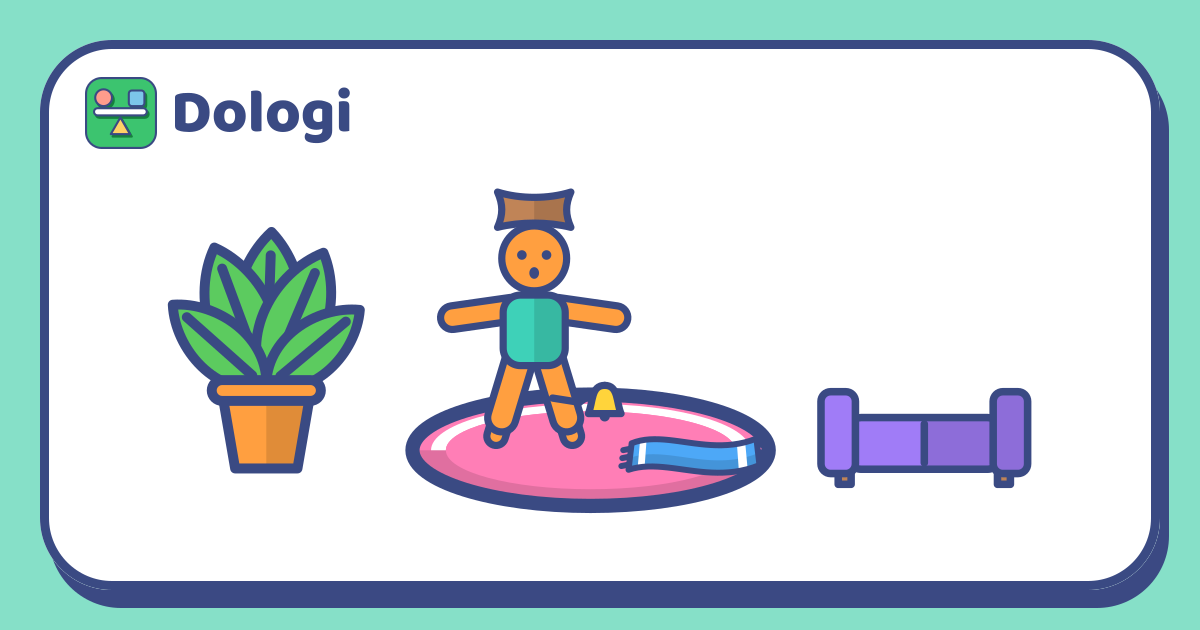
It is five in the afternoon. Your child has sat still at school all day and comes home wanting to run and jump. But the apartment has one small living room, someone lives downstairs, and every jump lands with a thud.
Children do not need to jump to use up energy. Moving very slowly, balancing and holding a pose for a long time are hard work too, just much quieter. Below are six games for small homes. Each one has a stop rule (when to freeze) and a counting rule (what to count, and how far), so your child moves and still has to pay attention.
Why quiet games are still tiring
Try standing on one leg while counting slowly to ten, or crossing the room so slowly that your feet make no sound. Both are harder than running a lap. The body works to hold the position, and the mind has to follow every step.
The stop rule and the counting rule are what make these games different from ordinary running about:
- The stop rule gives your child a moment to pause and breathe, instead of getting wilder the longer they play.
- The counting rule gives the game a clear target: how many steps, how long a hold. Next time, your child tries to beat their own last result.
Setting up the space
Nothing to buy. Just clear a patch of floor.
- A clear patch of floor about two strides each way, with a rug or a blanket folded in half. Move tables with sharp corners out of the way.
- Bare feet are best. Socks slip on tiles and wooden floors.
- A small bell threaded onto a soft hair elastic and worn loosely around the ankle. Pick a bell too big for a younger sibling to put in their mouth, and put it away after play.
- A homemade beanbag: pour a few handfuls of rice or dried beans into an old sock and tie the top tightly.
- Two or three thin scarves, a small basket or box, and a few scrunched-up balls of paper.
Quiet walks across the room
- The cat with a bell. Your child wears the bell on one ankle and creeps from one end of the rug to the other like a cat stalking, without letting the bell ring. The trick is to put the toes down first, then the heel. You can sit at the far end with your eyes closed and point towards any jingle you hear.
- Stop rule: if the bell rings, freeze, count silently to three, then carry on.
- Counting rule: count how many times the bell rings in one crossing. Next time, try for fewer.
- Slow-motion beanbag walk. Put the beanbag on your child's head and have them cross the room in slow motion, one number per step: "one… two… three…". Older children can try walking backwards, circling a cushion, or sitting down and standing up again without dropping it.
- Stop rule: if the beanbag falls, freeze like a statue, pick it up, put it back and carry on from that spot.
- Counting rule: count the steps to the other side. The slower the walk, the more steps, and the better.
For an extra balance challenge, lay down a line of masking tape to follow, as in the tape line balance game.
Moving on the spot
- Scarf pick-up with toes. Your child sits on the rug with a few scarves scattered on one side and the basket on the other. They grip each scarf with their toes and move it into the basket without using their hands. Older children can try it standing, holding on to a chair or the wall with one hand.
- Stop rule: if a scarf drops on the way, leave it, put both hands on the knees, take a breath, then pick it up again.
- Counting rule: you count slowly to twenty. How many scarves made it into the basket?
- Hold the animal pose. Call out an animal and your child holds its pose: a heron on one leg, a cat stretching its back, a frog crouching, a tortoise curled up tight. Everyone counts slowly together.
- Stop rule: two soft claps mean change animal, and everyone stays silent while changing.
- Counting rule: children around 4 or 5 hold to five, older ones to ten. Wobbling is fine; if a hand touches the floor, carry on counting from where you were.
Close to the floor and in pairs
- Slow mirror. You and your child sit or stand facing each other. The leader moves their arms, head and shoulders very slowly, and the other copies exactly, like a reflection. Nobody talks. Swap so your child leads.
- Stop rule: when the leader freezes, the "mirror" freezes too.
- Counting rule: hold each movement for three silent counts before moving on.
- Paper ball blow. Your child lies on their tummy or crawls on hands and knees, blowing a scrunched-up paper ball from the start line (one scarf) to the finish line (the other scarf). It takes deep breaths and makes almost no noise.
- Stop rule: if the ball rolls off the rug, go back to the start line.
- Counting rule: count how many puffs it takes to reach the finish. Fewer puffs is better.
Stop rules and counting: keeping it quiet
The hardest part is not the games but stopping the session from turning into a noisy romp. A few ideas:
| What | How |
|---|---|
| One shared stop signal | Raise a hand or clap softly twice: everyone freezes and takes a breath |
| Count silently or softly | Loud counting easily becomes shouting. Counting on fingers works too |
| Keep it short | A few rounds of each game, about fifteen minutes in all |
| Let your child lead | They call the animals and count while you hold the pose. Setting the rules is attention practice too |
| Finish with the slowest game | Slow mirror or the curled-up tortoise, then put the scarves and bell back in their box together |
Once your child has calmed down and wants to sit for a while, a few puzzles from the Focus topic in Dologi are a gentle way to move on to something still. If you have more room, or it has been raining all day, there are more ideas in rainy day games at home.
In short
- Children do not need to jump to burn energy: slow walking, balancing and long holds are tiring and kind to the neighbors.
- Every game has a stop rule (when to freeze and breathe) and a counting rule (a clear target to beat next time).
- Clear a patch of floor with a rug, play barefoot, and put the bell and beanbag away afterwards.
- Keep sessions short, count softly, and end with the slowest game.
Read more: Stop-and-go games: building self-control through play