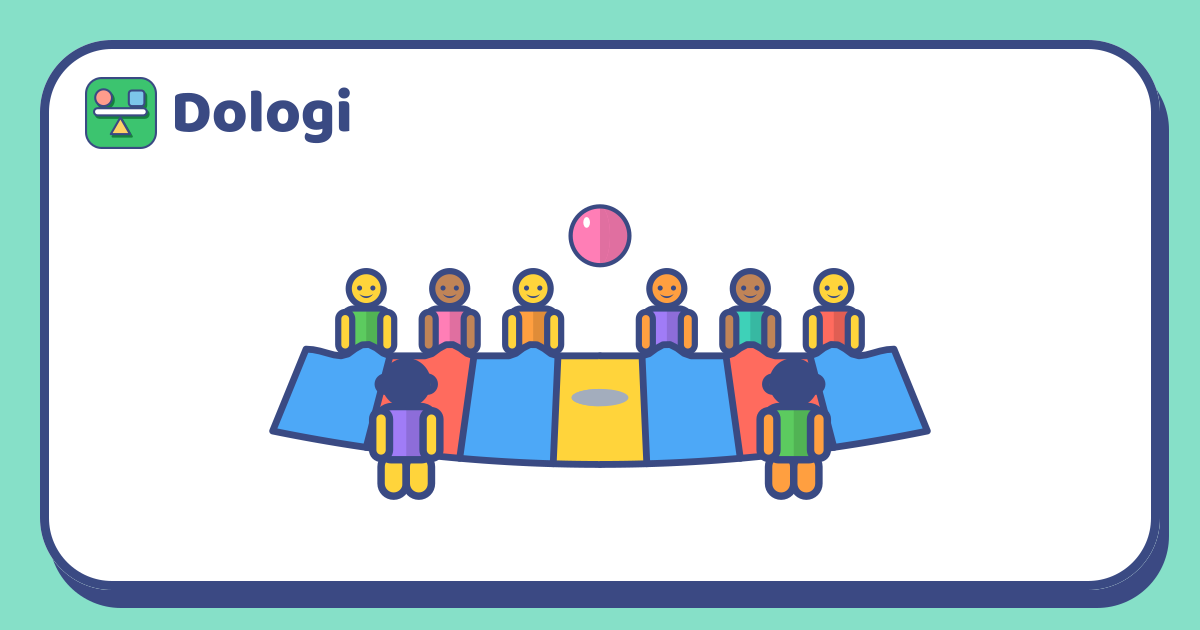
You have a group of children, a garden or a cleared living room, and not much time to prepare. An old bedsheet and a soft ball are enough for half an hour of play. Every child holds part of the edge, and the whole group works together to make the ball bounce, roll or fly.
There are no winners and losers here. If the ball falls, everyone picks it up and tries again. This article explains how to set up, then walks through four games, from the easiest for children of about 4 to the trickier ones that 9- and 10-year-olds enjoy.
What you need and how to start
- An old bedsheet, ideally a double or larger, so that four to ten children can stand around it with a little space each. A sheet with stripes or a big pattern makes it easier to see where the ball is.
- A soft, light ball, such as a beach ball, a foam ball or a pair of rolled-up socks. Light balls bounce higher and are easier for small hands to control.
- A clear space: a yard, a lawn or a room with the table and chairs pushed against the wall.
Ask the children to spread out around the sheet and hold the edge with both hands, palms facing down, as if they were holding a steering wheel. The sheet should be pulled flat but not tight. One adult stands among them, both to hold a section and to call out the instructions.
Start by lifting the sheet slowly up to shoulder height and lowering it back to the knees, all together. Count out loud, "one, two, up!", so that everyone moves on the same beat. This small warm-up is already the most important part of the game: listening and moving with the group.
Keep the ball bouncing, then roll it around the edge
Keep the ball bouncing. Put the ball in the middle. On "up!", everyone lifts the sheet sharply at once so the ball jumps into the air, then catches it on the sheet. The group counts the bounces together. The aim is to beat your own score, not to beat each other: "We got to six bounces, can we get to eight?"
Younger children (around 4 to 5) can simply try to keep the ball on the sheet while gently shaking it. Older ones can try two balls at once, or bounce the ball high and catch it on a perfectly still sheet.
Roll the ball around the edge. Now try to make the ball travel in a circle close to the edge without falling off. Each child lowers their part of the sheet just as the ball arrives in front of them, then lifts it again once it has passed. The ball rolls from one child to the next like a wave.
This game asks for a lot of attention: each child has to watch where the ball is, guess when it will reach them, and act at the right moment. When the ball goes the whole way round, call "change!" and send it the other way.
Swap places under the sheet
This game is a favorite, especially for children of about 5 and up. Everyone lifts the sheet high above their heads so it rises like a roof. While it is in the air, the adult calls out two names, for example "Lan and Minh!". Those two children let go, run under the sheet and swap places before it comes down again.
Variations to keep everyone listening:
- Call by a feature instead of a name: "everyone wearing something blue", "everyone who has a little sister".
- Ask the children to swap by hopping, walking backwards or crawling.
- Let a child take a turn as the caller.
The children who stay at the edge have a job too: they have to keep the sheet up long enough for their friends to get across. No one is out if they don't make it in time; the sheet just comes down gently on top of them, which usually ends in laughter.
Big waves, small waves
The adult calls out the weather on the sea and the children move the sheet to match:
| Call | What the children do |
|---|---|
| "Calm sea" | Hold the sheet completely still, flat at waist height |
| "Small waves" | Shake gently, small quick movements |
| "Big waves" | Large movements, up to the shoulders and back down |
| "Storm!" | Shake as hard as they like |
| "Freeze!" | Stop instantly, the sheet held still |
Mix up the order and the speed, and add a ball to see how it reacts to each kind of wave. "Freeze!" is the trickiest call: going from a storm to stillness in one beat takes real self-control, and children love being the group that manages it.
Once they know the game, let a child take over the calls. They have to watch the group and choose the right moment, which is a different kind of attention.
Why everyone wins
In many group games, someone is out early and has to watch from the side. With a sheet, the game only works when everyone holds on. A shy child or a younger sibling is part of the team in exactly the same way as the oldest one.
These games also exercise skills that are useful elsewhere: following the ball with your eyes, listening for your name or the next call, waiting for your moment, and matching your movements to the people around you. Children practice them without noticing, because they are focused on the ball.
On a quieter day without a group, the Focus topic in Dologi has "Follow the cup" puzzles: cups move around, and your child keeps their eyes on the one hiding an object. It is the same kind of steady watching, practiced alone in a few minutes.
In short
- An old bedsheet and a soft ball are enough for a group of four to ten children of about 4 to 10.
- Warm up by lifting and lowering the sheet together, counting out loud.
- Four games to try: keep the ball bouncing, roll it around the edge, swap places under the sheet, and big and small waves.
- Everyone holds part of the sheet, so nobody is out: the group simply tries again together.
Read more: Birthday party games for children: everyone plays, nobody is out, Keep the balloon up: a playful focus game for the living room