Your child comes home and announces: "Everybody hates the new lunch menu." You ask who said so, and it turns out to be the four friends at their table. Nobody is lying, and the counting is right: all four friends really did complain. The problem is somewhere else. Those four people were never a fair picture of the whole school.
This is the idea of a biased sample, and it sits behind many wrong conclusions, from playground claims to headlines. It sounds like a grown-up statistics topic, but children aged roughly 9 to 12 can understand it very well with a jar of beans. This article gives you the game, a way to carry it over to questions about people, and three questions your child can ask before trusting a sentence that starts with "most children…".
What a sample is, in plain words
When we want to know something about a big group, we rarely check every single member. We look at a part and guess about the whole. That part is called a sample: the spoonful of soup you taste, the ten classmates you ask, the handful of beans you count.
A sample is useful only if it looks like the whole group. If it was picked in a lopsided way, for example only from the top of the jar or only among people who think alike, then even careful counting gives a wrong picture. You can explain it to your child in one sentence: "What you find depends on where you look."
The bean jar game
You need a clear jar with a lid, two kinds of dry beans in different colors (for example white and red, or any rice and lentils you have), a small bowl and paper for tallies. Small beans are not toys for little ones, so keep the game away from toddlers.
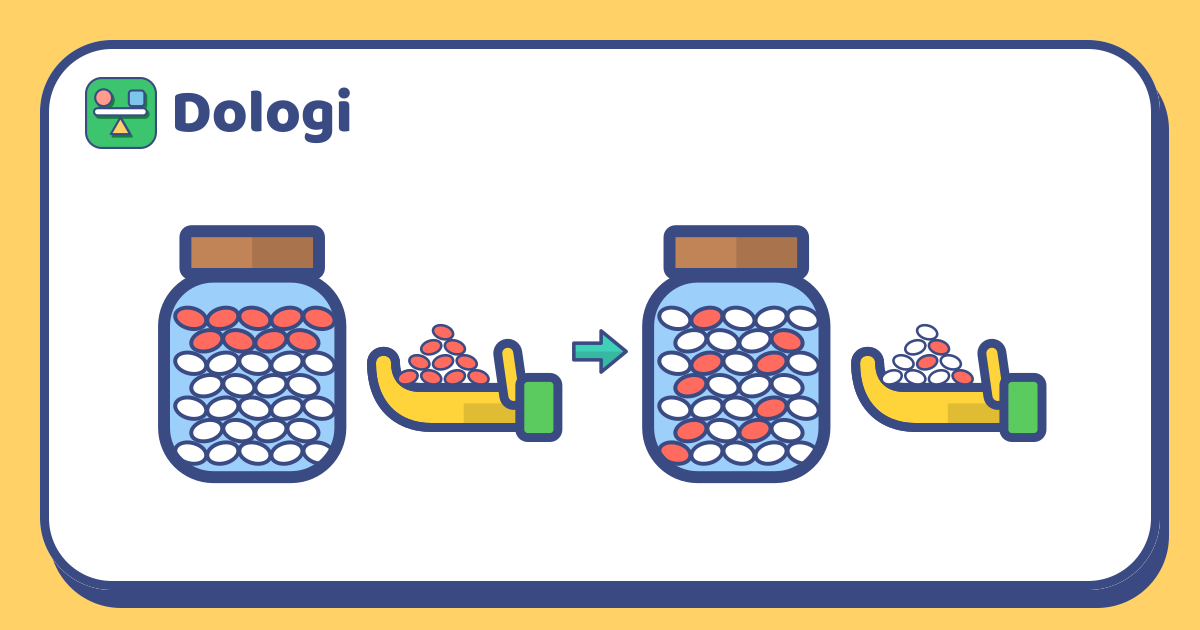
- Build the layers. Fill most of the jar with white beans. Pour a thinner layer of red beans on top. Do not shake or stir.
- Scoop from the top. Your child takes one handful from the very top, counts the red and white beans, and writes the numbers down.
- Make a guess. Hide the jar or turn it away, and ask: "From your handful alone, what do you think the jar is full of?" A child who only saw red beans will usually say "mostly red".
- Mix well. Put the lid on and shake and turn the jar until the colors are spread evenly.
- Scoop again. Take another handful, count it, and compare with the first one.
- Check the whole. Look at the jar together, or pour it out and make a rough count. Which handful looked more like the real jar?
| Handful | What it showed | Was it a fair picture? |
|---|---|---|
| From the top, before mixing | Almost all red | No: it only came from one layer |
| After mixing | Mostly white, some red | Much closer to the whole jar |
Two follow-up ideas make the game richer. Take three mixed handfuls and notice that they are similar but not identical: a fair sample is close to the truth, not a perfect copy. Then try a tiny pinch against a big handful. The bigger mixed handful usually lands closer, which is a good first feel for why size also matters.
From beans to people: the favorite food survey
Now move from the jar to real questions. Ask your child to find out "what is the most popular food" in two ways:
- Survey A: ask only friends of the same age, for example classmates.
- Survey B: ask people of many ages: grandparents, parents, cousins, younger siblings, neighbors.
Put the results side by side. Children often find that the answers change a lot: a dish that wins easily among ten-year-olds may hardly appear in the family survey. Then talk it through:
- Which survey could say something about "children your age"? Which could say something about "our family"?
- Did either survey find out what everybody likes? Who was missing from each one?
- If you wanted to know what the whole school likes, who would you need to ask?
The point is not that one survey is good and the other is bad. Each one is a fair picture of the group it came from, and only of that group. Trouble starts when we use a narrow sample to talk about a much bigger crowd, just like using the top layer to describe the whole jar.
Three questions before believing "most kids like…"
Once the jar game makes sense, give your child three short questions to carry around:
- Who was asked? Classmates, a sports team, people walking past one store, the readers of one website?
- Who was left out? Younger children, older people, people who were busy, people who live somewhere else?
- How were they chosen? Did they volunteer? Did only the people with strong feelings bother to answer? Online reviews are a good example: they are often written by people who were very happy or very annoyed.
Practice on everyday claims. "Everyone in my class has a phone" becomes "who is everyone?". "This game is the best, all the comments say so" becomes "who writes comments?". You can also turn it around and catch your own family's biased samples, which children enjoy a lot: "Dad says everyone loves his soup, but he only asked Grandma."
In Dologi's Math topic, many puzzles ask children to count and compare amounts before choosing an answer. That fits well with this game: first count carefully, then ask whether what you counted really stands for the whole group.
In short
- A sample is the part we look at to guess about the whole; a biased sample comes from only one corner, so careful counting still gives a wrong picture.
- The bean jar game makes this visible: a handful from the unmixed top looks all red, a handful after mixing looks much more like the real jar.
- Surveying only same-age friends versus the whole family shows the same thing with people: each sample speaks only for the group it came from.
- Before believing "most kids like…", ask: who was asked, who was left out, and how were they chosen?
Read more: Misleading charts: check the axis, units and numbers, Collecting data with children, Probability for young children